

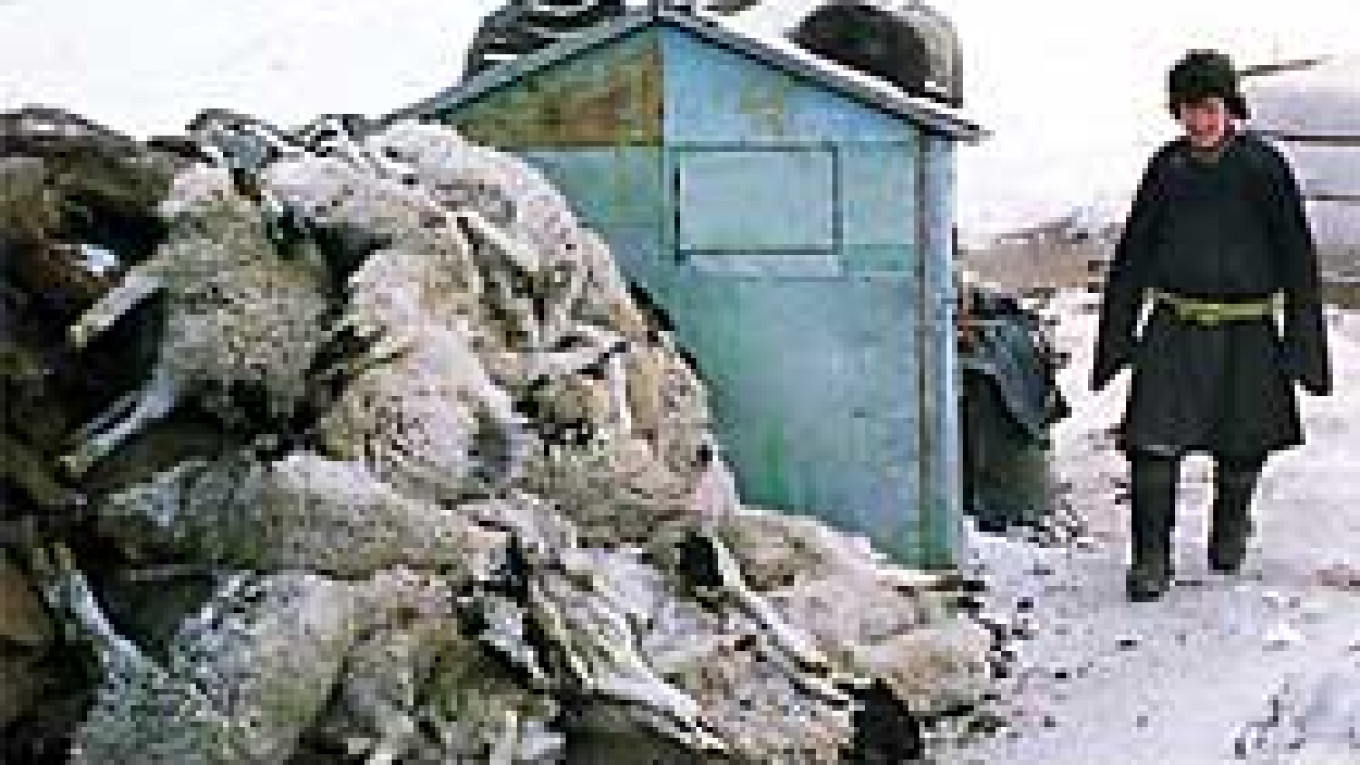
Even if a few of Batbayar?€™s animals pull through, this winter has put a question mark over a way of life that has defined the character of this vast nation since before the days of Genghis Khan.
"I wonder if any animals will survive," Batbayar, 56, says with a sigh as he stubs out a cigarette on a crust of ice that has turned winter pastures into a frozen desert littered with emaciated animal carcasses.
"I want to continue living the traditional way with my family," says Batbayar. "I can?€™t imagine living any way except how our ancestors lived for thousands of years."
The question is whether that proud nomadic tradition, briefly interrupted by Soviet-style collectivism only to be revived under democratic reforms a decade ago, can survive.
The problem for Batbayar is that Mongolia is no longer the land of Genghis Khan, the 12th-century founder of an empire that once stretched from Beijing to Budapest, Hungary. The expectations of modern Mongolians like Batbayar have changed, too. Herds have been crossbred with more productive but less hardy foreign stock, and their numbers have soared. Over-grazing by cashmere goats, a lucrative new source of income, has turned vast swathes of pasture into wasteland.
Sense of Euphoria
Where nomads on horseback once drove their animals over grasslands that stretched to the distant horizon, they now jostle for grazing space with their large herds and fight for agricultural inputs.
To survive, latter-day nomads need a more sophisticated support structure: transport for winter fodder, veterinary care to avoid epidemics like foot and mouth disease, livestock insurance, credit cooperatives, milking stations and slaughterhouses.
In the days when Mongolia was a virtual Soviet satellite, herds were mainly looked after by collective farms, which also offered a logistics base for nomads who stuck to old ways. Generous financial aid from the Kremlin kept the system afloat. A decade ago, when democracy swept away the Communist government, the herds were privatized. Mongolians celebrated the renaissance of a traditional nomadic culture.
"Once herds were privatized, there was a sense of euphoria," recalls Toemor, governor of Sergelen and the former head of the dairy cooperative. "They all believed they would be fine."
Two catastrophic winters in a row have brought tradition face to face with harsh economic reality. Many of those who turned to herding after privatization simply lacked the experience and local lore needed to survive on the steppes after decades in cooperative farms.
Passionate Debate
While many cling to the ideal that defines Mongolia?€™s cultural identity ?€” the self-sufficient family unit freely roaming the steppes ?€” there is a growing feeling the old cooperatives were not such a bad idea.
"The bad weather has led people to believe we need more cooperation ?€” some sort of joint farming system," says Toemor. "The old traditional way does not fit today?€™s situation."
So far, Batbayar has suffered staggering losses, including half of a herd of 140 sheep, cattle, horses and goats ?€” his only source of shelter, fuel, food, transport and income. And few of Mongolia?€™s 700,000 herders, who make up one-third of the population, are faring any better. Cyclical winter disasters known in Mongolian as zud have come and gone over the centuries.
But Carolyn McAskie, Emergency Relief Coordinator for the United Nations Office for Coordination of Humanitarian Affairs, argues that a modern nation cannot depend entirely on an agricultural sector so susceptible to the vagaries of nature.
Even though livestock outnumber people more than 10 to 1, shops are filled with imported meat and dairy products ?€” Anchor butter from New Zealand, processed cheese slices from Finland, canned beef from Germany.
"They have to make a choice as to whether or not they want to protect a truly traditional way of life or to build some kind of a hybrid," says McAskie. "This is a matter of intensely passionate debate at the moment."
Nobody is suggesting a return to the days when animals were owned by the state. There will always be a nomadic tradition as livestock are moved between winter and summer pastures. But many agricultural experts argue for a pooling of resources for veterinary care, fodder and transport to improve security and income.
"Strengthening the cooperative movement is part of the answer, but I?€™d be cautious about saying the traditional nomadic form of herding is not viable," says Barry Hitchcock, the Asian Development Bank?€™s resident representative in Mongolia. In livestock, there was "a lot of promise to establish a private-sector operation with some support from the government."
A Message from The Moscow Times:
Dear readers,
We are facing unprecedented challenges. Russia's Prosecutor General's Office has designated The Moscow Times as an "undesirable" organization, criminalizing our work and putting our staff at risk of prosecution. This follows our earlier unjust labeling as a "foreign agent."
These actions are direct attempts to silence independent journalism in Russia. The authorities claim our work "discredits the decisions of the Russian leadership." We see things differently: we strive to provide accurate, unbiased reporting on Russia.
We, the journalists of The Moscow Times, refuse to be silenced. But to continue our work, we need your help.
Your support, no matter how small, makes a world of difference. If you can, please support us monthly starting from just $2. It's quick to set up, and every contribution makes a significant impact.
By supporting The Moscow Times, you're defending open, independent journalism in the face of repression. Thank you for standing with us.

Remind me later.