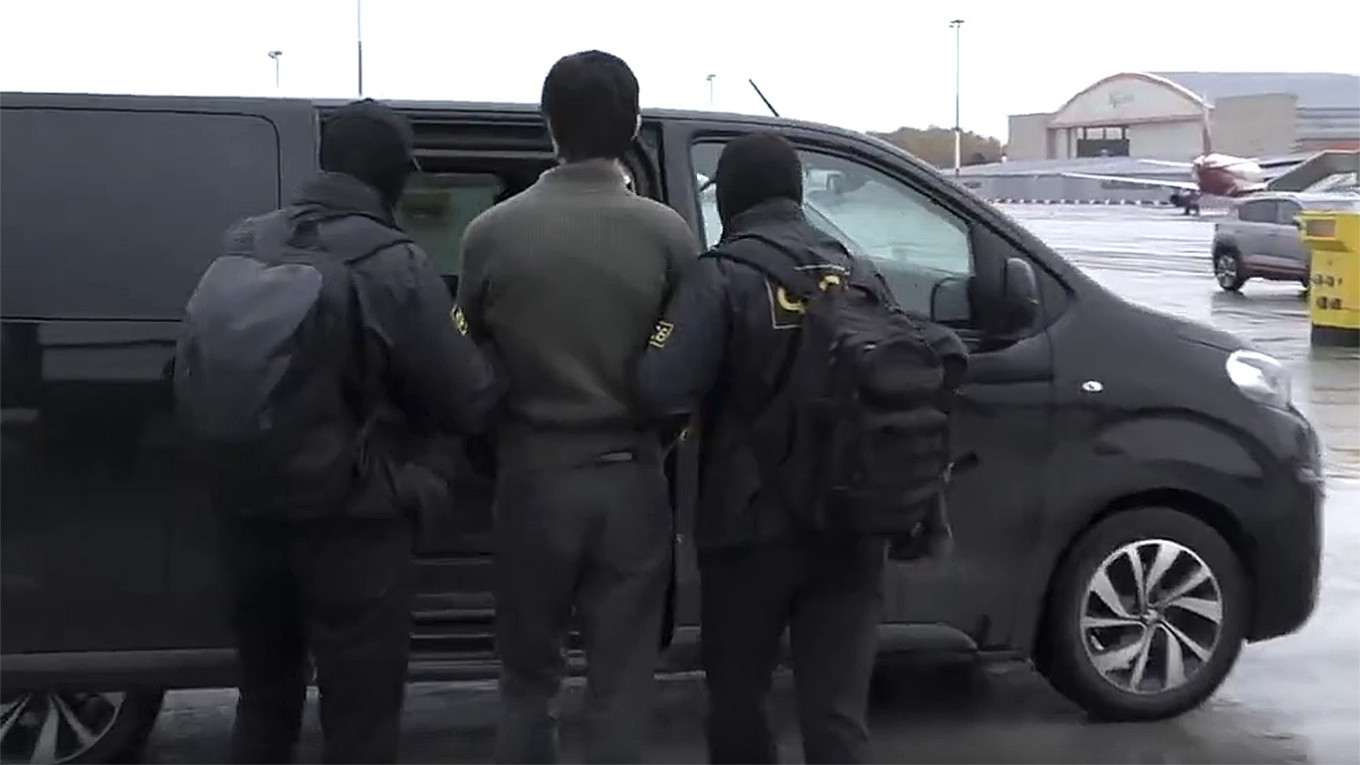
After bursting into the hotel room in Yuzhno-Sakhalinsk on October 13, the masked FSB agents quickly pressed the suspect to the floor and handcuffed him. The FSB video then shows the man being whisked from Sakhalin to Moscow, where he was placed in pre-trial detention for two months at Lefortovo Prison.
Was this some dangerous terrorist? Not at all. The suspect is Imai Yuki, a 34-year-old Japanese journalist from the Hokkaido Shimbun, a regional newspaper on Japan’s northernmost main island. The FSB accuses him of espionage on behalf of Japan’s intelligence service.
The charges are almost certainly trumped-up. Japan does not even have an external intelligence service.
The FSB also failed to produce any proof of its allegations. They weakly suggested that he had gathered information about residents of the Southern Kuril Islands sent to fight in Ukraine. This is not espionage but legitimate journalism, especially since Japan claims these disputed islands as its own territory. Ludicrously, one of the supposedly suspicious documents displayed by the FSB is a Japanese taxi receipt.
The Russian security services do, of course, have a record of detaining foreigners for use as diplomatic leverage. In March 2023, Evan Gershkovich, an American journalist for The Wall Street Journal, was detained on similarly flimsy espionage charges.
Sentenced to 16 years in a maximum-security penal colony, Gershkovich was freed after 491 days thanks to a multinational prisoner exchange that saw several Russian intelligence officers and criminals returned to Moscow.
This tactic of hostage diplomacy is not even a secret. On October 9, Deputy Chair of the Russian Security Council Dmitry Medvedev posted on Telegram that, in response to the detention of Kremlin propagandist Mikhail Zvinchuk in Montenegro, Russia needs to “fill up the exchange pool with European and American idiots in order to pull our own people out.”
In the case of Japan, there is no obvious person whose release the Kremlin is seeking. On Oct. 6, it was reported that Japan had detained a Russian citizen suspected of being a member of Qilin, a Russian cybercriminal group accused of multiple ransomware attacks, including against Asahi Holdings, the Japanese brewer. The suspect has, however, already been extradited to Germany.
There remains the possibility that Imai could be part of a multinational prisoner exchange, with Japan’s Western partners releasing Russian citizens — most likely more spies and criminals — in return for Imai and other unfortunate Westerners.
Yet, Russia’s recent policy toward Japan suggests there is more to Imai’s detention than the Putin regime refilling the exchange pool.
On Aug. 13, President Putin visited Iturup (known as “Etorofu” in Japanese), the largest of the Southern Kurils. While other Russian politicians, including Dmitry Medvedev, have visited the disputed islands, Putin had never done so. The trip was therefore a significant escalation and was condemned by Prime Minister Sanae Takaichi as “absolutely unacceptable.”
Other confrontational steps followed. On Sept. 4, a new monument to the Soviet victory over Japan in 1945 was unveiled in Khabarovsk. It controversially features a Soviet soldier smashing the Imperial Japanese chrysanthemum, the symbol of the much-revered imperial family.
Later that month, Foreign Minister Sergei Lavrov lambasted Japan (and Germany) at the United Nations General Assembly for taking “the path of militarization and revanchism.” Russian military activity around Japan has also intensified, including bombing drills on Japan-claimed Iturup from Oct. 13–17.
Another Oct. 13 provocation came when Russian media reported that a delegation from China’s Heilongjiang Province had visited Iturup. This is sensitive because Japan strongly opposes the involvement of third countries on what it claims to be inherent Japanese territory. It is especially worrying that the delegation was Chinese since Japan’s government fears Moscow and Beijing uniting against it in East Asia.
At first glance, this Russian barrage is puzzling since, earlier this year, Japan’s government had tentatively explored re-engagement with Russia. Unlike Fumio Kishida, who led Japan from 2021 to 2024, Prime Minister Takaichi has few strong feelings about Ukraine. She rarely speaks about the war and has yet to visit Kyiv.
This gave a green light to those within the government who favour re-engagement. In May, Japan’s Ministry of Economy, Trade and Industry led a business delegation to Moscow. Japan’s Ministry of Foreign Affairs also resumed sending young Japanese to Russia for short-term study. The first of these arrived in St. Petersburg just one day before Putin’s visit to Iturup.
It seems perverse that Russia should unleash a hardline campaign just when Japan was seeking rapprochement. What prompted this?
Scanning the period before the start of Russia’s campaign, two things stand out. First, thanks to the initiative of Defense Minister Shinjiro Koizumi, Japan announced on May 29 that it had contributed 2.2 billion yen ($14.7m) to NATO’s Prioritised Ukraine Requirements List (PURL). Through this scheme, countries can fund the purchase of United States-manufactured military equipment for provision to Ukraine. Japan also announced it would deploy four Self-Defense Force personnel to the headquarters of NATO Security Assistance and Training for Ukraine in Wiesbaden, Germany.
Japan’s contribution to PURL is limited to non-lethal military equipment. Yet, even this level of cooperation with NATO is strongly opposed by Moscow since it views it as an attempt by the Atlantic alliance to extend its influence to East Asia. For helping Ukraine in this way, Russian Foreign Ministry spokeswoman Maria Zakharova accused Japan of supporting “the terrorist Zelensky regime” and seeking the “strategic defeat” of Russia.
The second factor was the deployment to Japan in mid-June of U.S. Typhon missiles, a ground-launched mid-range system that can fire missiles that were prohibited under the now-defunct INF Treaty. Officially, Washington deployed them to Japan for the joint U.S.-Japan Orient Shield drills in September. However, Moscow is convinced that this is a pretext for the permanent deployment to Japan of missiles with the range to strike targets in the Russian Far East.
In response to the Typhon deployment, Zakharova warned on September 1 that Moscow would take “compensatory countermeasures.”
Moscow’s intention is clear. It intends to impose pain on Tokyo and thereby compel it to back away from further steps that the Russian government opposes.
This was made explicit on Oct. 20, when senior Japanese diplomat Kimitake Nakamura visited Moscow to seek the release of the detained Japanese journalist. He was told that the deterioration in bilateral relations was the direct result of Japan’s “unfriendly stance.” Moreover, normalisation would require Japan “to abandon anti-Russian activities” and to show greater “consideration for Russia’s national security concerns.”
This places Japan’s government in a bind. Of course, it wishes to do everything to secure the release of Imai Yuki, an innocent victim of Russia’s geopolitical games.
At the same time, if Japan makes concessions on key issues such as cooperation with NATO and missile deployments, it will have allowed its security policy to be taken hostage by Russia. Concessions would also encourage the Putin regime to repeat these criminal tactics.
As tragic as the situation is for Imai, Japan’s government should demonstrate that it cannot be bullied. It should respond not with concessions, but with punitive measures against the Putin regime, including fresh sanctions and additional support for Kyiv.
A Message from The Moscow Times:
Dear readers,
We are facing unprecedented challenges. Russia's Prosecutor General's Office has designated The Moscow Times as an "undesirable" organization, criminalizing our work and putting our staff at risk of prosecution. This follows our earlier unjust labeling as a "foreign agent."
These actions are direct attempts to silence independent journalism in Russia. The authorities claim our work "discredits the decisions of the Russian leadership." We see things differently: we strive to provide accurate, unbiased reporting on Russia.
We, the journalists of The Moscow Times, refuse to be silenced. But to continue our work, we need your help.
Your support, no matter how small, makes a world of difference. If you can, please support us monthly starting from just $2. It's quick to set up, and every contribution makes a significant impact.
By supporting The Moscow Times, you're defending open, independent journalism in the face of repression. Thank you for standing with us.

Remind me later.