
More than a century ago, the French writer Anatole France mocked the “majestic equality” of the law, which forbade rich and poor alike from sleeping under bridges, begging in the streets and stealing bread. They might have been equal before the law, but hardly equal in their ability to navigate it.
The EU — and, ironically, France itself — has now provided a modern variation on his joke.
Since Russia’s full-scale invasion of Ukraine, a Russian passport has come with a growing list of restrictions in Europe, from banking and visas to asylum procedures. But not everyone is affected equally by those barriers. Russia’s wealthiest and best-connected individuals and organizations have resources and years to contest measures imposed on them and, in doing so, to make courts and governments look beyond the passport and ask who they are and how much influence they had over Putin’s regime. Russians with far less money, access and time struggle to get beyond the word “Russian” in Europe at all.
But the inequality goes deeper than who has heavyweight lobbyists or can afford better lawyers. It lies in the radically different degrees of political agency expected from different Russians. Those closest to the Kremlin spend years explaining why their proximity to power gave them little say over Putin’s decisions and left them unable to stop the war. Those much further from the regime face the opposite expectation. With fewer resources and far more to lose, they are still expected to prove that they protested, spoke out or otherwise did all they could to bring Putin down.
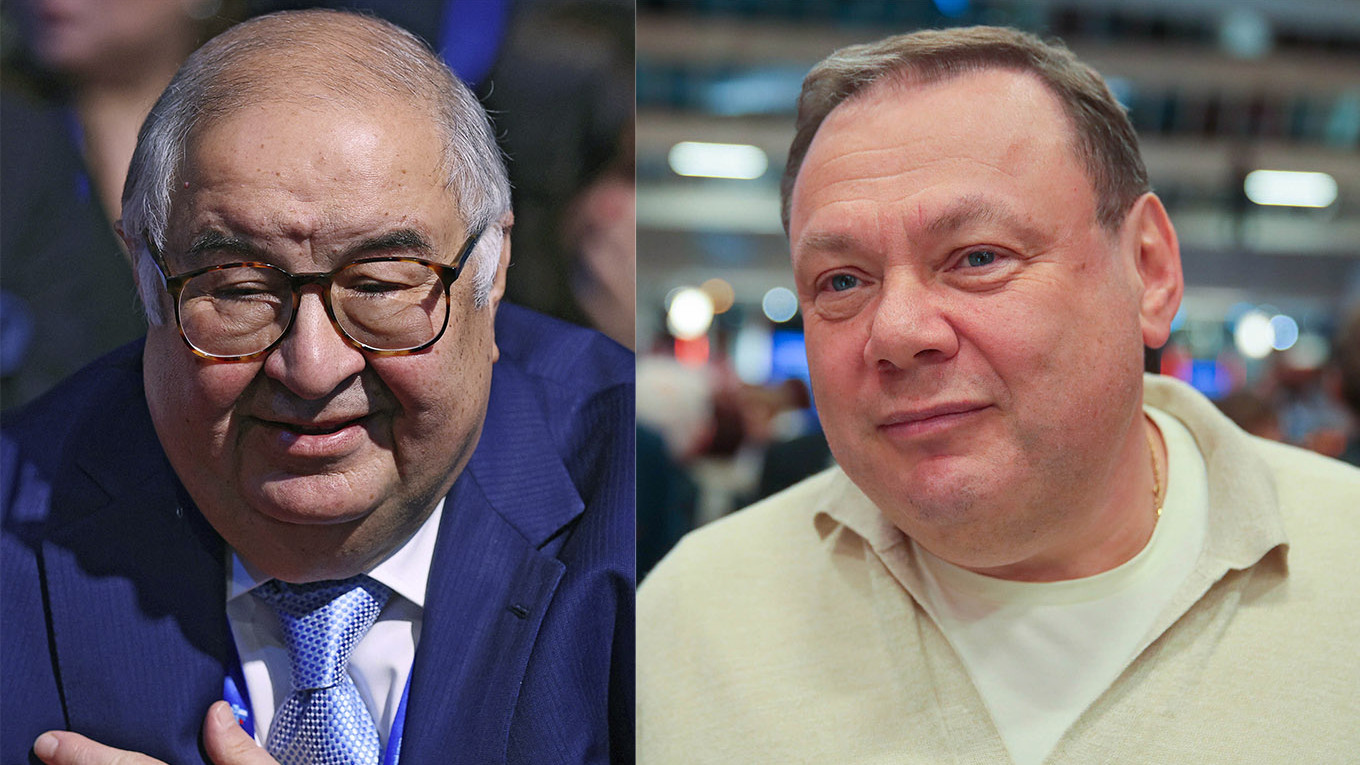
Few cases expose this inequality as clearly as those of Alisher Usmanov and Mikhail Fridman. Both Russian billionaires were sanctioned shortly after the full-scale invasion over what the EU described as their ties to President Vladimir Putin and Russian decision-makers. In the years that followed, their listings were repeatedly challenged in court and contested politically.
Slovakia had long pushed for Usmanov’s removal. But the stakes changed when France — one of the EU’s largest and most influential member states — took up the demand, citing unspecified national-security grounds. Paris did not confirm reports linking the French position to negotiations with Azerbaijan over detained French nationals, but its demand put the renewal of the wider sanctions regime at risk. Extending the measures required unanimity; even one government could hold up sanctions on thousands over the fate of a single billionaire.
Once France had opened that door, Luxembourg followed. It argued that if Usmanov was removed, Fridman should be too — while the latter was pursuing a multibillion-dollar arbitration claim against Luxembourg over assets frozen under the sanctions regime. On Sept. 22, the compromise was struck. Fridman and Usmanov came off the list, while sanctions on more than 3,000 other individuals and entities were renewed for another three years, setting an uncomfortable precedent in which individual names could become bargaining chips in negotiations over the wider sanctions regime.
To be clear, there is nothing wrong with contesting sanctions. If the grounds for listing someone no longer hold, there should be a way to challenge them. Nor does this outcome prove that Fridman and Usmanov simply bought their way off the list. What it does show is what money and access give you: the ability to keep institutions listening.
And listen, they did. For years, lawyers picked apart evidence down to photographs, meeting records and emails; journalists interviewed them and investigated their connections. Their relationship with the Kremlin was scrutinized, weighed and reweighed, until questions about two Russian billionaires were resolved at the highest political level in Europe. And all that attention gave them space to make a paradoxical argument: despite standing near the top of the Russian system and prospering within it, they had little say over the man at its centre.
Fridman said it plainly after he was sanctioned in 2022: Western policymakers misunderstood Russia if they imagined oligarchs could simply tell Putin to stop the war. The removal of his personal sanctions four years later does not mean the EU accepted that argument; the decision came through political compromise.
But that brings us to the much bigger question: if one of Russia’s billionaires can say that even he has little ability to influence Putin, how exactly are Russians with no access to power supposed to do so?
For years, every Russian has nevertheless been expected to protest and challenge the regime with whatever means they have. Western nationality-based sanctions rested, at least in part, on an assumption: make the costs of the Kremlin’s policies felt, and discontent from below will eventually translate into pressure on the regime. But authoritarianism breaks that logic. Economic pain does not readily become protest when people have little room to organise and much to fear, while elites are often better shielded from the consequences.
In principle, the EU itself recognized this problem. Its sanctions were supposed to target “the Kremlin and its accomplices” while minimising the consequences for “ordinary Russians.” The Anti-Corruption Foundation pushed the same logic further, compiling a list of thousands of officials, businesspeople, propagandists and others it argued should face personal sanctions for enabling Putin’s regime and the war. Instead of spreading the costs across society and hoping they traveled upwards, the idea was to target those who sustained the system.
Yet Europe is increasingly doing the reverse. Restrictions tied to Russian nationality have accumulated, even as some of the individually sanctioned elite have found their way off the list. Those far from the Kremlin are still expected to bear the costs and resist; some of those sanctioned for their ties to it have managed to escape them. That inversion is difficult to reconcile not only with the EU’s stated commitment to “human dignity, freedom, democracy, the rule of law and human rights,” but with the purpose for which these measures were introduced in the first place: supporting Ukraine and weakening the system waging war against it.
For most Russians, the consequences cut deeply into everyday life. In the EU, a Russian passport can determine something as basic as whether you can cross a border, visit your family or keep a bank account — often leaving little room for personal circumstances.
Asylum makes the contradiction even sharper, because here the system is explicitly supposed to look at the individual. But under the EU’s new asylum rules, nationality helps determine how much time you get to make your case. Applicants from countries with an EU-wide recognition rate of 20% or lower can have their claims fast-tracked. Sometimes, those applying at the border can also be placed in a procedure that must normally be completed within 12 weeks. Russia is among the countries whose recognition rate falls below the 20% mark.
That does not mean every Russian asylum seeker will have their claim handled this way, let alone rejected. Each case still has to be examined individually. But where the procedure applies, the timetable shrinks. An applicant has weeks to reconstruct years of their life: protests they attended, organisations they worked with, statements they made, threats they received and reasons they cannot return — and provide evidence for all of it. If they fail to convince the authorities that the risk they face is sufficiently personal and serious, they can be denied protection and ultimately returned to Russia — potentially to the repression, prosecution or imprisonment they fled in the first place.
Formally, every Russian in Europe is judged as an individual. In practice, not everyone has the same chance to be seen as one. For some, it stretches over years; for others, it is measured in weeks.
That is the majestic inequality running through Europe’s policies towards Russians: the oligarch can afford to make Europe understand his powerlessness; the asylum seeker has to make Europe believe in their courage.
A Message from The Moscow Times:
Dear readers,
We are facing unprecedented challenges. Russia's Prosecutor General's Office has designated The Moscow Times as an "undesirable" organization, criminalizing our work and putting our staff at risk of prosecution. This follows our earlier unjust labeling as a "foreign agent."
These actions are direct attempts to silence independent journalism in Russia. The authorities claim our work "discredits the decisions of the Russian leadership." We see things differently: we strive to provide accurate, unbiased reporting on Russia.
We, the journalists of The Moscow Times, refuse to be silenced. But to continue our work, we need your help.
Your support, no matter how small, makes a world of difference. If you can, please support us monthly starting from just $2. It's quick to set up, and every contribution makes a significant impact.
By supporting The Moscow Times, you're defending open, independent journalism in the face of repression. Thank you for standing with us.

Remind me later.