Russia’s Central Bank sees no realistic path to meeting President Vladimir Putin’s target for expanding the stock market by 2030, a senior official said, as falling share prices and limited investor demand push the goal further out of reach.
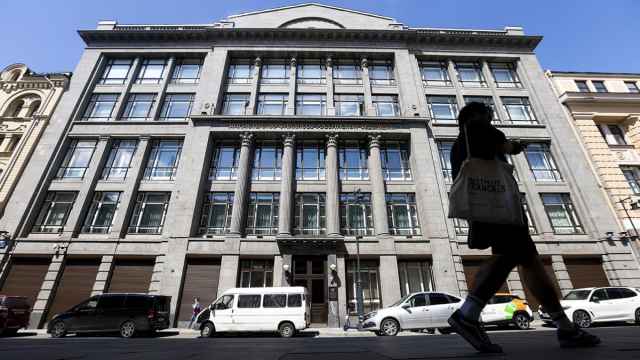
The Central Bank and Finance Ministry are reassessing what level of market capitalization Russia can achieve, Interfax cited First Deputy Governor Vladimir Chistyukhin as saying Thursday.
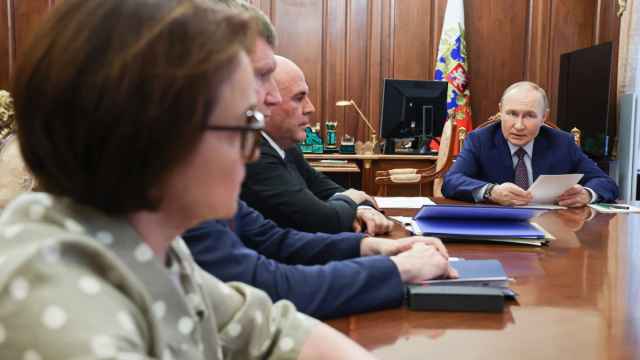
Putin ordered Russia to double its stock market capitalization to at least 66% of gross domestic product by 2030 in a decree issued in May 2024, shortly after beginning another presidential term.
“Our calculations simply do not get us to 66%,” Chistyukhin said.
The assessment underscores the difficulties of expanding a market that has lost access to much of its foreign investor base since Russia invaded Ukraine and now relies heavily on individual investors.
Market capitalization, the combined value of listed companies, has fallen by about a third since Putin issued the decree.
“We are moving very quickly, but unfortunately in the opposite direction,” Sergei Shvetsov, chairman of the Moscow Exchange’s supervisory board, said previously.
According to Central Bank calculations, the MOEX stock index has been among the worst-performing financial instruments both since the start of the war and this year. Investors have lost 10.5% since the beginning of 2022, even after accounting for dividends.
Rating agency Expert RA estimated that stock market capitalization had fallen from 47% of GDP to 23%, meaning it would now need to roughly triple to meet Putin’s target.
The Center for Macroeconomic Analysis and Short-Term Forecasting, a think tank close to the Kremlin, projects that capitalization will reach 40% of GDP by 2030 in its optimistic scenario. Its pessimistic forecast puts the figure at 28.8%, below the level when Putin signed the decree.
Market capitalization can grow through rising share prices or new listings. Chistyukhin warned that the measures under consideration might still be insufficient to reach the target.
Meeting it would require enormous share offerings, he said, raising questions about whether investors could absorb them.
Since the invasion, funds belonging to investors from countries Moscow designates as “unfriendly” have been frozen in special accounts. Individual investors now account for about two-thirds of share trading on the Moscow Exchange.
Chistyukhin cited the roughly 30 billion ruble ($354 million) initial public offering by state housing finance company Dom.RF, the largest in recent years, as a deal individual investors had been able to absorb.
Offerings of 300 billion rubles ($3.54 billion) or 500 billion rubles ($5.9 billion) would pose a much greater challenge, he said.
Expert RA has also warned that individual investors cannot replace foreign funds in large deals worth 50 billion rubles ($590 million) or more.
Sberbank CEO German Gref and Central Bank Governor Elvira Nabiullina have both identified investor confidence as essential to increasing stock market valuations.
Repeated tax increases, nationalizations and the seizure of shares bought on the exchange have raised concerns about the security of investments.
Gref said Sberbank, Russia’s most valuable publicly traded company, had long tracked the performance of its most successful investors. Those who took a cautious approach and favored bank deposits consistently came out ahead.
“Over a 10-year horizon, a five-year horizon and a three-year horizon, conservative investors won every time,” he said.
This article was translated with the help of artificial intelligence and was reviewed by a Moscow Times editor before publication. Learn more about our newsroom's AI policy here.
Read this article in Russian at The Moscow Times' Russian service.
A Message from The Moscow Times:
Dear readers,
We are facing unprecedented challenges. Russia's Prosecutor General's Office has designated The Moscow Times as an "undesirable" organization, criminalizing our work and putting our staff at risk of prosecution. This follows our earlier unjust labeling as a "foreign agent."
These actions are direct attempts to silence independent journalism in Russia. The authorities claim our work "discredits the decisions of the Russian leadership." We see things differently: we strive to provide accurate, unbiased reporting on Russia.
We, the journalists of The Moscow Times, refuse to be silenced. But to continue our work, we need your help.
Your support, no matter how small, makes a world of difference. If you can, please support us monthly starting from just $2. It's quick to set up, and every contribution makes a significant impact.
By supporting The Moscow Times, you're defending open, independent journalism in the face of repression. Thank you for standing with us.

Remind me later.