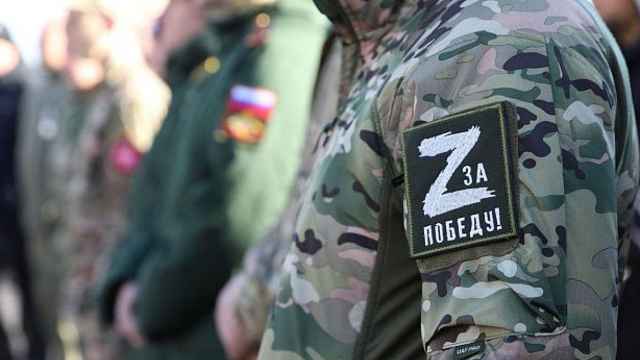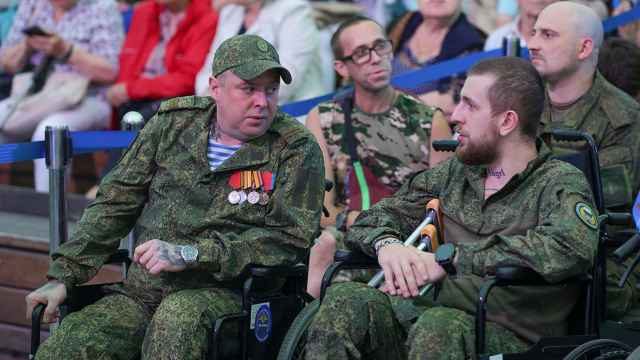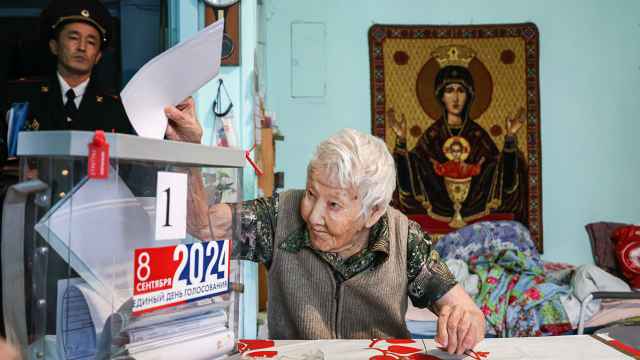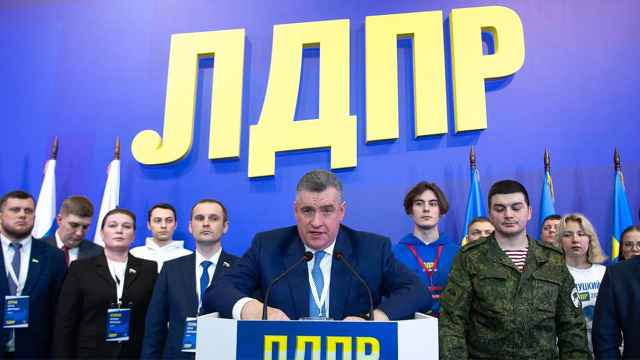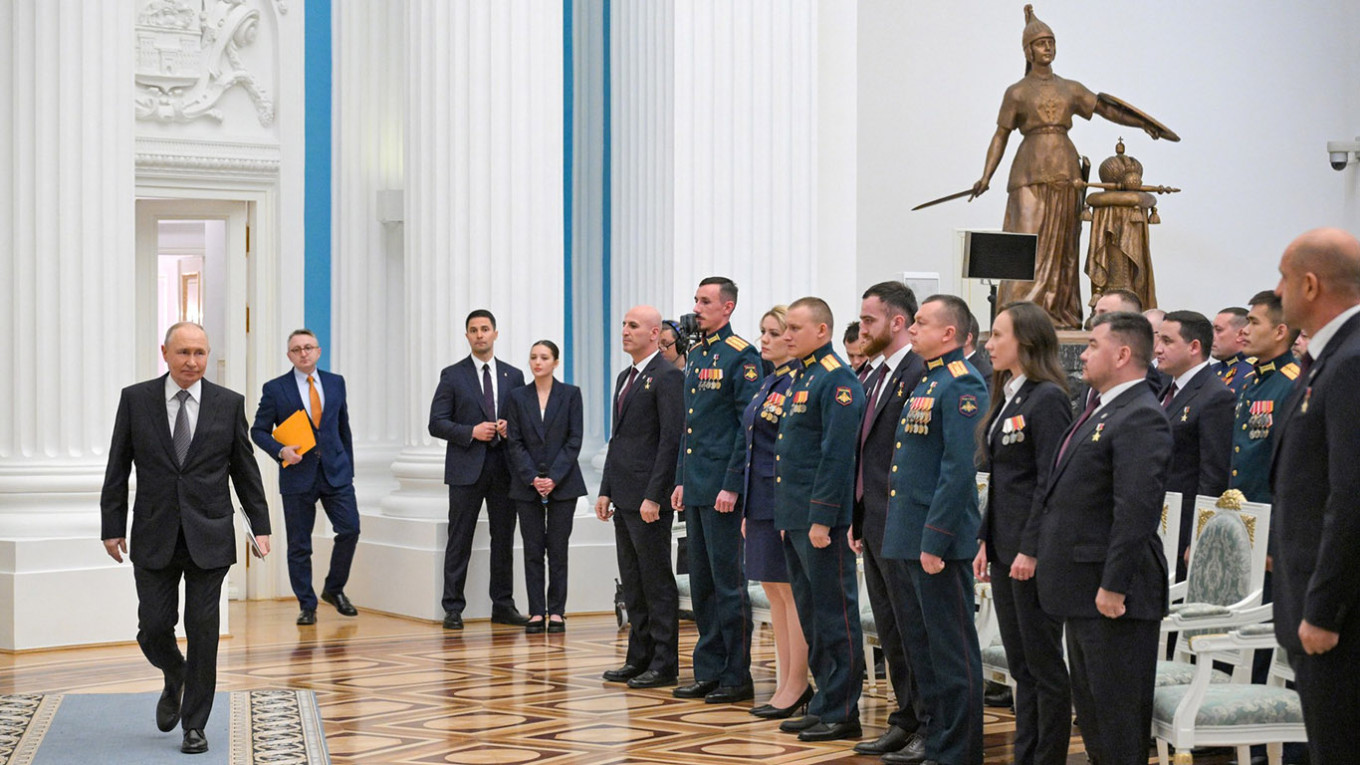
The first session of Russia’s State Duma after the 2026 parliamentary elections opened with a 20-second standing ovation for the newly elected “participants in the special military operation.”
Veterans of the war in Ukraine now comprise just over 10% of the lower chamber of parliament. The Central Electoral Commission chief Ella Pamfilova declared that the new veteran members will “set a certain tone” for the new State Duma. That tone will be one of further militarization of Russian politics and society. It is also a reflection of the emergence of a new political constituency produced by the war against Ukraine.
Like the wider process surrounding the vote, the number of veterans entering parliament was managed at the top. United Russia initially announced after voting had ended that 86 veterans from the party had been elected. This statement was quickly removed from state media and later revised to say that 49 United Russia veterans would take up their seats.
On Sept. 25, Pamfilova confirmed the final number of veterans across all parties at 46, which broadly aligns with the 40-50 projected by Kremlin insiders back in May. These shifting figures suggest that veterans’ representation in parliament was a matter of managed political allocation rather than one left entirely to the electoral process.
The latest election is part of a broader reshaping of Russia’s political system. In February 2024, Putin personally announced an ambitious new state project — the Time of Heroes program — designed to equip patriotic veterans for future service in senior government roles and top positions in state-linked companies.
Out of 83 participants admitted in the first cohort, reportedly selected from 44,000 applicants, three went on to become heads of Russian regions and at least eleven secured jobs in the Presidential Administration.
For Putin, the initiative addressed the need for a new “genuine” Russian elite, distinct from the bureaucratic and business elites who had “lined their pockets in the 1990s.” Drawn from contract soldiers and mobilized servicemen who fought in Ukraine, this new generation would become the force to whom “Russia can one day be entrusted,” Putin claimed.
Beyond the program itself, the Kremlin has also eased the path for veterans to run in elections at all levels, leading to more than 1,600 veteran candidates registering for municipal and regional elections in 2025. The latest Duma elections mark the latest step in the project to systematically integrate former combatants into Russia’s political system.
To encourage participation in its primaries, United Russia gave veterans from some regions a 25% bonus to their vote totals, alongside simplifying requirements for submitting documents and conducting their campaigns.
Some of the newly elected United Russia deputies have been accused of war crimes in Ukraine. One of them is Nursultan Mussagaleyev, a decorated “Hero of Russia” who is suspected of killing civilians in the Kyiv suburb of Bucha.
Another, Adam Delimkhanov, commanded Chechen forces during the assault on Mariupol, which effectively destroyed the city.
Vladislav Golovin, the new chairman of the State Duma Youth Policy Committee, is another participant in the devastating siege of Mariupol. Ukrainian authorities have accused him of war crimes against civilians and of involvement in the military training of Ukrainian children.
Golovin, 29, is also head of Yunarmiya, a youth military-patriotic movement run by the Defense Ministry, and was among the top five candidates on United Russia’s federal electoral list.
Yet the Kremlin’s veteran category extends beyond those who fought at the front. The professional perks available to former combatants have made veteran status attractive to career politicians and technocrats looking to advance their careers.
As a result, the “veteran” category encompasses a diverse mix of former military personnel and officials or managers who, in some cases, have spent only limited periods near the front to acquire veteran credentials.
The former mayor of the southern city of Krasnodar, Yevgeny Pervyshov, for example, secured the governorship of Tambov region after signing up to fight in 2022 and entering the Time of Heroes program. The drone regiment in which he served is known for recruiting high numbers of United Russia members and is mostly involved in drone operations far from the front line.
This mixing of former combatants with ordinary officials goes beyond mere career opportunism. Rather, it should be read both as a way of inculcating patriotism and as a deliberate effort by the Kremlin to prevent the emergence of a distinct veteran bloc within Russia’s political structures.
The late Wagner leader Yevgeny Prigozhin’s mutiny exposed the risks posed by organized combatants who are critical of the Kremlin’s conduct of the war. Capable of turning their networks and battlefield experience against the regime, they could cause a problem for Russia’s leadership, especially if it does not carefully manage the process of demobilization once the fighting subsides.
By bringing this group into the political system on its own terms, the authorities are thus seeking to manage a hardline constituency that could otherwise acquire a distinct political voice.
The war has reshaped every facet of the Russian system. Its economy, industry and judiciary are increasingly geared towards sustaining Putin’s militarized political course. The new Duma provides the latest confirmation of this trend.
For the Kremlin, the systematic and tightly managed integration of veterans into state structures could help renew an ageing government bureaucracy by embedding some of the regime’s most loyal supporters within its institutions. It also demonstrates to the wider population that frontline service presents a viable route to social and political advancement.
For veterans, it offers a degree of recognition and suggests that they have an important role to play in civilian life — a sharp contrast with the lack of institutional support afforded to veterans of the Afghan and Chechen wars. Representatives of both groups found themselves on the margins of society without adequate possibilities for rehabilitation. In the case of the Afgantsy, many found their way into organised crime.
The Kremlin’s initiative to appoint loyal veterans to positions of responsibility in the system is still only in its early stages. The cohort that has entered the Duma will provide the first real chance to test the effectiveness of its approach.
There are already grumblings from some veteran groups that some of the new Duma deputies are “fake” veterans. The Russian authorities know that pro-war groups present a far greater threat than the anti-war community because they are more difficult to control and cannot be accused of lacking patriotism. Taking more steps beyond increasing the role of veterans in parliament may be required to keep them under control.
A Message from The Moscow Times:
Dear readers,
We are facing unprecedented challenges. Russia's Prosecutor General's Office has designated The Moscow Times as an "undesirable" organization, criminalizing our work and putting our staff at risk of prosecution. This follows our earlier unjust labeling as a "foreign agent."
These actions are direct attempts to silence independent journalism in Russia. The authorities claim our work "discredits the decisions of the Russian leadership." We see things differently: we strive to provide accurate, unbiased reporting on Russia.
We, the journalists of The Moscow Times, refuse to be silenced. But to continue our work, we need your help.
Your support, no matter how small, makes a world of difference. If you can, please support us monthly starting from just $2. It's quick to set up, and every contribution makes a significant impact.
By supporting The Moscow Times, you're defending open, independent journalism in the face of repression. Thank you for standing with us.

Remind me later.