
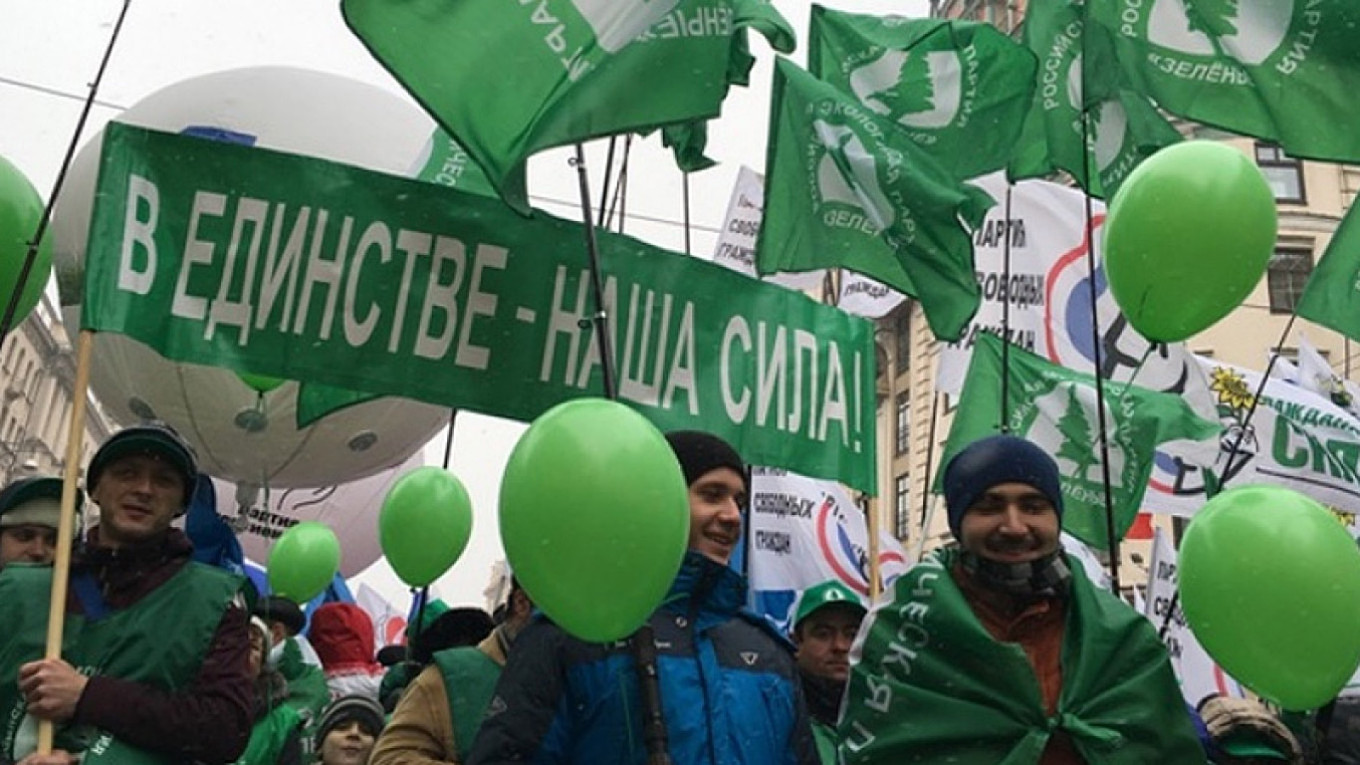
You most likely heard nothing about Russia’s so-called Green Party, which took part in Russia’s 2026 parliamentary elections. Not that its candidates have had success in anything other than getting its competitors from the liberal Yabloko party blocked in courts across the country.
Despite its state-registered name, it is completely wrong to call the members of this party greens, so let us come up with something more realistic for this description. For example, the pseudo-environmental pseudo-party — PEPP.
This is far from the first time that the presidential administration has authorized pseudo-environmentalists in elections, but this has never resulted in any success at the federal level. The situation seems paradoxical: Russians are generally sympathetic to environmental causes but are not prepared to vote for the dubious sorts of people who usually run for office on an environmentalist platform.
Previously, projects like these at least had Russian names. Now this one is simply a calque of the name of the German Green Party, the most successful party of its kind in the world and a fierce opponent of Putin and the war in Ukraine. A copy is always much worse than the original, not that you can describe this PEPP as much of a copy.
We look at the face of the party online and immediately find a statement against hatred and cruelty — all very commendable. Apparently following this principle, one of the party’s co-chairs, Andrei Nagibin, enthusiastically supported the war in Ukraine from 2022 onwards, saying he was deeply concerned about the supposed biolaboratories scattered all across Ukraine.
Another candidate on the federal list — No. 2 — is Alexandra Kudzagova. She studied journalism and wrote for various newspapers in northern Russia before moving suddenly to Moscow, where she became editor-in-chief of a trade publication covering low-rise construction. Before long, she was working in the Moscow regional government. Her duties included overseeing contentious issues that provoked protests. At that, Alexandra did such a good job that she was given the post of deputy environment minister in the Moscow region. What we have before us, therefore, is not a journalist but a PR specialist hired to dampen protest sentiment, rather than to solve the environmental problems that create that sentiment.
In 2026, Alexandra Kudzagova won the Leaders of Russia competition, where she was backed by none other than the grey cardinal of Russian politics, Sergei Kiriyenko. So she clearly knows how to dampen public protests.
St. Petersburg deputy Marina Shishkina is the top candidate on PEPP’s federal list. Although she has spent more than one decade in the corridors of power, Shishkina was seized by a love of environmental party-building only very recently — in March 2026. Before that, she worked for a long time in A Just Russia, one of Russia’s pro-war parties. Marina is a professional PR specialist and a professor who has taught many others the trade. I would never have thought that people received state awards for developing the “science of PR,” but here is a living example.
It is highly revealing that Shishkina and Kudzagova, the leading figures on PEPP’s federal list, have the same profession, which consists of manipulating public sentiment.
There are two more people in the top five of PEPP’s federal list — Ruslan Khvostov and Sergei Shakhmatov. The first is known for his direct connection to the leadership of the pro-Kremlin movement Mestnye. Among other things, Mestnye carried out the task of “controlling the environmental agenda” when traditionally green concerns were becoming mobilizing forces in Russian politics. The Green Party’s website claims that Ruslan Khvostov is a participant in the war in Ukraine, but there is no information about this in the public domain. His namesake Dmitry Khvostov, a former deputy governor of Vladimir region, really did go off to fight. As for Ruslan Khvostov, he collects and delivers "humanitarian aid" to Russian servicemen and civilians in the Donbas.
More than 10 years ago, Sergei Shakhmatov was deputy environment minister in the Krasnoyarsk region. Local environmental activists criticized him for being soft on the area’s main polluters — Rusal and Norilsk Nickel. But he became better known for being expelled from Krasnoyarsk city council. The local prosecutor’s office established that in 2021, while serving as a deputy, Sergei Shakhmatov purchased shares in more than 20 foreign companies worth a total of 196 million rubles ($2.3 million). He was stripped of his mandate for violating anti-corruption legislation.
But PEPP is not made up only of manipulative PR specialists, corrupt officials and contractors for Putin’s administration. There is also a little-known federal council.
And do you know who they have there? An expert on climate policy!
What?! Yes!
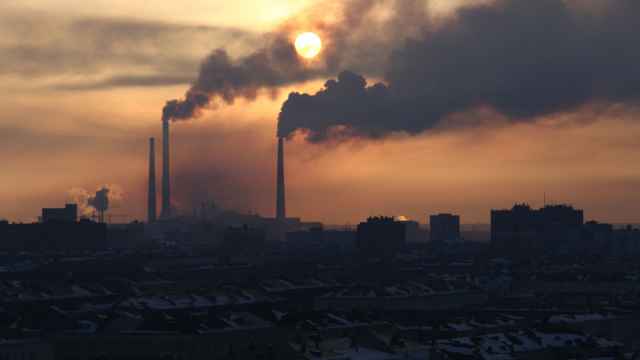
In an atmosphere of universal obscurantism, surely any ray of light is a good thing? After all, climate change, one of the greatest problems facing humanity, is simply ignored by all mainstream parties and politicians in Russia. Politicians are convinced that ordinary people do not understand the problem, reflecting their own ignorance. Secondly, fighting climate change means that the use of oil, coal and gas must be reduced rapidly in favor of renewables.
But unlike in most countries, Russian officials are unwilling to address the crisis. Putin said that wind turbines make worms crawl out of the ground. In short, Putin’s administration will not pat you on the head for similar sentiments. Challenge the status quo and you will have about as much chance of seeing another election as you do of seeing your own ears.
There is no need for him to worry about the Green Party: its climate expert is simultaneously also an expert for the Russian Gas Society. What he calls for is not a reduction in gas consumption but, on the contrary, an increase. He also welcomes nuclear energy. PEPP’s website claims that in the second half of the century nuclear energy should become the foundation of the future of Russia’s energy system. If you know even a little about the subject, it becomes clear what nonsense this is. It was written on the assumption that nobody will read it anyway, and that nobody will have to answer for these words. Or perhaps they simply wanted to please Putin’s domestic policy chief Kiriyenko, who is a former head of Rosatom.
In sum, Russia’s Green Party is a classic spoiler, counting on attracting ordinary people who are not especially sophisticated politically and have nobody else to vote for. And, probably, some of those who would have voted for the anti-war Yabloko, which was arbitrarily removed. It is pure manipulation, having nothing to do with either protecting nature or protecting Russians’ environmental rights.
I have bad news for those who voted for them simply because there was no better alternative. Their vote was a vote in support of the current system, manipulation and war. Nothing more and nothing less.
A Message from The Moscow Times:
Dear readers,
We are facing unprecedented challenges. Russia's Prosecutor General's Office has designated The Moscow Times as an "undesirable" organization, criminalizing our work and putting our staff at risk of prosecution. This follows our earlier unjust labeling as a "foreign agent."
These actions are direct attempts to silence independent journalism in Russia. The authorities claim our work "discredits the decisions of the Russian leadership." We see things differently: we strive to provide accurate, unbiased reporting on Russia.
We, the journalists of The Moscow Times, refuse to be silenced. But to continue our work, we need your help.
Your support, no matter how small, makes a world of difference. If you can, please support us monthly starting from just $2. It's quick to set up, and every contribution makes a significant impact.
By supporting The Moscow Times, you're defending open, independent journalism in the face of repression. Thank you for standing with us.

Remind me later.