
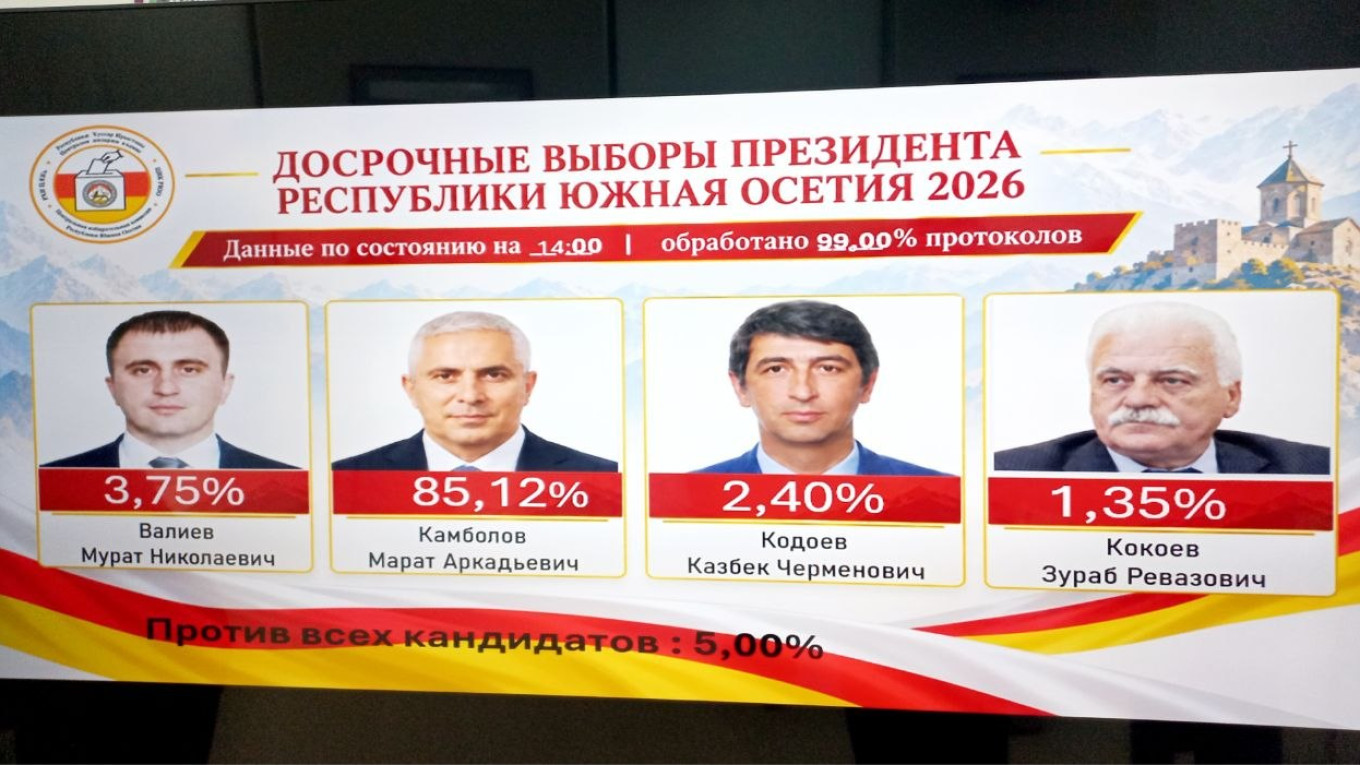
A former Russian official has been elected president of South Ossetia, the Russia-backed breakaway region of Georgia, in a vote Moscow hailed on Saturday as a sign of the territory's desire for closer ties with Russia.
Marat Kambolov, the new president, is from North Ossetia, a Russian republic on the other side of the Caucasus Mountains from South Ossetia.
He has no previous ties to South Ossetia, which broke away from Georgia during the collapse of the Soviet Union in the early 1990s and later secured de facto independence with Russian backing. A brief war between Russia and Georgia in 2008 drove Georgian forces from parts of the territory they had previously controlled.
"The results demonstrate South Ossetian society's widespread desire for domestic political stability, progress and the comprehensive development of ties with the Russian Federation," Russia's Foreign Ministry said.
South Ossetia and Russia signed a treaty in May that deepened cooperation on defense, foreign and security policy and set out plans to integrate energy grids and transportation networks.
Georgia condemned the treaty as an attempt by Russia to cement its "de facto annexation" of South Ossetia and Abkhazia, another Russia-backed breakaway Georgian region.
Tbilisi also criticised Russia's decision to open polling stations in both territories for its State Duma elections running Sept. 18-20.
The 61-year-old Kambolov previously held senior posts in Russian federal government offices, including in the Education Ministry.
He was appointed South Ossetia's prime minister in June after Alan Gagloyev stepped down as president to become an adviser to Russian President Vladimir Putin.
Putin congratulated Kambolov on Saturday in a telegram published on the Kremlin's website.
In a victory speech in the South Ossetian capital Tskhinvali, Kambolov pledged to improve living standards in the region.
"We have a great deal of work ahead of us. Only together can we change our republic, our Tskhinvali," he said.
South Ossetia, with a population of about 50,000, is heavily dependent on Russia for food, equipment and energy imports and has little industry of its own.
Moscow funds public-sector wages, pensions and major infrastructure projects and operates a military base in the territory.
Russian state media said Kambolov won 85% of the vote in Friday's election, with his rivals polling in the single digits. Turnout was 73%.
A Message from The Moscow Times:
Dear readers,
We are facing unprecedented challenges. Russia's Prosecutor General's Office has designated The Moscow Times as an "undesirable" organization, criminalizing our work and putting our staff at risk of prosecution. This follows our earlier unjust labeling as a "foreign agent."
These actions are direct attempts to silence independent journalism in Russia. The authorities claim our work "discredits the decisions of the Russian leadership." We see things differently: we strive to provide accurate, unbiased reporting on Russia.
We, the journalists of The Moscow Times, refuse to be silenced. But to continue our work, we need your help.
Your support, no matter how small, makes a world of difference. If you can, please support us monthly starting from just $2. It's quick to set up, and every contribution makes a significant impact.
By supporting The Moscow Times, you're defending open, independent journalism in the face of repression. Thank you for standing with us.

Remind me later.