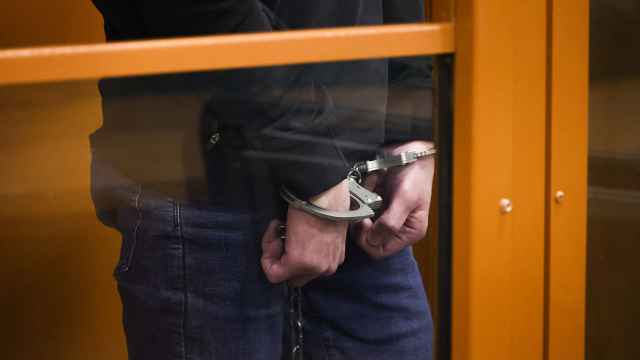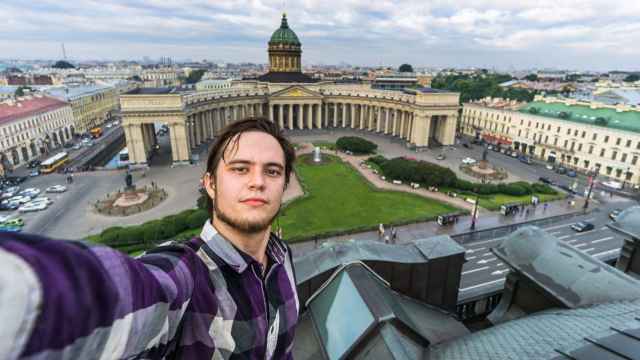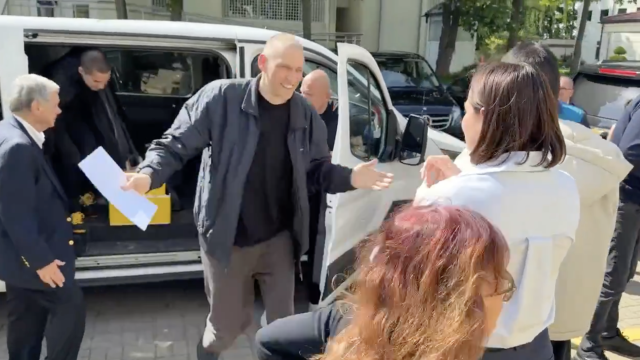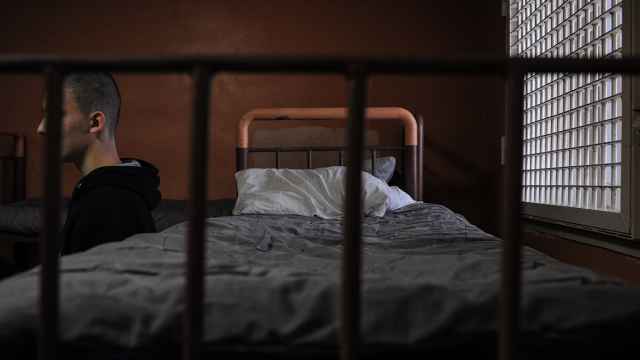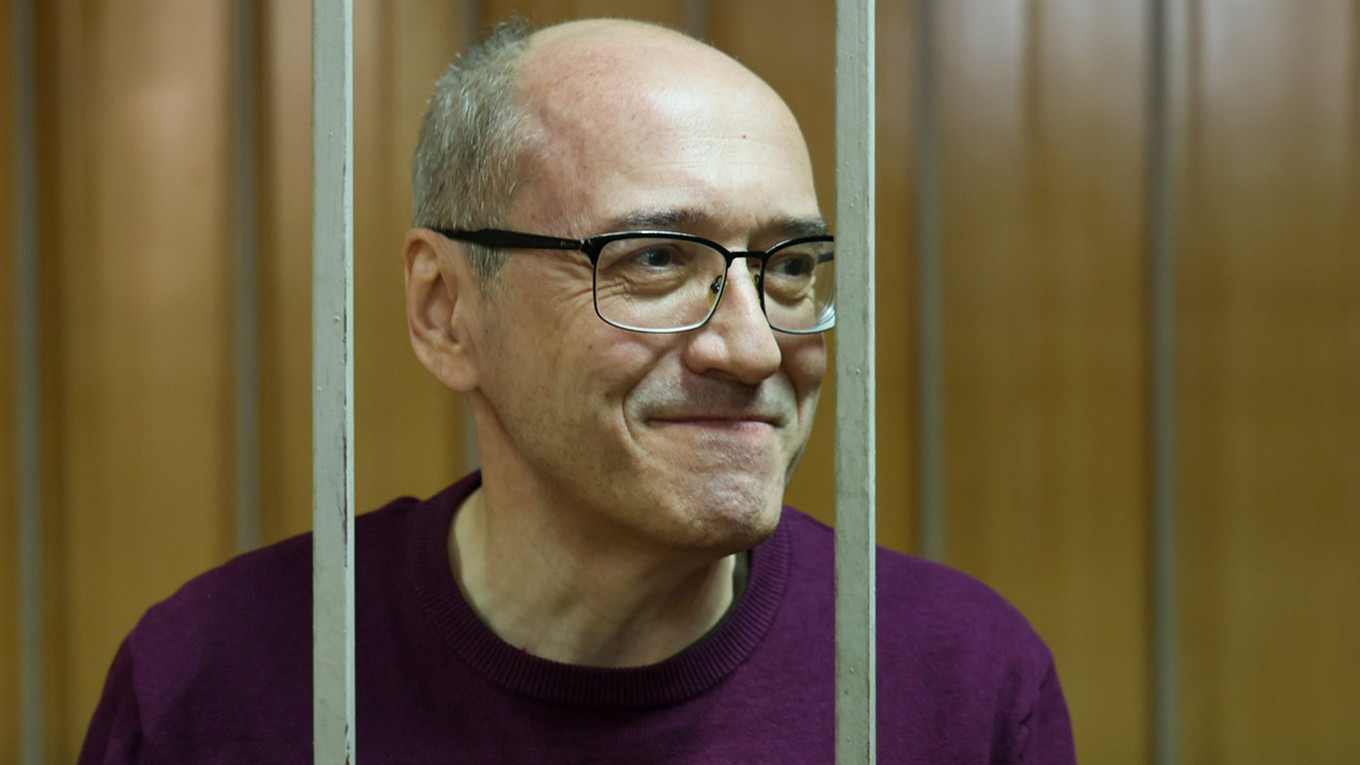
Russian culinary historian Pavel Syutkin was sentenced Tuesday to six years in prison over social media posts about alleged Russian atrocities in Bucha, Ukraine, during the opening weeks of Moscow’s full-scale invasion.
In an April letter translated and republished below, Syutkin, a longtime food columnist for The Moscow Times, describes the criminal case against him in his own words.
The letter was originally published here.
My case is unquestionably political. There’s not much to prove in cases like this. They are punishing me for my words and for openly opposing the war. I have never tried to hide my position. Moreover, after months in prison, I have become even more convinced that many Russians feel the same.
The investigators are outraged that I published political commentary on a channel devoted to culinary history, thereby sowing doubts about Putin’s most peaceful policy in history among an audience with no formal political training. For many years, I have answered such arguments as follows:
“The very idea that ordinary people might have opinions of their own in Russia today clearly borders on criminality. Well, all of us, cooks, doctors, scientists and drivers, are what you call the people. Under the Constitution, all power in the country belongs to them. No matter how ridiculous that may sound today.”
In any case, I am a historian, not a cook. I have the right to share my thoughts with my readers, whoever they may be. I also have the right to analyze my country’s past and present.
My cellmates have criminal case files running to 20 or even 80 volumes. Mine consists of just one. “Well, maybe we’ll split them into one and a half,” the investigator clarified. Most of it consists of two expert assessments, one psychological and one linguistic. The first is straightforward: my mental health is sound enough to send me to Mars. But the second is a rather comical document.
I should explain that my starting position is simple. I do not admit guilt of any kind. I do confirm that I wrote everything the investigators cite about Putin and his war. The logic is obvious: Russian citizens have the right to express their opinions, including publicly, on matters of public importance. The Constitution guarantees that right. There are no untouchable figures in our country. Even the president, as a public official, may be criticized, especially when there is plenty to criticize him for.
The actions taken against me by the investigators and the Federal Security Service violate Russian law as well as Russia’s international obligations. Even amid the current drive to isolate the country from the civilized world, Russia has not withdrawn from the International Covenant on Civil and Political Rights. The covenant affirms everyone’s right to freedom of expression. It also prohibits discrimination on the grounds of political opinion. The slogan used by Soviet dissidents in the 1970s therefore suits my case perfectly: “Observe your own Constitution!”
The investigators’ main objective is to prove that Syutkin P. P., “who harbored hatred and contempt for the state structure of the Russian Federation, as well as for its domestic and foreign policies, and who is a staunch opponent of the special military operation being conducted by the Russian Armed Forces on the territory of Ukraine, formed the criminal intent to publicly disseminate knowingly false information under the guise of reliable reports.” That is a quotation from the indictment.
…
The investigators have therefore placed their main hopes in the expert assessment, or, as it’s called in the case, the “comprehensive psychological and linguistic study.” It was conducted by Tatyana Troitskaya, a well-known “in-house” expert in political cases. The public knows her for the numerous “expert assessments” she has produced in the trials of political prisoners.
The assessment itself reads like some kind of comedy sketch. One of my posts, featuring a collage of portraits of Putin, Stalin and Hitler, received close scrutiny from Troitskaya. The portraits, she discovered, appeared against a “blood-red background.” From this, she concluded that “the author considers Putin’s policies bloody.” How my particular shade of “blood red” differs from the red used in the Soviet and Russian flags remains a mystery. Nor does the presence of portraits of Putin and Hitler in the same image show that the author, meaning me, equates the two.
…
In fact, drawing historical parallels appears to have been my principal sin in the expert’s eyes. The words “Kyiv was bombed” forced an analogy with the actions of Nazi Germany. My comparison of the tragedy in Bucha with Babyn Yar prompted the expert to produce several pages of historical research intended to prove me wrong. Her main argument, however, was a statement from the Russian Defense Ministry claiming that nothing had happened in Bucha and that, if anything had happened, Ukrainian fascists had killed everyone. My cellmate later joked: “Could I bring in a letter from the housing office saying I never committed a crime? Or perhaps one from the local clinic?”
Troitskaya’s masterpiece was her conclusion about what the author might have been thinking when he wrote a post. Take my joking remark, “When we finally defeat the fascists, there may still be some food left.” According to the expert, it “referred to the final victory over Putin and his regime.” That, she emphasized, was how “the author’s opinion may be interpreted.”
Troitskaya justifies these paradoxical conclusions by stating that she “uses a working hypothesis” under which “the views expressed in the published materials effectively coincide with the author’s own views and positions.” In other words, the expert is attempting to answer the question of what the author might have been thinking when he published a particular post. Troitskaya’s method for identifying a “hidden meaning” supposedly encoded in the material, to use the words from the methodology section of her own assessment, is simply an anti-scientific invention. Naturally, it appears in none of the methods used by Russia’s leading state forensic institutions, including the Justice Ministry’s Federal Center for Forensic Examination, the Interior Ministry’s Forensic Science Center and the Investigative Committee.
One particularly absurd example of this approach concerns a post cited as evidence of my guilt: “A terrible morning for Putin today. He woke up to the news that Ukraine had won.” In her introduction, Troitskaya writes that her analysis aims to “establish the meaning of the statement based on, among other things, the context of the message.” Unfortunately, she did not even bother to establish the context of this particular post. I published it on May 15, 2023, the morning after Ukrainian performers won the Eurovision Song Contest, which was watched by millions of Russians. It had nothing whatsoever to do with discrediting Putin or his war.
Another episode in my “criminal” activity involved using the word “war” to describe current events. “We are conducting a special military operation,” the expert and the investigators insisted. This did not stop Russian propagandists from repeatedly claiming that they were carrying on the glorious legacy of their grandfathers, who defeated fascism.
…
At the same time, I understand perfectly well that these arguments of ours will have no effect. “Russian courts have no authority to make independent decisions in political cases,” I said at one hearing. They merely rubber-stamp the materials handed to them by the investigators and the FSB.
I am certain that we will see this in my trial.
A Message from The Moscow Times:
Dear readers,
We are facing unprecedented challenges. Russia's Prosecutor General's Office has designated The Moscow Times as an "undesirable" organization, criminalizing our work and putting our staff at risk of prosecution. This follows our earlier unjust labeling as a "foreign agent."
These actions are direct attempts to silence independent journalism in Russia. The authorities claim our work "discredits the decisions of the Russian leadership." We see things differently: we strive to provide accurate, unbiased reporting on Russia.
We, the journalists of The Moscow Times, refuse to be silenced. But to continue our work, we need your help.
Your support, no matter how small, makes a world of difference. If you can, please support us monthly starting from just $2. It's quick to set up, and every contribution makes a significant impact.
By supporting The Moscow Times, you're defending open, independent journalism in the face of repression. Thank you for standing with us.

Remind me later.