
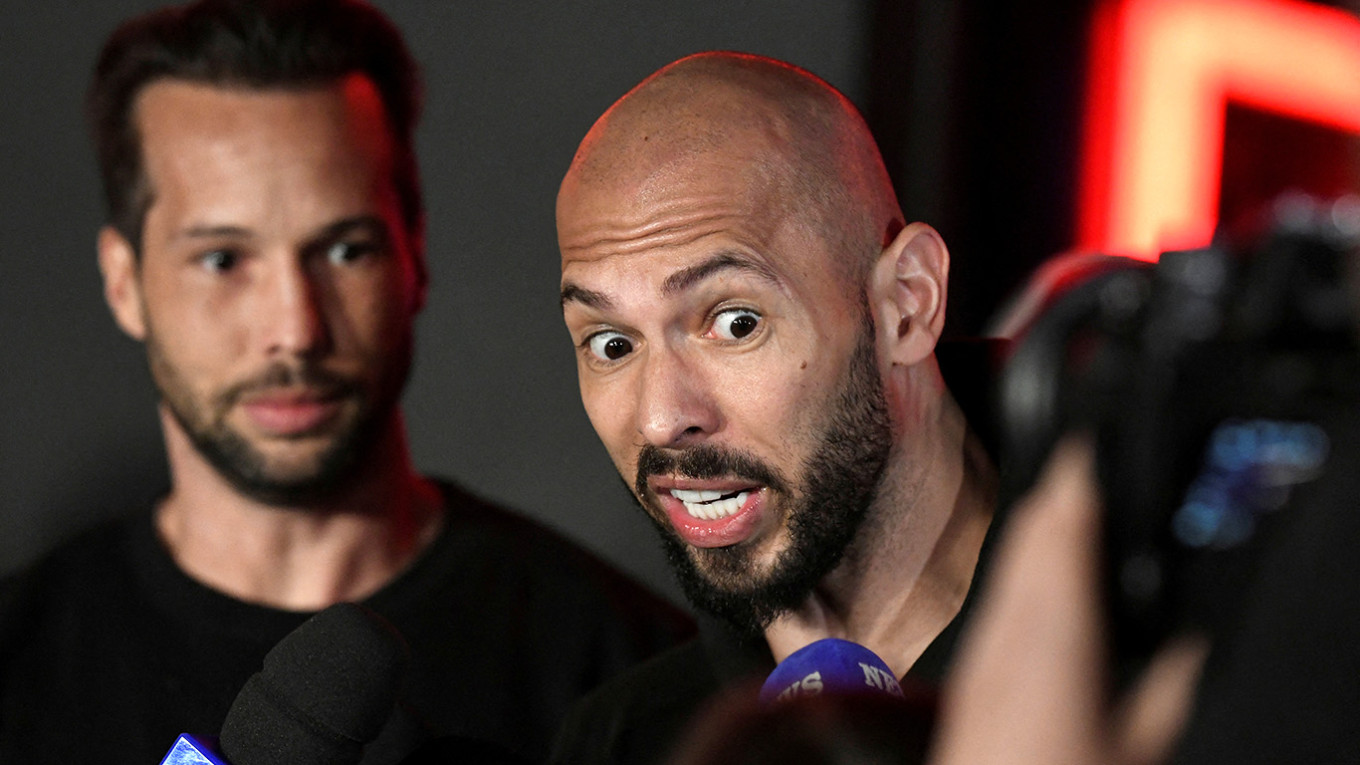
The Manosphere darlings Andrew and Tristan Tate have been a menace on our feeds for years, earning their scandalous reputation over years of hard work spouting misogyny, trafficking women, having close ties with the Romanian mafia through their cage-fighting and webcam businesses, becoming the faces of modern-day social media misogyny, including being charged with human trafficking.
They could now add another charge to their roster of infamy. In late August, Alicia Kearns, the British Conservative MP and former chair of the Foreign Affairs Select Committee, referred both brothers to Counter Terrorism Policing. The trigger was a forty-minute video the Tates published themselves, documenting a June trip to Russia in which the two rode a Soviet tank, threw grenades and fired a flamethrower on a military range. The question is whether they were required to register under the Foreign Influence Registration Scheme, the disclosure regime created by the National Security Act, under which failing to declare that you are acting for a specified foreign power carries up to five years.
No evidence has been produced that the brothers were paid or directed by Moscow. Their representative says the visit was "private and personal," that they received nothing from the Russian state and deliberately stayed away from the St Petersburg forum that many people assume they visited.
But the possibility of these men acting in the Kremlin’s interests is part of a larger pattern. Rather like the looksmaxxing influencer Braden Eric Peters — better known online as Clavicular, they are a fantastic hotbed of propaganda darlings for the Kremlin due to their large audience reach and their simple needs and wants in return for posting content: money, attention and women.
The Tate brothers epitomize the evolution of how the Manosphere has become useful to the Kremlin. It begins with a popular figure spouting seemingly innocuous Kremlin talking points. In a re-upload of an old interview, Andrew would argue the familiar line that NATO has always encroached on Russia following the collapse of the U.S.S.R. and the loss of Central European countries as the buffer states, adding: "when all these countries that were previously U.S.S.R. now now all join the EU, all join NATO, all put in anti-missile systems along their borders [...] we're the aggressive ones." One could only wonder if such discourse would go down well in the presence of his many Romanian friends.
What about his brother, Tristan? He has been doing much the same work, although largely overshadowed by the older Tate. In 2024, Dmitry Medvedev, ex-president of Russia and now a hawk reduced to barking like a rabies patient from his seat on the Security Council, posted that Russia could retaliate against NATO missiles with weapons of mass destruction aimed at Kyiv and NATO facilities, and that this meant World War III. Tristan replied: "We are relying on Russia to save the world." Other narratives spread by the brothers include Russia being a manufactured boogeyman held to account for the crimes of a U.S.S.R. that no longer exists, puzzlement over why Poland should be frightened of it, and, by February 2026, the position that Ukraine must join NATO because Russia would never attack NATO, which rather concedes what happens to countries outside it.
Then the double standard. In a 2023 interview, Andrew recalls his father's bafflement at the Taliban's refusal to be beaten by America: they didn't want pride flags; they wanted to be left alone to be their own people. Tate considers Russia part of that same tradition of resisting outside influence without appearing to notice that the argument works just as well one country to the west. Ukraine also wants to be left alone by Russia, and to be its own people too, but is denied the privilege of being an individual subject. You find the same asymmetry in almost every proponent of these talking points. When Russia resists NATO and the EU, it is because it wants to pursue its own path. When Ukraine resists Russia, there must be someone pulling the strings behind the scenes. As Andrew himself puts it: "so what is [war] for if its not for money and power?"
That’s a fair question, and one he could have answered had he read about how the men surrounding the Kremlin have profited from the war. Despite sanctions, Russian billionaires' combined wealth hit a record $696.5 billion in April 2026, an 11% rise in a year. The state has spent the war nationalizing some 200 companies for reasons ranging from their foreign ownership to the pretext that their 1990s privatization was improper. So: a fundamental double standard. Maybe one of the reasons why the war has persisted into its fifth year is simple to understand: profit.
Next, the influencer undertakes something akin to a christening: a pilgrimage to the Third Rome. In June, the brothers, frozen out of every decent public event in the West, flew to Moscow and were met at the airport by an ensemble of performers, one of the women offering them bread and salt, which Andrew chewed with his mouth open.
No alpha male trip, in which the men took selfies in Red Square and drank cocktails at a rooftop bar, would be complete without cosplaying as soldiers. While still a far cry from their father, Emory Tate, who wore a uniform for a living in the United States Air Force, the two enjoyed a day at the Russian equivalent of Six Flags, riding a T-80BV tank, throwing grenades from a trench and firing a flamethrower on a range in camouflage and Russian flag patches, while the officer running the course joked that whoever finished fastest would get a special medal from the Russian defense minister. Naturally, no propaganda trip is complete without Katyusha, much to our ears' regret.
Then comes the reckoning. The strong hand of the law quickly turned the Tates into simple, meek "betas" like the rest of us, as the brothers admitted in court that the Andrew and Tristan we see on our screens are mere characters. Their properties and luxury cars? Rentals. How surprising and disappointing!
But whatever characters their lawyers now say they were playing, the state has the bigger stick and always did. Instead of sitting in a Miami jail cell because of a tank ride, the brothers are there awaiting extradition on charges brought by women.
Where is Russia in all this? The Russia that met them at the airport with bread and salt? Nowhere to be found, just after Tenet Media, when the Justice Department alleged RT had funnelled nearly $10 million through shell companies to a Nashville firm paying American influencers to make videos, without telling them or their audiences where the money came from. The two RT employees indicted are now safely in Moscow. The company folded. And the influencers who suffered the reputational damage? They are picking up the pieces, as they should.
We've come in many ways to misunderstand the importance of free speech in a unilateral, absolutist manner. Many in Europe who, sometimes rightfully, point to more frivolous cases of prosecutions over social media posts, shiver at the mere mention of a return to a time when the UK government legally penalized pessimism, despair, and anti-war sentiment under the Emergency Powers (Defence) Act 1939.
The arrest of the brothers has earned a similar response from their supporters, who have argued that the earlier dismissals of trafficking charges in Romania prove that the brothers were innocent, and their referral to counter-terror investigators was merely another way to suppress their freedom to express their truth.
So I asked someone who lives inside that jurisdiction. Imogen Payter heads UK Friends of Ukraine and works across party lines. Saying NATO bears responsibility for the invasion is not in itself a criminal act, she told me. What moves something across that line is coordination with, direction from, funding by or material benefit from a hostile state. Which is why she thinks this story is worth watching. "The issue being raised isn't simply that they have expressed views sympathetic to Russia," she said, but the combination of the statements, the visit, the military-style activities and the unanswered question of the Russian state's involvement. "I certainly agree that the Tate brothers need investigating."
The ground has been moving for months. On July 8, the National Security (State Threats) Act became law, letting the Home Secretary designate bodies engaged in foreign power threat activity, modelled on terrorism proscription, with sentences of up to fourteen years. Days after Kearns wrote her letter, Germany blamed Russia for the 4 August drone attack at Leipzig/Halle Airport, closed Moscow's last consulate general in the country and evicted the Russian House from Berlin. Britain lined up behind Berlin.
Payter reads it the same way: not a government preparing to criminalize pro-Russian opinions, but "a growing recognition that Russia's information warfare is part of a broader campaign against European security."
This is new. For years the British instinct on all of this was a sort of tired shrug: unpleasant, yes, but people are allowed to be wrong in public, especially as the alternative looks worse. What has changed is not the tolerance for opinion, but the willingness to ask what sits underneath it.
That shift has a cost, and the people warning about it are not the Tates' defenders. Because material benefit includes information, Index on Censorship warned that journalists may not interview members of proscribed groups for legitimate purposes for fear of falling foul of the law. Independent reviewers of terrorism legislation said the same of foreign correspondents and NGO workers.
Which brings us to what I suspect the brothers failed to understand about the video they made themselves. The tank isn’t the problem. You can pay to ride a tank, and there are even places in Britain for exactly that. But it is unlikely that the full package, complete with jokes about medals from the defense minister, is something you can buy. And that access, unlike opinion, is precisely what this legislation was written to make visible.
None of which means charges. An intelligence journalist put it to me privately that the authorities have more obvious material to work with: the sex and trafficking charges. Whether the brothers did anything that violated Ukrainian sovereignty and international law is yet to be determined.
But the strongest defense against Russian influence, as Payter puts it, isn't censorship. It is transparency, scrutiny and making sure that people acting on behalf of hostile states cannot pass it off as ordinary political campaigning.
A Message from The Moscow Times:
Dear readers,
We are facing unprecedented challenges. Russia's Prosecutor General's Office has designated The Moscow Times as an "undesirable" organization, criminalizing our work and putting our staff at risk of prosecution. This follows our earlier unjust labeling as a "foreign agent."
These actions are direct attempts to silence independent journalism in Russia. The authorities claim our work "discredits the decisions of the Russian leadership." We see things differently: we strive to provide accurate, unbiased reporting on Russia.
We, the journalists of The Moscow Times, refuse to be silenced. But to continue our work, we need your help.
Your support, no matter how small, makes a world of difference. If you can, please support us monthly starting from just $2. It's quick to set up, and every contribution makes a significant impact.
By supporting The Moscow Times, you're defending open, independent journalism in the face of repression. Thank you for standing with us.

Remind me later.