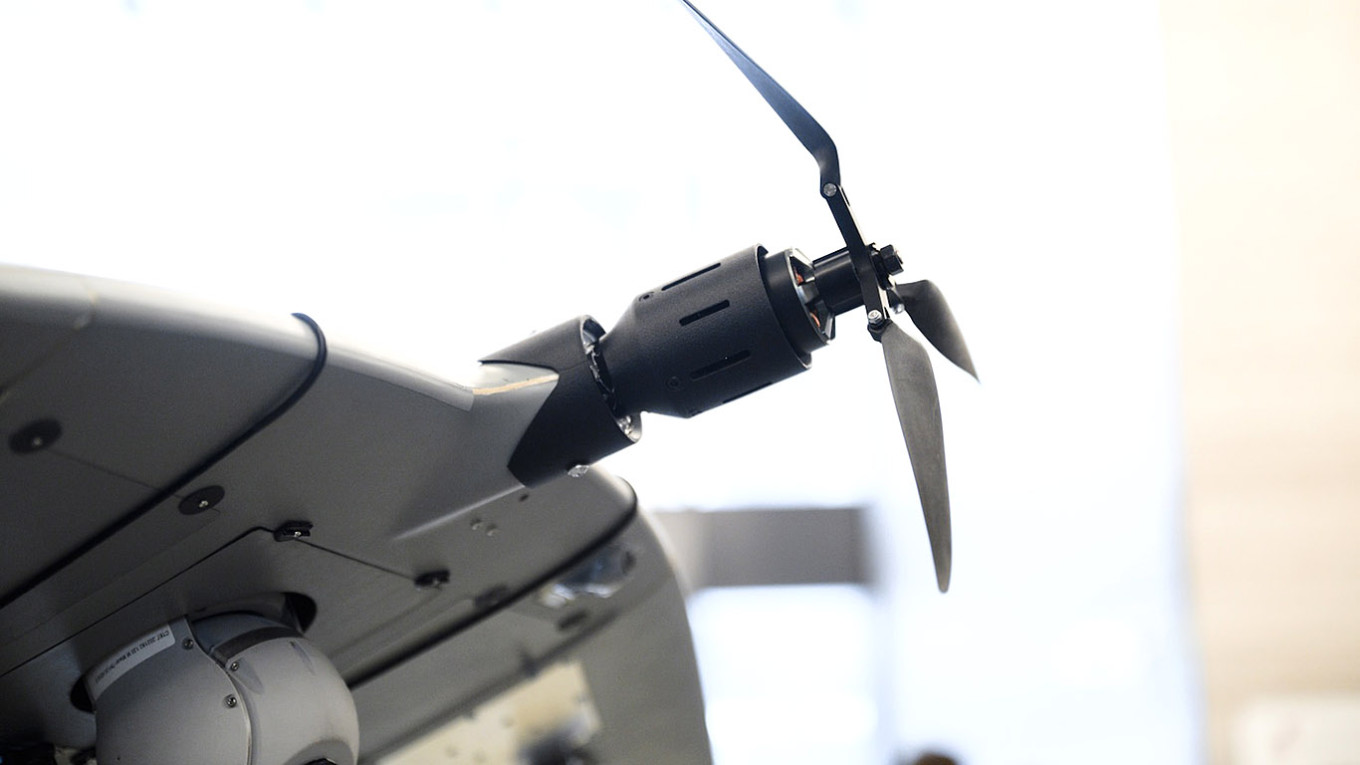
On July 6 in Zaporozhzhia, a drone with no connection to its original operator determined targets on its own and delivered a lethal payload, killing three civilians. The incident may be the first case of Russia deploying a drone that could target and detonate based entirely on determinations made by an onboard AI.
Russia has crossed this threshold in autonomous weaponry despite its position as a laggard in frontier models. By investing heavily in more narrow use cases than the generalized models that dominate headlines, Russia is carving out a niche as a leader in applying machine learning to acts of war.
Putin understood early on the importance of artificial intelligence, declaring in 2017 that “whoever leads in AI will rule the world.” He poured billions into the development of Russian AI, built partnerships between state institutions and tech firms and hosted international conferences.
But Russia’s foreign policy undermined the drive for AI leadership at every turn. The invasion of Crimea cut Russian academics off from the international community just as the AI revolution was beginning, and the full-scale invasion sent tech talent fleeing months before the launch of ChatGPT-3 set off the chatbot boom. Russia never came close to China or the United States in its ability to release the powerful language models that have become nearly synonymous with AI, with firms like Yandex relying on retrained versions of Alibaba’s Qwen and Sber’s GigaChat, Russia’s only foundational model, years behind the leaders in the sector.
Instead of competing on language models, Russia has focused extensively on how smaller, less generalized models can be applied to the battlefield. The result was an intense focus on Convolutional Neural Networks (CNNs), a form of machine learning that breaks images into constituent features and, after millions of examples, can classify the patterns. GosNIIAS, the State Research Institute for Aviation Systems, launched Platform-GNS in 2023, a system for simplifying the training of CNNs, and made the system freely available to any qualifying enterprise within the Russian defense-industrial base. GosNIIAS supplemented the training platform with an extensive dataset of battlefield and target imagery that partners can use as training sets for their models. Freely sharing the foundations for model training creates a broad ecosystem for attempting new approaches to battlefield challenges.
Complementing the public-private partnership between GosNIIAS and drone makers, developers on the Habr forum publicly shared tutorials and guidelines for training CNNs for military and military-adjacent use cases. The field coalesced around an approach called You Only Look Once (YOLO), which is able to analyze the entirety of an image at once rather than feature-by-feature, yielding far more efficient training and classification. YOLO is freely available as a Python library and has been a favorite for detecting images in video since its launch in 2015. One Habr post shows how YOLO can make battlefield determinations based on under 20,000 images. These optimized image detection models require only a fraction of the power and memory to execute as CNNs, which in turn required only a fraction of the power and memory of language models.
To make any of that useful on the battlefield, however, the models needed to fit within the constraints of lightweight drones already constrained by the demands of power and computation for flying and maneuvering. The larger the model, the more power required and the more weight the drone must bear. The more power, the more heat generated and the more space and weight needed still. Russia has applied several engineering approaches to reduce the power and heat needed, such as activating the models only in the terminal stage of the flight and finding the appropriate balance between model compression and accuracy. But sufficiently efficient chips solve the constraints by executing more computational processes and holding more memory while requiring less power to do so.
At the time of writing, NVIDIA’s Jetson Orin Nano is the only chip with the required performance numbers and was the chip found in the drones in Zaporozhzhia. The United States, along with most Western countries, banned the sale of powerful chips to Russia shortly after the full-scale invasion. But Russia quickly found alternative imports. NVIDIA chips are readily available on secondary markets in Singapore, and a report by Kateryna Bondar at CSIS revealed that the majority of electronic components used in Russian drones are of Western origin. Russia blends these Western devices with ones from China, like the Leetop A603 motherboard used on the Zaporozhzhia drone. China’s chips are rapidly catching up as well, with the Beijing-based manufacturer Cambricon expected to produce chips on par with Jetson Orin Nano within the next one to two years.
The progress by Russian drone makers, researchers and developers on Habr all point to a far expanded use of fully autonomous lethal weaponry as the war progresses. The models will continue to advance both in accuracy and efficiency as they have over the past few years. The chips needed to mount the models will become more energy efficient, more performant and hold more memory. Soon, they will be developed by a Russian partner. Russia has little prospect of catching up on large language models. But in applying AI to lethal means, the Russian tech community is already changing the nature of the war.
A Message from The Moscow Times:
Dear readers,
We are facing unprecedented challenges. Russia's Prosecutor General's Office has designated The Moscow Times as an "undesirable" organization, criminalizing our work and putting our staff at risk of prosecution. This follows our earlier unjust labeling as a "foreign agent."
These actions are direct attempts to silence independent journalism in Russia. The authorities claim our work "discredits the decisions of the Russian leadership." We see things differently: we strive to provide accurate, unbiased reporting on Russia.
We, the journalists of The Moscow Times, refuse to be silenced. But to continue our work, we need your help.
Your support, no matter how small, makes a world of difference. If you can, please support us monthly starting from just $2. It's quick to set up, and every contribution makes a significant impact.
By supporting The Moscow Times, you're defending open, independent journalism in the face of repression. Thank you for standing with us.

Remind me later.