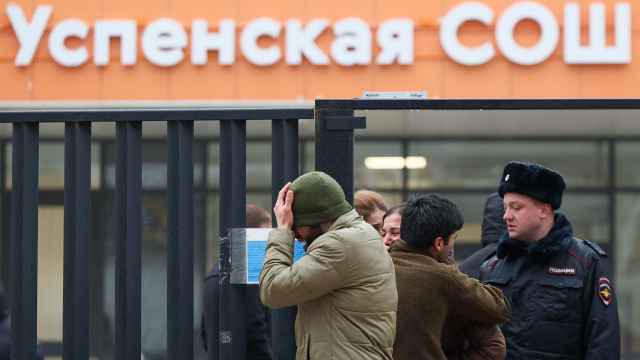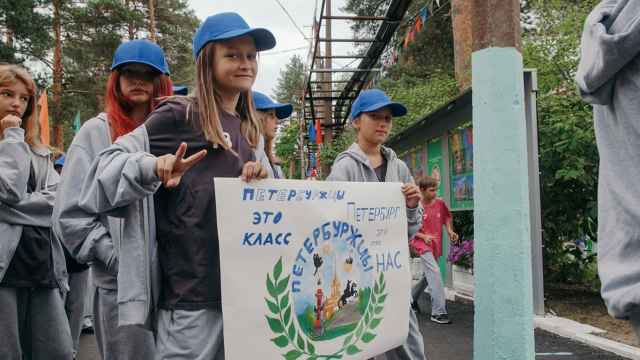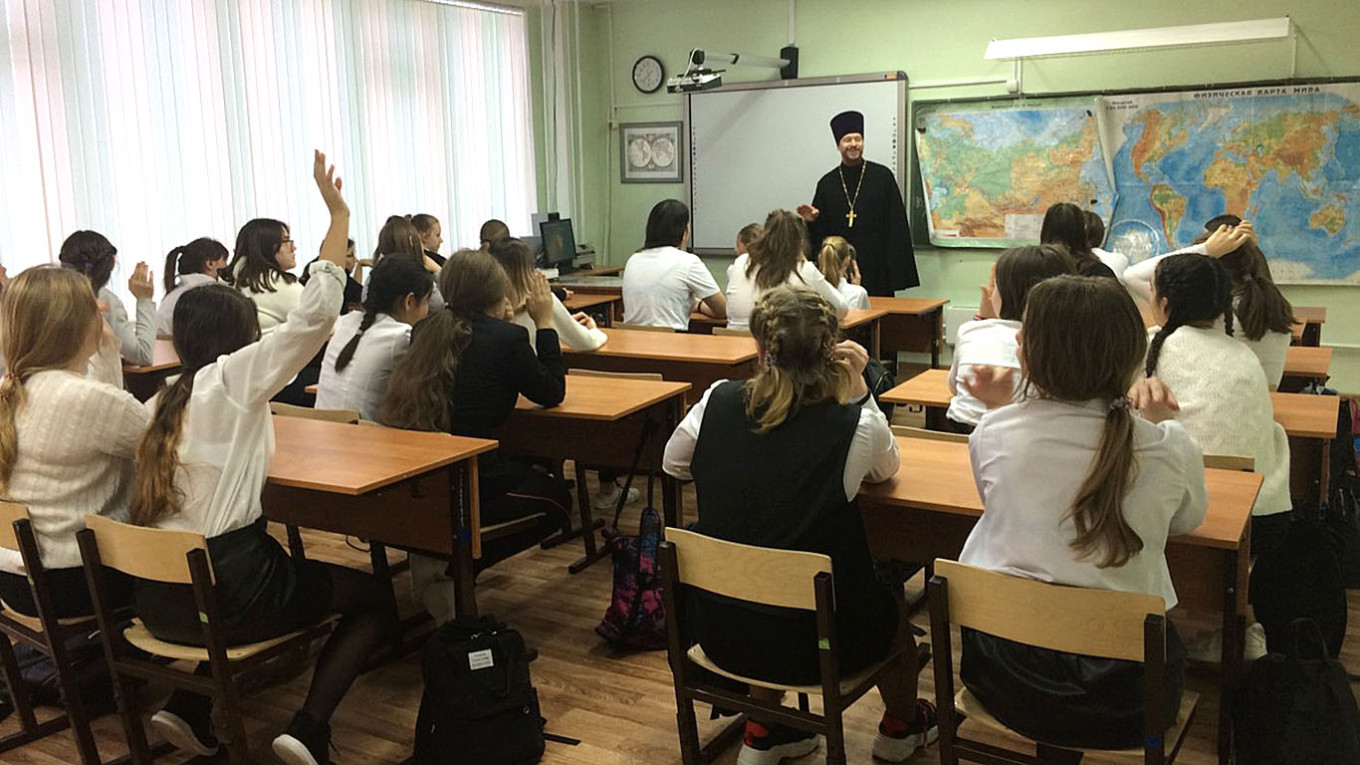
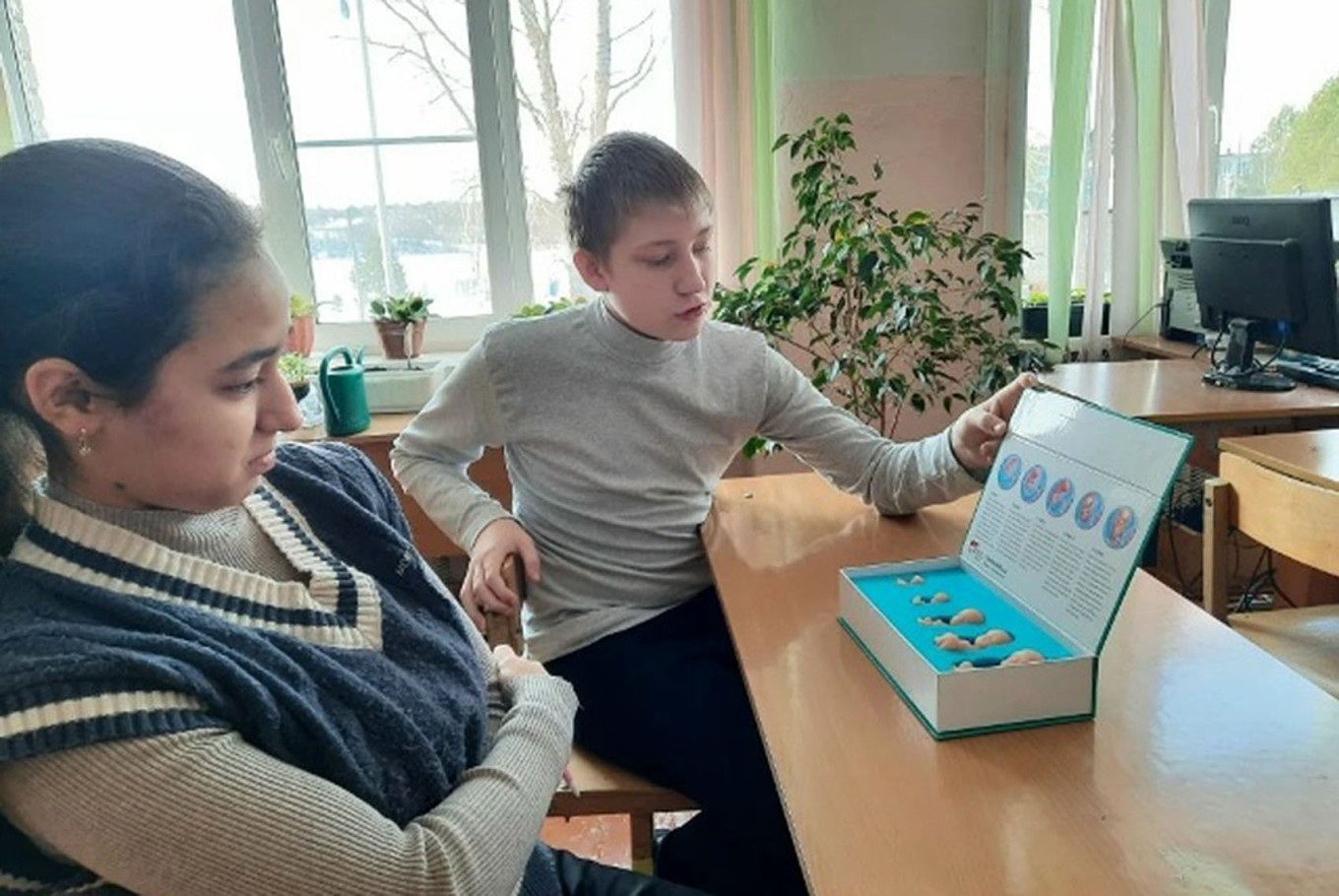
At a rural school in Russia’s Tver region this March, a class of ninth-grade students examined models of fetuses during a lesson.
“Future adults have come to understand a woman’s responsibility toward the life of an unborn child,” the school administration wrote of the lesson. “This is the period that determines whether a small human being will live a full life or die forever.”
This class was a so-called “chastity lesson,” part of a growing nationwide campaign that brings Orthodox priests into classrooms to promote abstinence before marriage, discourage abortion and reinforce what Russian authorities describe as traditional family values.
The campaign comes as Russia grapples with a deepening demographic crisis. Earlier this year, the country’s fertility rate fell to its lowest level in two decades.
“Priests have always been present in schools, but over the past three years we’ve seen a systematic presence in Family Studies and Fundamentals of Orthodox Culture classes,” Marianna Muravyeva, a professor at the Finnish Center for Russian and East European Studies who specializes in gender studies, told The Moscow Times.
Many of the so-called “chastity lessons” take place as part of Family Studies, the Education Ministry’s new course on family life introduced in 2024.
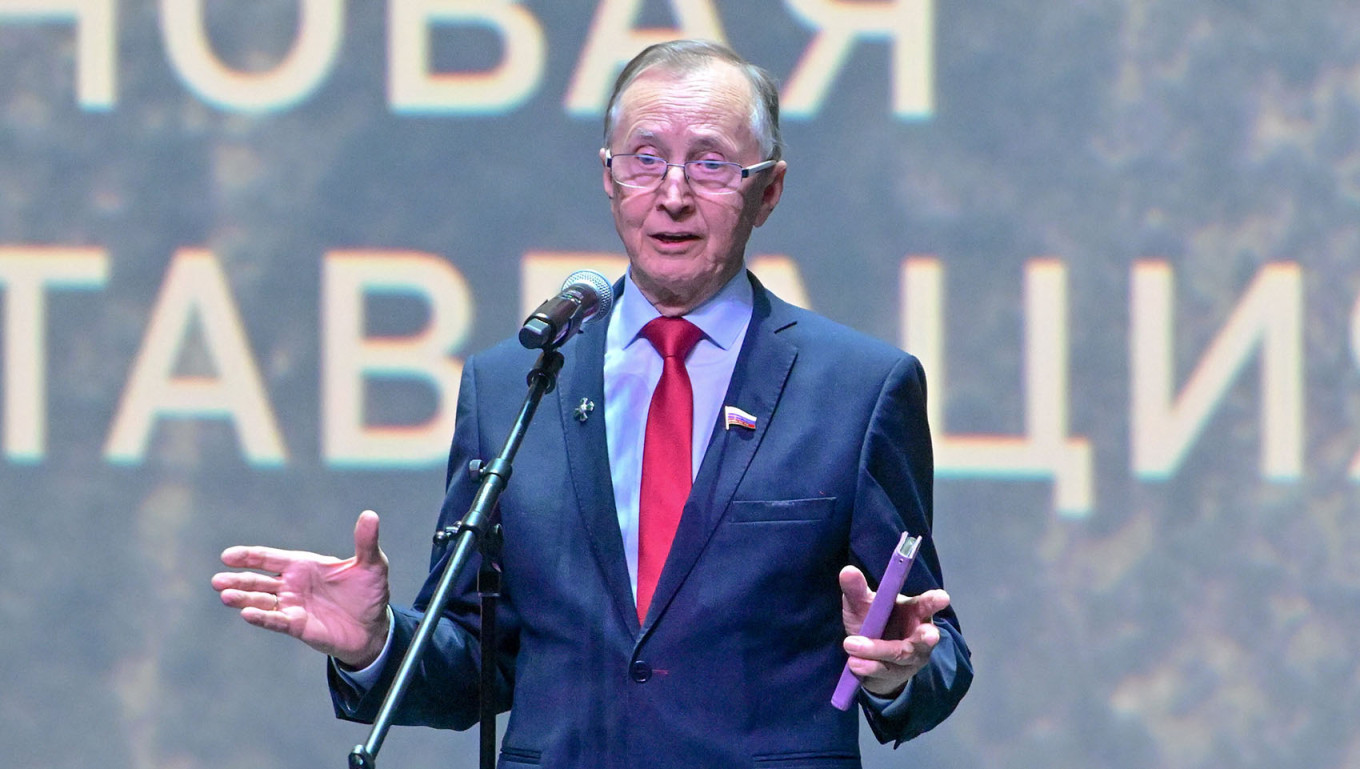
In 2025, when State Duma lawmaker Nikolai Burlyaev proposed making chastity lessons compulsory, Family Studies was taught in 42 Russian regions and the first textbooks were developed.
The subject is due to be rolled out to schools nationwide as an optional extracurricular course in the 2026-27 academic year.
Burlyaev’s proposal drew mixed responses from teachers and parents at the time.
“Soon there won’t be anyone left to teach the core subjects at this kind of pay, but sure, let’s have chastity lessons,” one user, Anna, wrote in a teachers’ group on the VKontakte social media site.
“Teachers should teach subjects, and everything related to family should be taught at home,” teacher Daria replied.
“‘Chastity lessons’ should first be held in the State Duma itself,” said Ivan, a father from the Siberian city of Barnaul.
Russian schools have traditionally covered topics such as human reproduction, anatomy and sexually transmitted diseases in biology and health-related classes rather than through a comprehensive sex education curriculum.
The newer Family Studies course instead emphasizes marriage, parenthood and traditional family roles.
Some church officials have proposed taking the campaign beyond the classroom. Archpriest Igor Aksenov has suggested producing chastity-themed merch, including T-shirts with slogans like “I’m waiting” and “Chaste until marriage,” that could appeal to teenagers.
‘What should a strong family life be built on — chastity or passion?’
The “chastity lessons” mainly target students in grades 9 through 11.
The Russian Orthodox Church says spiritual and moral education should provide an alternative to what it calls the “hedonistic values that dominate society.” As a result, classes often contrast Christian marriage with cohabitation, which is commonly referred to in Russia as a “civil marriage.”
At a school in the Tver region town of Staritsa earlier this year, 10th-graders were asked: “What should a strong family life be built on — chastity or passion?”
Students walked to the front of the classroom and cast their votes on a board divided into two columns, one for each choice. Photos of the vote were later published on the school’s official VKontakte page.
Muravyeva said such lessons are especially common in central Russian regions like Voronezh, Bryansk, Vladimir, Yaroslavl and Kostroma. The latter two regions have offered the elective course Fundamentals of Orthodox Culture since the 2010s.
“You won’t see this many lessons with priests in Siberia, Udmurtia or Buryatia,” as the Russian Orthodox Church plays a less prominent role in schools there, Muravyeva said.
The classes have nevertheless spread to some of Russia’s ethnic republics. At a school in Kyzyl, the capital of the Siberian republic of Tyva, Antony Dulevich, a representative of the local Orthodox diocese, led a lesson titled, “Is Intimacy Before Marriage Acceptable?”
Dulevich heads the diocese’s youth outreach department, a role often held by priests who visit schools, Muravyeva said.
He has publicly claimed that around 1 million embryos die from abortion in Russia every year, though state statistics agency Rosstat has recorded roughly half a million abortions annually in recent years.
‘No other way to convey the truth’
In late 2024, a school in the Sakhalin region showed students graphic footage of surgical abortions, with the clergy arguing that such videos were “necessary” despite their potential to distress young viewers.
“I show [the children] what different types of abortions look like and what their consequences are. This information may be shocking, but there’s no other way to convey the truth,” archpriest Yevgeny Klementyev told the Journal of the Moscow Patriarchate.
Klementyev, who serves in the Saratov diocese, also leads sessions of Important Conversations, the state-sponsored classroom program introduced after the full-scale invasion of Ukraine.
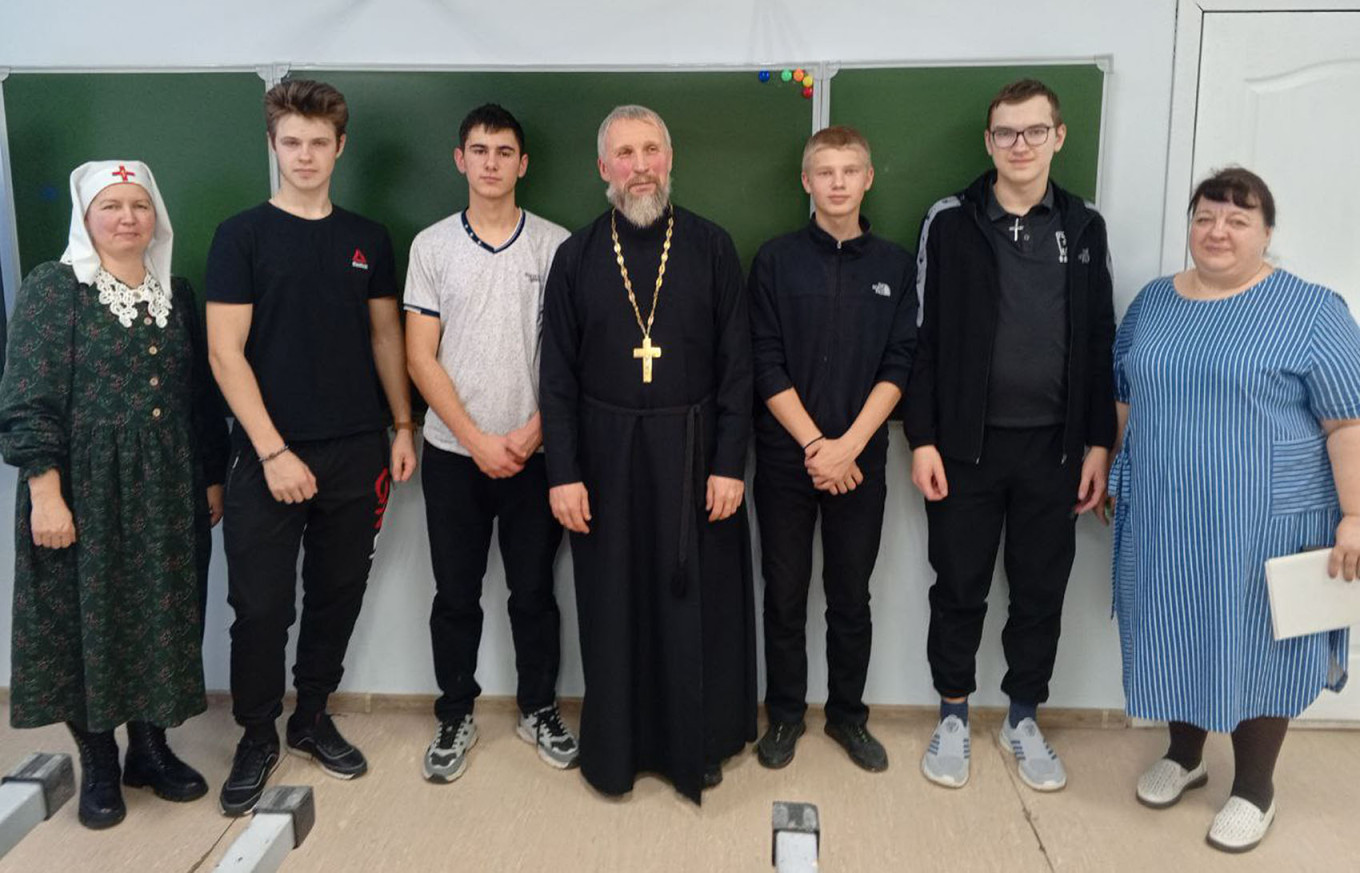
Priests sometimes hold morality lessons for teachers as well. This spring, archpriest Nikolai Arkhangelsky led a seminar in the Volga city of Ulyanovsk on “Current Issues in the Spiritual and Moral Upbringing of Children and Youth.”
He urged teachers to discuss the importance of the Bible and the unacceptability of abortion with students.
“A baby’s life must be a priority — it must be protected,” Arkhangelsky told the teachers. “The family is a small church. If the family collapses, states will fall too.”
‘Changing abortion-related attitudes in Russian society’
Alongside fetal models and presentations featuring images of embryos, priests also screen films promoting anti-abortion messages and traditional family values.
During a school break last fall, some students watched “Mama’s Letter,” a film produced by the Orthodox television channel Spas.
The film follows a mother and daughter who become pregnant at the same time and ultimately choose to give birth despite considering abortion. The termination of pregnancy is cast as a moral dilemma that strengthens their relationship.
“Vacuum or medication [abortion] — it’s all the same, and any abortion can lead to complications,” a friend tells the film’s main character.
Spas has said that the film’s goal is to “change abortion-related attitudes in Russian society toward protecting the lives of children before birth,” as well as to influence Russia’s demographic situation and regional abortion policy.
Clergy have also organized discussions of “Playing Family,” another Spas production that echoes the Russian Orthodox Church’s critical stance on cohabitation and premarital sex.
In late 2023, priest Alexei Skrynnik of the Church of the Holy Spirit in Krasnodar led a discussion of the film with tenth-graders at School No. 37.
At the start of the film, television presenter and Spas Director General Boris Korchevnikov reflects on premarital intimacy.
“We lack patience,” he says. “We’re ready to see ‘the one’ even in someone who isn’t. We start making mistakes, rushing, doubting.”
Still, despite reports from local schools about holding such lessons, Muravyeva was skeptical about their impact.
“If you take a religious family, a teenage girl already has a concept of chastity, especially if she attends Sunday school,” she said.
But for a child from an ordinary, not deeply religious family, chastity is unlikely to become a priority despite lessons taught by priests, she said.
“That’s not enough to make a teenage girl suddenly start believing in chastity. It does happen sometimes, but a single lesson with a priest simply isn’t enough, given the information environment that surrounds a teenager today,” she said.
A Message from The Moscow Times:
Dear readers,
We are facing unprecedented challenges. Russia's Prosecutor General's Office has designated The Moscow Times as an "undesirable" organization, criminalizing our work and putting our staff at risk of prosecution. This follows our earlier unjust labeling as a "foreign agent."
These actions are direct attempts to silence independent journalism in Russia. The authorities claim our work "discredits the decisions of the Russian leadership." We see things differently: we strive to provide accurate, unbiased reporting on Russia.
We, the journalists of The Moscow Times, refuse to be silenced. But to continue our work, we need your help.
Your support, no matter how small, makes a world of difference. If you can, please support us monthly starting from just $2. It's quick to set up, and every contribution makes a significant impact.
By supporting The Moscow Times, you're defending open, independent journalism in the face of repression. Thank you for standing with us.

Remind me later.