

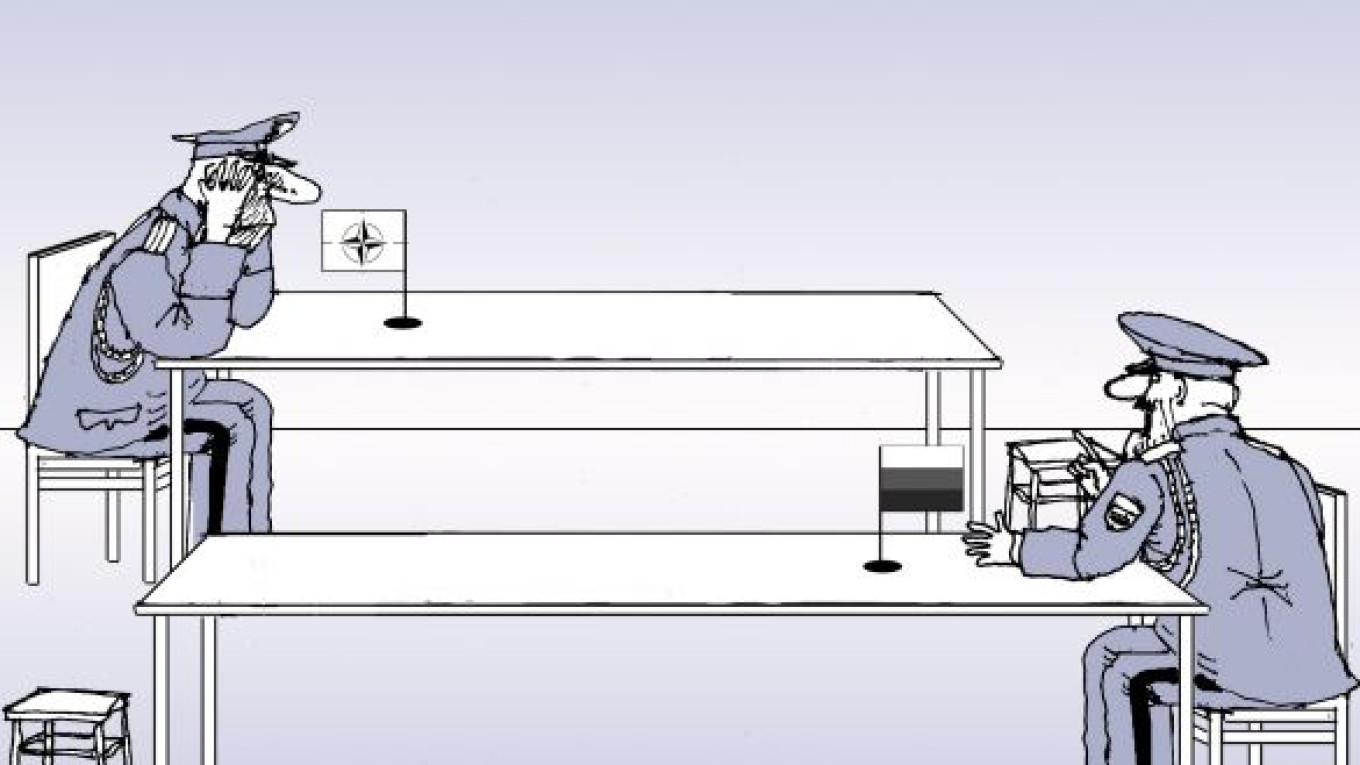
It is often said that young lovers argue for one main reason: to experience the sweet pleasure of making up shortly thereafter. The exact opposite is true in Russian-NATO relations: The only reason they make up is to argue once again shortly thereafter. Indeed, no sooner had the two sides announced a reconciliation last year, they once again reverted to the usual expressions of distrust and resentment.
The source of conflict this time is an idea that was originally intended to prove that NATO-
Russian relations are no longer built upon confrontation: a joint U.S.-Russian or NATO-Russian proposal to develop a pan-European missile defense system. The problem, of course, is that the Kremlin’s proposal for a “sectoral missile defense” is a nonstarter. According to this plan, NATO would be responsible for defending against Russian-bound missiles that travel over its territory, and Russia would be responsible for NATO-bound missiles that travel over its territory.
The biggest problem with the sectoral idea is that NATO has little faith in the ability of Russia?€™s missile defense system — which is limited to an outdated installation in the Moscow region ?€” to shoot down missiles headed for a NATO member that travel over Russian territory.
The other problem is that the Russian missile defense system is based on fundamentally different principles than the U.S. system. It is designed for a Russian missile to intercept an incoming enemy missile with a nuclear explosion as it arcs through space toward Moscow. What?€™s more, the goal is simply to intercept the first wave of enemy missiles in order to give Russia?€™s leaders an extra 30 minutes to reach safe command centers. The fate of their millions of fellow Muscovites is not the top priority. NATO aims to protect the entire population of all its member states.
In short, NATO?€™s and Russia?€™s missile defense systems are inherently incompatible, and NATO officials have no desire to waste time on pointless negotiations. This is why NATO Secretary General Anders Fogh Rasmussen last week, while addressing Russian journalists (myself among them), said: ?€?The North Atlantic Treaty Organization is responsible for protecting the territory of NATO member states and for the safety of their populations. We do not intend to transfer that responsibility to anyone else.?€? This was Rasmussen?€™s very diplomatic way of saying to the Kremlin, ?€?Thanks, but no thanks,?€? regarding Russia?€™s sectoral idea.
This polite refusal follows what amounted to President Dmitry Medvedev?€™s ultimatum to NATO when he said during a Dec. 24 meeting with Dmitry Rogozin, Russia?€™s envoy to NATO: ?€?We have two options. Either we agree on certain principles with NATO and create a joint [sectoral] system to resolve missile defense tasks, or we fail to reach an agreement, and then we will have to make a number of unpleasant decisions regarding the deployment of offensive nuclear missile installations.?€?
Speaking at this week?€™s security conference in Munich, Foreign Minister Sergei Lavrov outlined the list of Russian complaints. First, NATO plans for a missile defense system are moving in two directions at once ?€” the creation of a system for NATO itself, and only afterward will NATO address the issue of unifying that system with Russia. Second, Lavrov complained that NATO is moving faster with plans for its own missile defense system than it is with talks for the joint system in the framework of the NATO-Russia Council. Moscow is worried that, in the end, it will be invited to join a system that was developed without its participation in a ?€?take it or leave it?€? deal.
Lavrov?€™s second objection is that the third and fourth stages of the U.S. ?€?phased adaptive approach?€? for developing an expansive missile defense system in Europe by 2020 would allegedly undermine Russia?€™s strategic nuclear potential ?€” the only military area that puts Russia on par with the United States. In other words, Russian leaders are worried that the United States could deliver an unexpected nuclear first strike, and that if Moscow were to fire its remaining missiles in retaliation, they would be intercepted by the NATO missile defense system. Russia?€™s top brass has convinced the Kremlin that by 2020, the NATO missile defense system would be able to intercept any Russian nuclear missiles fired at the United States along a North Pole trajectory. According to this theory, NATO will try to hide its ships equipped with Aegis missile defense systems in the Norwegian fjords. Therefore, the argument goes, the Kremlin must convince NATO to sign a legally binding agreement promising not to deploy missile defense systems on any territory over which Russia?€™s nuclear missiles would travel.
This idea takes Russia back to the worst, primitive Cold War years of mutual nuclear deterrence. What is particularly absurd about the Kremlin?€™s overreaction is that the U.S. and NATO system is designed to intercept only medium-range missiles, and not strategic missiles that Russia still claims is so crucial to its national security vis-a-vis NATO and the United States.
The latest cries from Russia over missile defense once again show that the Kremlin is willing to go to absurd extremes to keep alive the imaginary boogeyman from the West.
Alexander Golts is deputy editor of the online newspaper Yezhednevny Zhurnal.
A Message from The Moscow Times:
Dear readers,
We are facing unprecedented challenges. Russia's Prosecutor General's Office has designated The Moscow Times as an "undesirable" organization, criminalizing our work and putting our staff at risk of prosecution. This follows our earlier unjust labeling as a "foreign agent."
These actions are direct attempts to silence independent journalism in Russia. The authorities claim our work "discredits the decisions of the Russian leadership." We see things differently: we strive to provide accurate, unbiased reporting on Russia.
We, the journalists of The Moscow Times, refuse to be silenced. But to continue our work, we need your help.
Your support, no matter how small, makes a world of difference. If you can, please support us monthly starting from just $2. It's quick to set up, and every contribution makes a significant impact.
By supporting The Moscow Times, you're defending open, independent journalism in the face of repression. Thank you for standing with us.

Remind me later.