

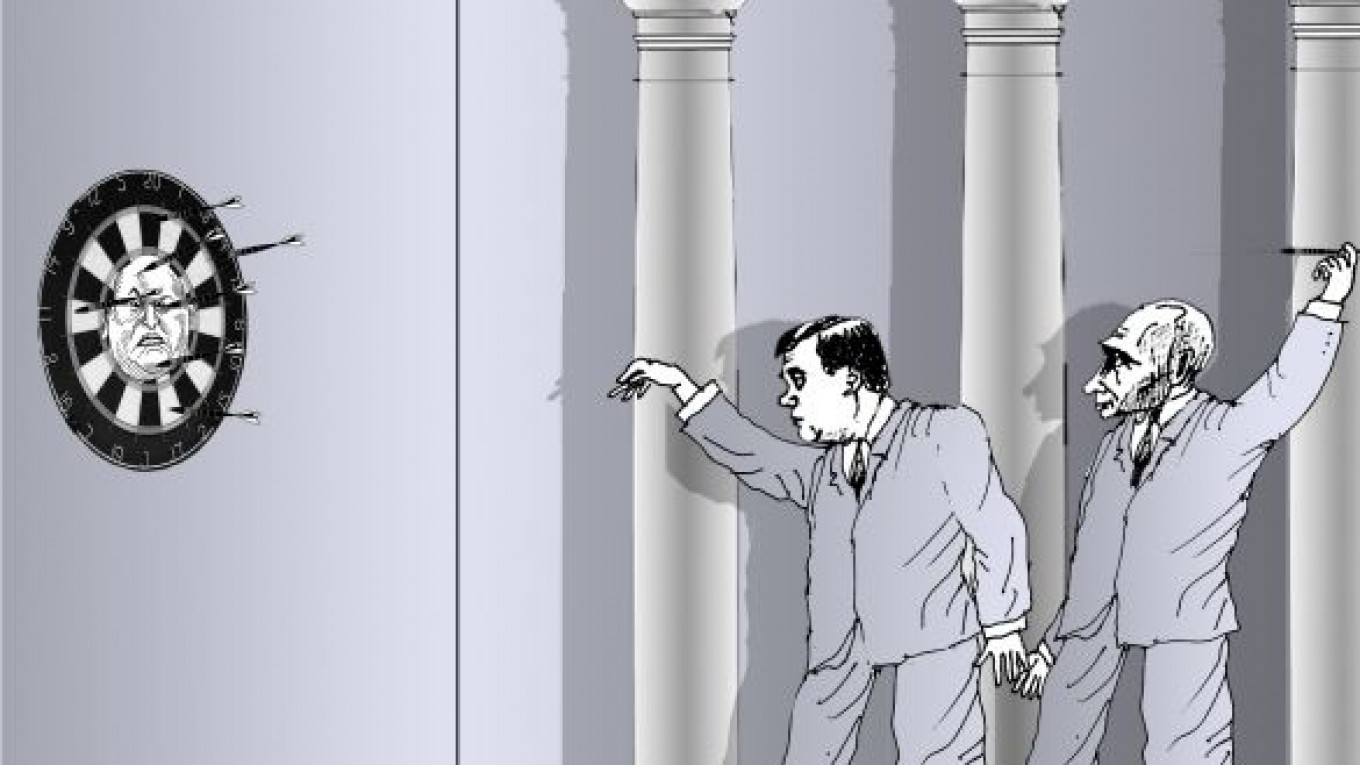
Most of the commentary regarding the firing of Yury Luzhkov can be summed up as, “The jackals have eaten one of their own.” Unfortunately, that conclusion is based on a large misconception. In fact, President Dmitry Medvedev and Prime Minister Vladimir Putin have always been at odds with Luzhkov.
Throughout the 10 years that Putin has been in power, Putin’s regime has done nothing but imitate real government. Russia has imitation elections, an imitation multiparty system, an imitation parliament, imitation political opposition and imitation press freedoms. There is one more sham you can add to the list: the 10-year “good relationship” between Putin and Luzhkov. Luzhkov pretended to be loyal and devoted to Putin, and Putin feigned a reserved respect for Luzhkov.
Luzhkov was indeed the archetype of the numerous former Soviet technocrats who became ministers, governors, mayors and directors of countless enterprises in the early 1990s. They were required to be not so much fiery orators for democracy as skilled specialists who could ensure that homes continued to receive heating during the winter, garbage was collected regularly and the metro kept running. Putin stuck with Luzhkov, however reluctantly, because he wasn’t sure that he could find someone from his team who could have filled Luzhkov’s shoes and run a city the size and complexity of Moscow.
But beneath the surface, there was a fierce hatred between them.
Luzhkov has had a chip on his shoulder ever since Putin in 1999 prevented him from rising to the new political heights. Shortly thereafter, Luzhkov was pressured to give up the Fatherland-All Russia party, which he co-founded, and merge it with the pro-Putin party Unity to form United Russia in 2001.? In addition, Luzhkov sharply disapproved of Putin’s decision in September 2004 that deprived Luzhkov of the right to be re-elected by Muscovites. Luzhkov, who was elected mayor by 95 percent of the vote in 1996, 69.9 percent in 1999 and 75 percent in 2003, knew he would be re-elected by a large margin in a direct election a fourth time in 2007. He resented that his popular mandate was taken away by Putin, and he didn’t want to be seen as another Putin lackey appointed from above.
For his part, Putin hates Luzhkov for his mishandling of national emergencies that occurred in Moscow, from the Dubrovka theater siege to a blackout that shut down more than half the city. Putin also deeply resents and regrets the fact that he was all but “forced” to appoint Luzhkov to a fourth term in 2007 because he had no alternatives.
Today, few remember that Luzhkov was also a thorn in the side of President Boris Yeltsin and his close associates during the first half of the 1990s, when Luzhkov had only just gained popularity in Moscow. Yeltsin sensed that Luzhkov was potentially his most dangerous competitor. Several attempts were made to force the mayor to resign. According to one theory, the March 1995 murder of popular television anchor Vladislav Listyev was allegedly a conspiracy to pin the killing on Luzhkov. At Listyev’s funeral, Yeltsin unexpectedly blamed his death on the Moscow authorities whom, he said, allowed gangs of hired assassins to roam freely in the capital.
The long-running feud ended years later when Yeltsin had become so weakened politically that he seemed unable to find a loyal successor, and an emboldened Luzhkov began boasting that he could easily become the country's next president or prime minister. But at the last moment, Putin popped up from out of nowhere, joined the election campaign and steadily gained five to 10 percentage points per week in the ratings until he finally left no chance at all for Luzhkov.
Characteristically, many commentators and bloggers who strongly criticized Luzhkov for his authoritarian leadership style, his overt cronyism, his bad taste in architecture, his heartless attitude toward old Moscow and the bureaucracy and corruption that ran rampant in the capital under his rule. These same people are now ready to pity the city boss for getting canned so unfairly and amid such a dirty smear campaign against him.
Contrary to many popular theories, it seems to me that there is no serious schism between Medvedev and Putin.? This is an expected struggle between the two leaders’ staffs — something that almost always occurs in a country with two centers of power. The members of the ruling tandem are living in perfect harmony, and the elite have no desire to make changes to the diarchy so soon after it has become firmly established. Putin is both prime minister and leader of United Russia, which has a majority of seats in the State Duma and the Federation Council. He enjoys his powers, the constant attention from the media and his consistently high ratings. Putin was convinced that this was the right time to finally put Moscow’s affairs in order after years of Luzhkov ruling Moscow like a king. Putin knew all too well that he who controls Moscow controls Russia.
The Luzhkov affair was just another “corporate takeover” in an entire series of similar Putin-orchestrated operations, including gaining control of Gazprom, three national television stations, the railways and Yukos, as well as consolidating aircraft and ship manufacturing under state unitary companies.
In this light, this was a clear win for Putin, and he is surely enjoying the victory. The only thing that could possibly rain on Putin’s parade is a sharp drop in oil prices.
Yevgeny Kiselyov is a political analyst and hosts a political talk show on Inter television in Ukraine.
A Message from The Moscow Times:
Dear readers,
We are facing unprecedented challenges. Russia's Prosecutor General's Office has designated The Moscow Times as an "undesirable" organization, criminalizing our work and putting our staff at risk of prosecution. This follows our earlier unjust labeling as a "foreign agent."
These actions are direct attempts to silence independent journalism in Russia. The authorities claim our work "discredits the decisions of the Russian leadership." We see things differently: we strive to provide accurate, unbiased reporting on Russia.
We, the journalists of The Moscow Times, refuse to be silenced. But to continue our work, we need your help.
Your support, no matter how small, makes a world of difference. If you can, please support us monthly starting from just $2. It's quick to set up, and every contribution makes a significant impact.
By supporting The Moscow Times, you're defending open, independent journalism in the face of repression. Thank you for standing with us.

Remind me later.