

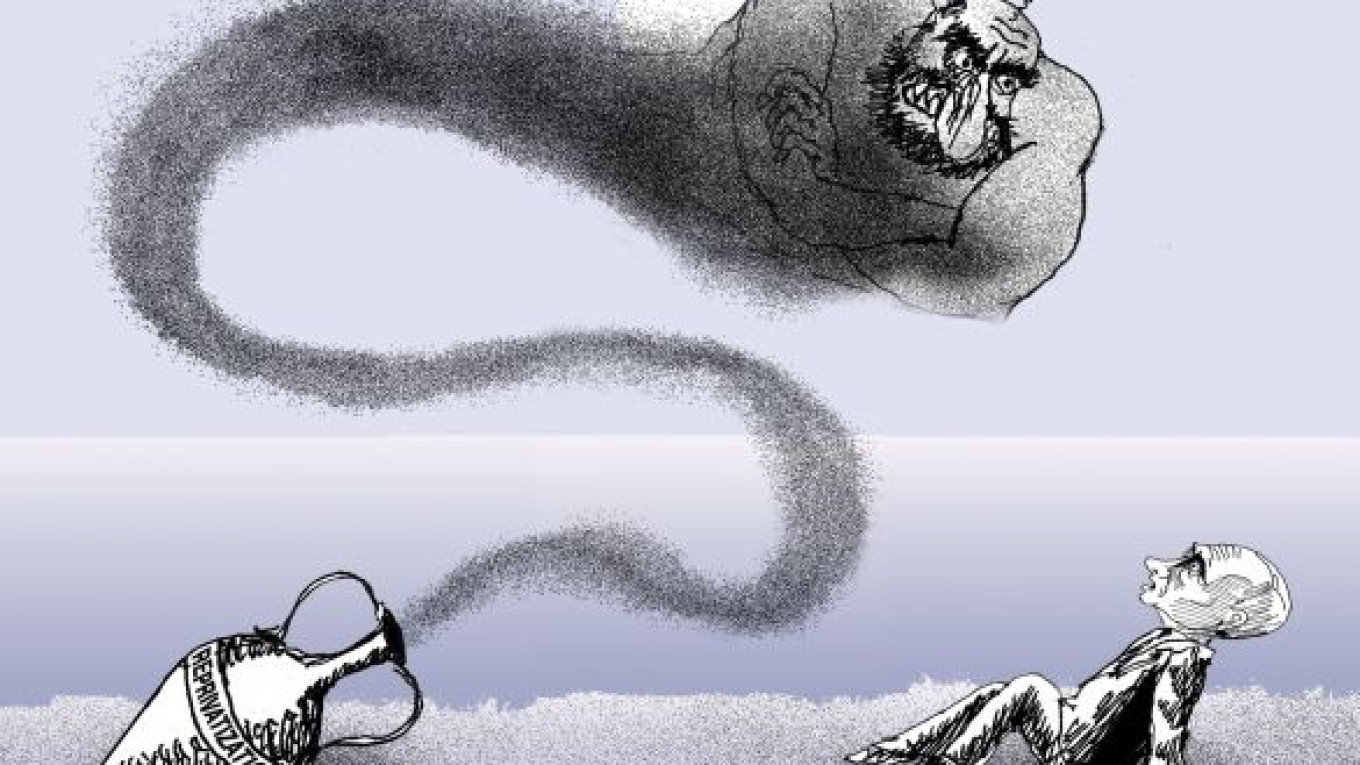
For years, Vladimir Putin has appealed to his electorate with stability and predictability. But on Feb. 9, he questioned the legitimacy of property rights in the country. At a meeting with the Russian Union of Industrialists and Entrepreneurs, Putin said Russia needs to resolve the problems of the dishonest and unfair privatizations from the 1990s. He suggested that those who acquired large assets in questionable deals in the 1990s should be taxed to bring at least partial justice to Russia's era of "bandit capitalism."
Ironically, Putin campaigns against Ukraine’s Orange Revolution of 2004, but its worst mistake was to raise the specter of “reprivatization” - that is, forcing the beneficiaries of a few of the biggest privileged privatizations to pay up or face renationalization. Now Putin has raised this topic in Russia. He would be wise to learn from Ukraine's failed attempt to revise previous privatizations.After the Orange coalition had been formed, reprivatization dominated public discussion for the first half of 2005. It had three devastating effects. First, this discussion absorbed the whole political agenda. How many enterprises should be reprivatized, a dozen or 5,000? Should they be nationalized or the owners be forced to pay up? How should penalties be assessed? Should the process be administrative, legislative or judicial? There were no good answers. After half a year, the government fell apart. Only one big company, the steelworks Kryvorizhstal, was reprivatized while little else was accomplished.
Second, investment and production plummeted, although the global economy was booming. Ukraine went from double-digit growth in October 2004 to falling production in summer 2005. As soon as reprivatization was dismissed in September 2005, economic growth returned, showing the negative impact of the reprivatization discussion.
The third effect was sharp divisions in the business elite. Oligarchs close to the new rulers hoped to seize companies from oligarchs who were loyal to the old elite. Takeover battles among the oligarchs contributed to economic destabilization.
Reprivatization or confiscation is tempting for Russian politicians since Russia has more than 100 billionaires. Putin ran his successful 2004 presidential bid on jailing former Yukos CEO Mikhail Khodorkovsky and confiscating his company. His obedient socialist and nationalist opposition in the State Duma — the Communist Party, A Just Russia and the Liberal Democratic Party — all demand some reversal of 1990s privatizations.
Even opposition leader Alexei Navalny raised this dangerous topic in a Dec. 26 interview with host Yevgenia Albats on Ekho Moskvy radio. He suggested that the owners of Norilsk Nickel and other large companies that were acquired for pennies on the dollar during the 1990s privatizations should be subject to a windfall tax of 65 percent of the difference between the original purchasing price and the current market capitalization.
On Jan. 30, Navalny called a meeting in Moscow with investment bankers and clarified that he had no intention to harm business, implicitly disowning his prior ideas of a windfall tax. The bankers left reassured.
But Putin picked up this cause right after Navalny had dropped it. In a speech on Feb. 9, he said: "We should state straightforwardly that society's [negative] attitude to entrepreneurship, to the institute of private property is based not only on the Soviet past … but also on what happened in the 1990s, [when] business often amounted to the simple slicing of the state pie."
But any attempt to tax questionable privatization deals would be highly problematic. Many years have passed, and what interest rate should be used? How should extensive restructuring be valued? Stocks and enterprises are traded back and forth, so who would be liable to pay the windfall tax?
The infamous loans-for-shares program is a favorite bogeyman for proponents of taxing or reversing privatization deals, but, in reality, they only involved 12 enterprises, of which only four changed controlling owner. Of those four, Sidanco went bankrupt, Yukos was confiscated, Sibneft was sold to Gazprom, leaving Norilsk Nickel as the only remaining case. In contrast, more than 16,000 companies were subject to voucher privatization, and their stocks have gone through so many hands that it would be impossible to assess compensation.
By calling for a broad discussion of how to correct privatizations without any limitation, Putin has opened a can of worms. Sergei Alexashenko, an economist and former first deputy chairman of the Central Bank, pointed out on his LiveJournal blog that this was the worst thing Putin could have done for the business climate, basically calling into question the property rights of Russian businesses. This renders all Putin's talk about an improved business and investment climate futile.
If the Kremlin attempts to reverse privatization, even in part, the negative consequences would arguably be greater in Russia than in Ukraine. Russia has many more oligarchs, and its stock market is much more liquid. This would allow frightened oligarchs to sell huge volumes of stocks and transfer cash abroad.
Putin should repudiate in no uncertain terms his devastating speech as soon as possible. Nobody can campaign for the status quo and a revision of property rights at the same time. So much for Putin's stability.
Anders Åslund previously served as an adviser to Russian and Ukrainian governments and is a senior fellow at the Peterson Institute for International Economics.
A Message from The Moscow Times:
Dear readers,
We are facing unprecedented challenges. Russia's Prosecutor General's Office has designated The Moscow Times as an "undesirable" organization, criminalizing our work and putting our staff at risk of prosecution. This follows our earlier unjust labeling as a "foreign agent."
These actions are direct attempts to silence independent journalism in Russia. The authorities claim our work "discredits the decisions of the Russian leadership." We see things differently: we strive to provide accurate, unbiased reporting on Russia.
We, the journalists of The Moscow Times, refuse to be silenced. But to continue our work, we need your help.
Your support, no matter how small, makes a world of difference. If you can, please support us monthly starting from just $2. It's quick to set up, and every contribution makes a significant impact.
By supporting The Moscow Times, you're defending open, independent journalism in the face of repression. Thank you for standing with us.

Remind me later.