

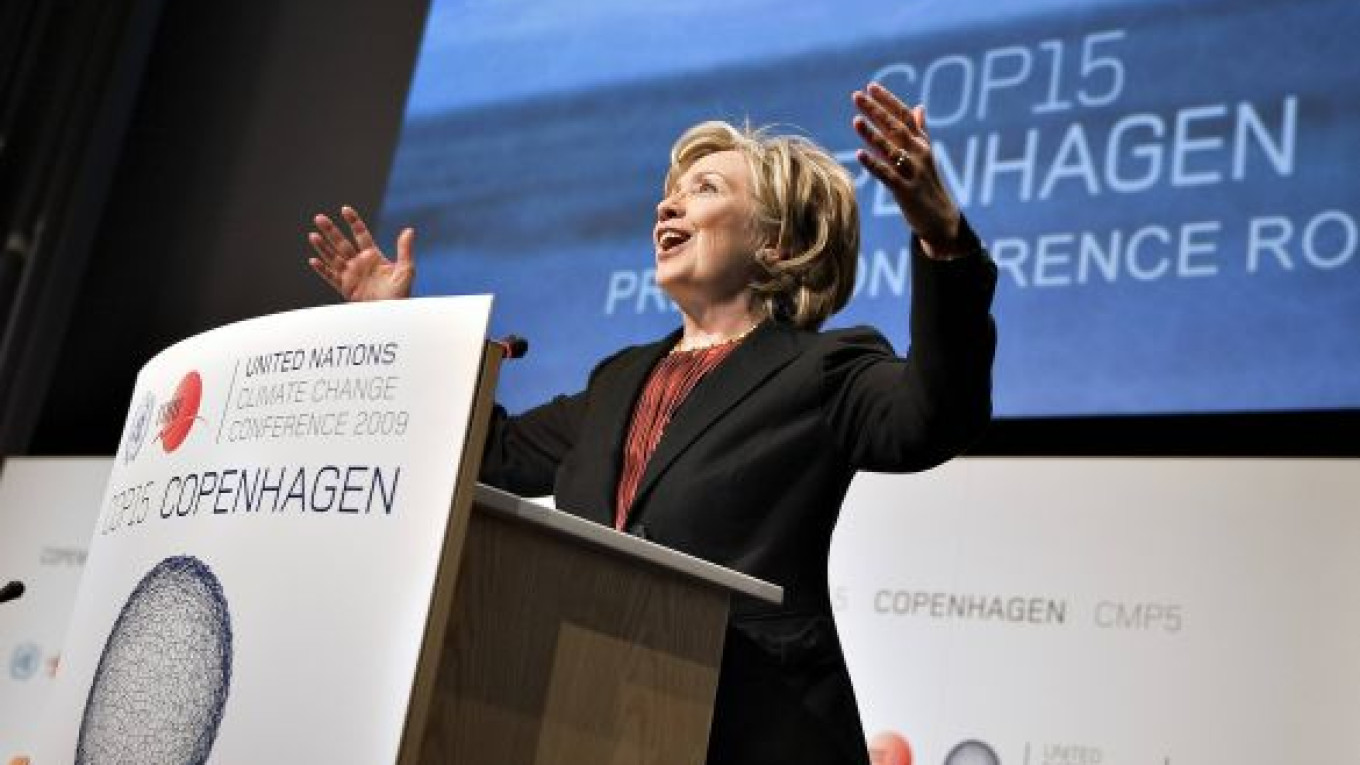
President Dmitry Medvedev flew to Copenhagen to deliver a short speech Friday at the end of a chaotic two-week United Nations climate change summit, where negotiators were scrambling to write an intelligible draft to present to world leaders.
Russia’s contribution to the summit is minimal, with the major problem being a deadlock between United States and China on carbon cuts. But Russia is also the world’s third-largest emitter, after the United States and China.
Hopes for a strong UN climate pact appeared slim until U.S. Secretary of State Hillary Clinton announced Thursday that Washington supported the creation of a $100 billion fund by 2020, adding political drive to negotiations also aimed at reaching agreement on many other measures, including saving rainforests, boosting carbon markets and stiffening global carbon emissions cuts.
Dvorkovich said Russia would consider the summit, the climax of two years of talks, a success if major emitters from both developed and developing countries agreed on their own emissions cuts.
“We realize that signing a global agreement in Copenhagen is virtually impossible. Nevertheless, this conference is one of the stages toward the signing of such an agreement,” he said.
He said Russia was ready to cut emissions by 25 percent from 1990 levels by 2020, but only if the United States, China and other emitters agreed to fair reductions as well.
Medvedev said earlier this week that a new climate pact would only work if all countries cooperated on cuts. “Our piecemeal efforts will be ineffective and senseless,” he said in his videoblog Monday.
Nevertheless, Russia is not insisting that all countries cut emissions as they tackle global warming because there are other measures that can be taken as well, Dvorkovich said.
But all countries have to adopt some kind of measures, he said. “This is a key principle for us, and an agreement will not be reached without it,” he said.
The new treaty must also provide “convenient” conditions for the transfer of technology, recognition of a country’s forests as gas absorbents and financial support for developing countries, Dvorkovich said.
Dvorkovich said poor nations needed assistance relinquishing fossil fuels and Russia was prepared to contribute $200 million in climate aid. Before Clinton declared the United States’ support for a $100 billion fund, the European Union had proposed a fund of $150 billion to help poor countries go green.
The Copenhagen summit is meant to reach a global climate deal that would serve as the foundation for a legally binding treaty next year to succeed the Kyoto Protocol, which expires in 2012. The measures aim to avoid dangerous climate change and promote a greener global economy less dependent on fossil fuels.
Russia’s emissions fell by about 30 percent from 1990 and 2000, leaving it with a surplus of carbon credits. Under the Kyoto Protocol, a country with a surplus of emissions quotas may sell them to other countries.
Russia is ready to consider selling its quotas to other countries if it helps negotiators reach a new agreement, Dvorkovich said. But he added that he doubted that Russia would sell its quotas this way.
“I think Dvorkovich was ironic while talking about quotas,” said World Wildlife Fund climate expert
Alexei Kokorin. “He meant that Russia was not going to sell its quotas in big chunks, but if any country needed our help, we would help it.”
He said Russia might sell quotas to Japan or Canada, which fail to fulfill the conditions of Kyoto Protocol.
“It’s more of an issue of saving political face for Japan and Canada. It’s a political problem rather than an economic one,” Kokorin said.
Russia could also sell smaller slices of quotas to Italy and Spain, Kokorin said.
Oleg Pluzhnikov, a senior official from the Economic Development Ministry, said earlier this week in Copenhagen that Sberbank was negotiating a possible sale of quotas. He said some sales might take place before the Kyoto Protocol expires.
Meanwhile, Dvorovich said Medvedev on Wednesday had signed a climate doctrine that analyzes the possible consequences of climate change on Russia and how Russia’s energy market would be affected by new climate measures.
“The main part of the doctrine is devoted to the measures we should take in order to increase the energy efficiency of Russia’s economy,” Dvorkovich said.
Russia plans to increase the energy efficiency of its economy by as much as 40 percent by 2020, Medvedev said on the videoblog.
Dvorkovich said Russia would increase the energy efficiency of its economy whether or not the global climate agreement was signed.
“This is beneficial for us. It will make Russia’s economy more competitive,” he said.
A Message from The Moscow Times:
Dear readers,
We are facing unprecedented challenges. Russia's Prosecutor General's Office has designated The Moscow Times as an "undesirable" organization, criminalizing our work and putting our staff at risk of prosecution. This follows our earlier unjust labeling as a "foreign agent."
These actions are direct attempts to silence independent journalism in Russia. The authorities claim our work "discredits the decisions of the Russian leadership." We see things differently: we strive to provide accurate, unbiased reporting on Russia.
We, the journalists of The Moscow Times, refuse to be silenced. But to continue our work, we need your help.
Your support, no matter how small, makes a world of difference. If you can, please support us monthly starting from just $2. It's quick to set up, and every contribution makes a significant impact.
By supporting The Moscow Times, you're defending open, independent journalism in the face of repression. Thank you for standing with us.

Remind me later.