

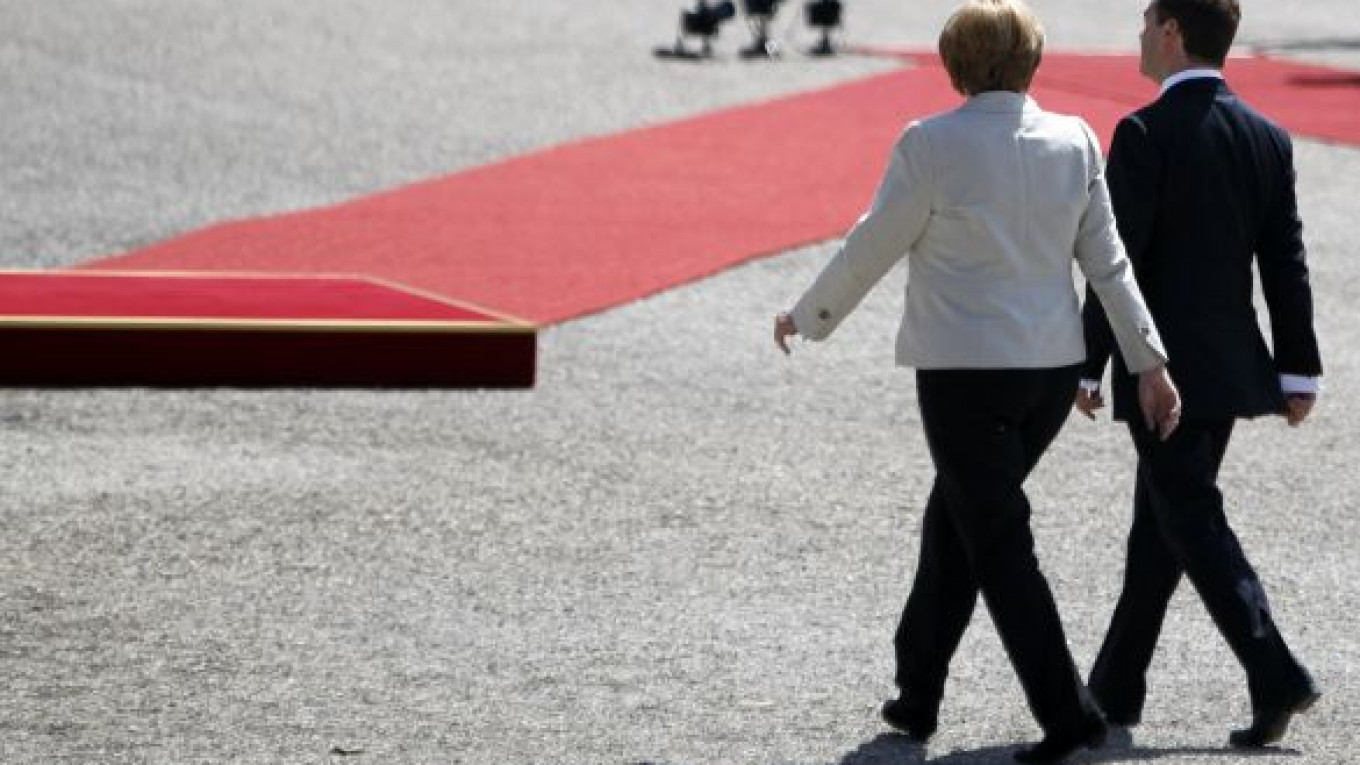
President Dmitry Medvedev on Tuesday lambasted the canceling of a German prize for Prime Minister Vladimir Putin as "cowardice," thus highlighting Moscow's anger over a decision that cast a shadow over talks with Chancellor Angela Merkel in Germany.
Medvedev said the cancellation showed both "cowardice and incoherence" and practically kills off the Quadriga award.
"Once they made a decision, they should have stuck to it. I think the award is finished [in the eyes of] the international community," he said at a televised news conference after a two-day visit outside the north German city of Hanover.
Last weekend, the Berlin-based Werkstatt Deutschland group canceled the award ceremony, scheduled for October, after facing a storm of criticism centered on a rollback of democracy during Putin's 12 years in power.
The about-face raised fears about the future of Moscow's ties with Europe's biggest economy at a crucial time. Gazprom and the country's energy sector are hoping for a massive upswing in business with Berlin after Merkel's government last month decided to phase out nuclear power in Germany over the next decade.
Merkel herself was careful about the issue, telling the same news conference on the sidelines of the Petersburg Dialogue forum that she should not comment but that she endorsed comments made by Russia's ambassador to Berlin.
Ambassador Vladimir Grinin said Monday that he found the decision "very distasteful and indecent" but added that he did not think it would harm relations.
This echoed comments from Putin's spokesman Dmitry Peskov, who said earlier that while the cancellation reflected the "mess plaguing the prize's board" it would not influence ties.
Medvedev seemed to leave it at that, saying that Moscow felt no pain. "This is a German headache, not a Russian one," he said.
The president also promised reporters that he would soon announce his decision on whether to run for re-election in next year's presidential vote.
"I ask you for a little more patience for just a little while. I will tell you about everything that I will do — whether I will be president or find some other work for myself," he said.
Earlier Tuesday, he hinted that he would not leave office when he told a plenary session of the Petersburg Dialogue that he and Merkel would not chair the organization anytime soon.
The top jobs at the Russian-German forum are widely seen as posts for political retirement, even though Deputy Prime Minister Viktor Zubkov took over as Russian co-chairman from Soviet leader Mikhail Gorbachev last year. His counterpart is Lothar de Maiziere, the last leader of the East German Democratic Republic.
"Angela and I spoke about when we will be chairing this forum, and we agreed that it would not yet be soon," Medvedev quipped, earning a burst of laughter from the chancellor, who was narrowly re-elected to a four-year term in 2009.
The annual forum has been widely derided as a talking shop in the past, and Merkel seemed to address the criticism when she told Tuesday's plenary session that the organization must admit younger members and allow more debates about controversial subjects like human rights and democracy.
"I would hope that nobody would feel attacked if such topics are raised," she , according to a transcript on her web site.
Merkel also admitted that Germany was to blame for slow progress regarding eased visa rules between the European Union and Russia.
"Germany was pulling the brakes, not Europe," she said, adding that it was her government's conviction that progress should be incremental. "We need to advance step by step."
Germany has been at the forefront of the EU member states with reservations about lifting visa requirements anytime soon. It has put forward technical reasons like safety concerns and political ones like the need to award visa-free travel first to post-Soviet states like Georgia and Ukraine as a reward for their democratic reforms. Differences between EU countries pose a challenge to Moscow's ongoing talks with Brussels about abolishing visas in the near future, because any decision by the EU needs unanimity.
Offering a feel of what could underlie any progress in the matter, Merkel said the German government has created a database to register people who pose a security threat so others could enjoy fewer visa restrictions. She didn't say whether the database would include only Russians.
In addition, Merkel said, it was "extremely desirable" that student and tourist exchanges were more intensive.
"I hope we will be able to propose something specific next year in terms of how we will move forward," she said, according to a transcript on the Kremlin web site.
Medvedev said Russia was prepared to do all it takes to cancel visas with either Germany or the EU in as little as six months.
Apart from visas, Moscow demands that foreigners in Russia register their residence with the government in a procedure that many members of Tuesday's discussions criticized. Michael Rutz, a journalist and member of the Petersburg Dialogue's steering committee, appealed to Medvedev to do something about the hurdle next year.
Medvedev responded that the government would "no doubt" take measures to simplify registration.
Medvedev and Merkel also discussed gas trade in light of Germany's recent commitment to phase out nuclear power by the end of 2022, a decision that stemmed from the disaster at a Japanese nuclear power plant earlier this year.
Putin indicated last week that the Gazprom-led Nord Stream pipeline — which is being constructed under the Baltic Sea — could expand capacity in anticipation that Germany will need more natural gas in its drive to use more fossil fuel-fired power plants.
Merkel on Tuesday said there was no need for such an expansion of the pipeline.
German Economics Minister Philipp Rösler said last month that about 10 gigawatts of new fossil-fueled generation capacity were under construction and another 10 gigawatts of coal and gas-fired power plants would still be needed by 2020 to secure power supply.
Sensing an opportunity to increase its business, Gazprom last week agreed to start talks with RWE, Germany's second-largest utility, on creating a joint venture to own existing or new power plants in Germany and Britain.
A Message from The Moscow Times:
Dear readers,
We are facing unprecedented challenges. Russia's Prosecutor General's Office has designated The Moscow Times as an "undesirable" organization, criminalizing our work and putting our staff at risk of prosecution. This follows our earlier unjust labeling as a "foreign agent."
These actions are direct attempts to silence independent journalism in Russia. The authorities claim our work "discredits the decisions of the Russian leadership." We see things differently: we strive to provide accurate, unbiased reporting on Russia.
We, the journalists of The Moscow Times, refuse to be silenced. But to continue our work, we need your help.
Your support, no matter how small, makes a world of difference. If you can, please support us monthly starting from just $2. It's quick to set up, and every contribution makes a significant impact.
By supporting The Moscow Times, you're defending open, independent journalism in the face of repression. Thank you for standing with us.

Remind me later.