

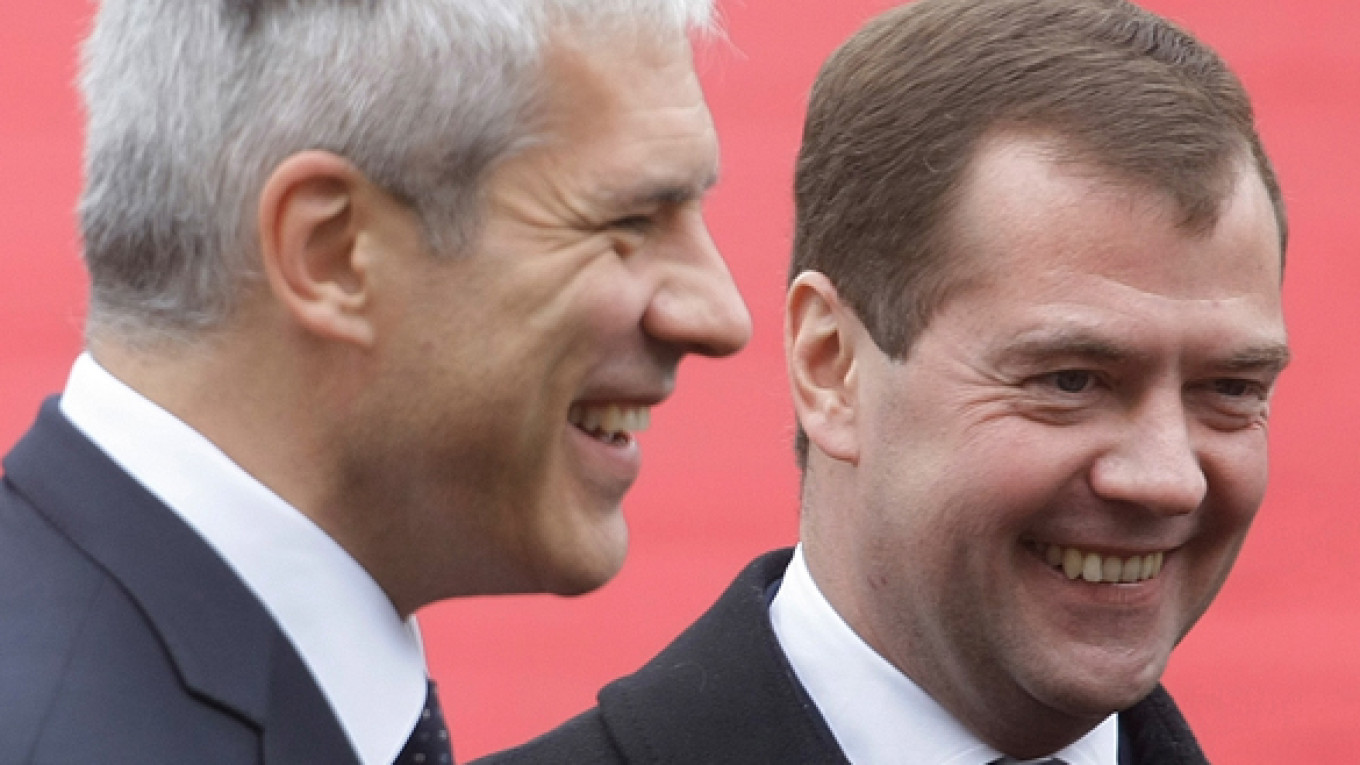
BELGRADE — President Dmitry Medvedev has arrived in Serbia, bringing a $1 billion loan to the recession-hit country as Moscow seeks to expand its influence in the Balkans.
The deal is to be signed during Medvedev's one-day visit, the first by a Russian president to Serbia.
The loan adds to Russia's growing political and economic clout in Serbia, which relies on Moscow's diplomatic support in the United Nations Security Council to oppose the secession of Kosovo, Serbia's former province.
Thousands of policemen were deployed on Belgrade streets on Tuesday and much of the Serbian capital was blocked for traffic amid tightened security for the visit.
"Medvedev's visit will confirm the political unity and mutual support between Serbia and Russia," said Serbia's Foreign Minister Vuk Jeremic.
Last year, Russia's state-controlled gas monopoly Gazprom bought Serbia's major oil and gas assets and agreed to a route through Serbia from the Black Sea for its South Stream pipeline.
The route across the Balkans, including Serbia, would avoid Ukraine, with which Russia has pricing and political disputes, and competes with a U.S. and EU-backed pipeline called Nabucco.
Gazprom has also purchased a 51 percent stake in Serbia's oil company NIS, a deal that allows the Russians to have the monopoly over the sale of gasoline and natural gas in the Balkan country until 2011.
Serbia and Russia are traditional allies, sharing a common Slavic background and Christian Orthodox religion. But their political relations have not matched their ethnic ties, and Belgrade has been seeking to integrate with the West, including joining the European Union.
Although reluctantly supporting Serbia's EU bid, Moscow officials have firmly spoken against its possible NATO membership.
The United States would like to see Serbia in the Western military alliance because that would add to the security in the Balkans region.
Medvedev will also attend celebrations marking the liberation of Belgrade from Nazi occupation in World War II by Soviet and local communist fighters. He will address the parliament and visit the seat of the Serbian Orthodox Church.
On the eve of the visit, Russian diplomats demanded that Belgrade authorities restore the names of streets that used to be named after the Red Army generals who took part in the liberation of the capital in 1945.
The names were changed after the fall of President Slobodan Milosevic in 2000. Milosevic had maintained close ties with Moscow.
A Message from The Moscow Times:
Dear readers,
We are facing unprecedented challenges. Russia's Prosecutor General's Office has designated The Moscow Times as an "undesirable" organization, criminalizing our work and putting our staff at risk of prosecution. This follows our earlier unjust labeling as a "foreign agent."
These actions are direct attempts to silence independent journalism in Russia. The authorities claim our work "discredits the decisions of the Russian leadership." We see things differently: we strive to provide accurate, unbiased reporting on Russia.
We, the journalists of The Moscow Times, refuse to be silenced. But to continue our work, we need your help.
Your support, no matter how small, makes a world of difference. If you can, please support us monthly starting from just $2. It's quick to set up, and every contribution makes a significant impact.
By supporting The Moscow Times, you're defending open, independent journalism in the face of repression. Thank you for standing with us.

Remind me later.