

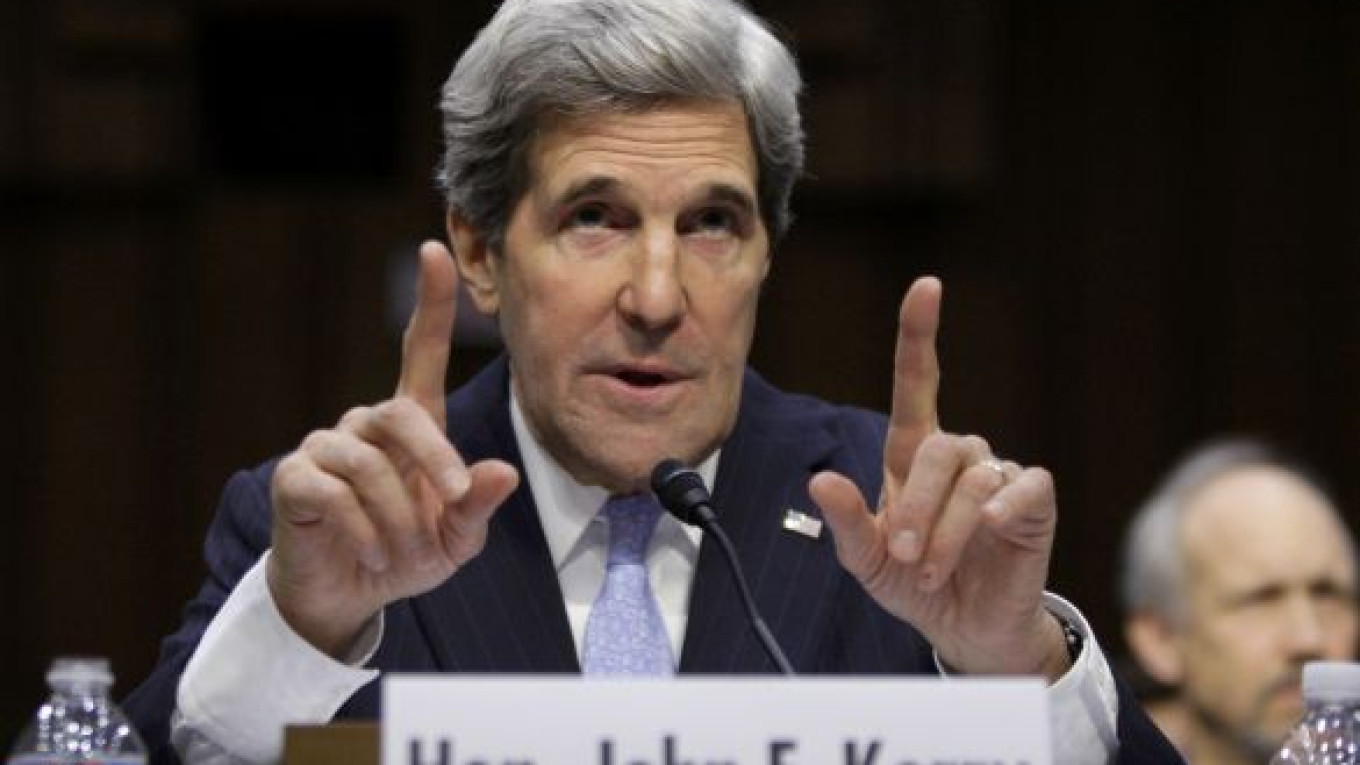
Moscow pundits gave a warm welcome to John Kerry on Tuesday, as U.S. senators were expected to confirm their veteran colleague as secretary of state. But they warned that U.S.-Russian relations were set for a potentially bumpy ride during President Barack Obama's second term, contrasting with the "reset" in relations that marked the first.
Kerry, who has been Democratic senator for Massachusetts since 1985, ran for president in 2004, and has chaired the Senate Foreign Relations Committee since 2009, is widely seen as a preferred candidate for both Russian Foreign Minister Sergei Lavrov and President Vladimir Putin.
"He is a more traditional person, and his huge experience will go down well with the Foreign Ministry and its conservative views," said Dmitry Trenin, director of the Moscow Carnegie Center.
Kerry stands out both against his predecessor, Hillary Clinton, and with Susan Rice, the U.S. ambassador to the United Nations who was Obama's preferred choice for the post, Trenin said.
He pointed out that the senator does not harbor strong political ambitions — unlike Clinton, who is seen as the Democrat front-runner for the 2016 presidential race — and that he is much less focused than Rice on human rights and developing countries.
"The peak of Kerry's career is over. He will make a good secretary of state," Trenin told The Moscow Times.
His comments were echoed by Sergei Markov, a Kremlin-connected analyst and vice rector of the Plekhanov Institute, who praised Kerry as a "super-experienced" man.
"His personal relationship with Lavrov will be better than with Clinton," Markov said, adding that the outgoing secretary of state had been increasingly perceived as harboring anti-Russian views.
The State Department has repeatedly criticized the Kremlin's crackdown on the opposition over the past months, and Clinton personally accused Moscow of failing to fulfill its human rights obligations during an OSCE meeting in Dublin in December.
Last week, the U.S. terminated a joint working group over civil society, citing frustration about increased restrictions on Russian civil rights groups.
Experts also agree that Lavrov, a career diplomat who has been in office since 2004 and already is the country's longest serving foreign minister since 1991, will stay put. "There is no risk that he will go anytime soon," Markov said.
However, the analysts stressed that in both countries, foreign ministers are not policy makers but servants to their bosses.
"Foreign policy is done by the presidents, and ministers are their aides," Trenin said.
He argued that Putin's third term as president, which began last year and lasts until 2018, would be marked by "sovereignization," meaning the "maximum exclusion of U.S. influence" on the country's domestic politics.
This policy has manifested itself in a massive crackdown on American non-governmental organizations, which Putin has openly accused of supporting the opposition and the protest movement against him.
Last year, USAID, the International Republican Institute and the National Democratic Institute were forced to close their Moscow offices or relocate outside the country. A new law forces national NGOs to label themselves "foreign agents" if they finance political activity with foreign money.
Moscow has also expressed dismay at Obama's signing of the Magnitsky Act, which punishes human rights offenders from Russia. In retaliation, Putin signed an "anti-Magnitsky" bill that sanctions U.S. officials, puts new restrictions on NGOs and bans U.S. adoptions of Russian children.
Putin's spokesman, Dmitry Peskov, said last week that the Kremlin had "zero tolerance" toward laws that interfere in domestic affairs like the Magnitsky Act and cautioned against any further U.S. meddling.
"The dialogue between the Russian government and the opposition cannot be a subject of the bilateral relationship between Moscow and Washington," he said in an interview with the magazine.
At the same time, few expect the White House to repeat its "reset" initiative of 2008.
Igor Ivanov, who served as foreign minister from 1998 to 2004, argued that Obama's foreign policy would become tougher in his second term. "The second term is the last, and the president's hands are unbound," he told Interfax last week.
Markov said the "reset" was over because there was no need for it. "Its sole reason was to overcome the problems under Bush," he said, referring to former U.S. President George W. Bush.
The Magnitsky Act could add further strain relations in April, when Obama must present Congress with a list of Russian officials subject to sanctions. Analysts fear that he will bow to pressure from lawmakers to publish some high-ranking officials' names, possibly Chechen leader Ramzan Kadyrov.
"There is a risk that we will see a list war," Trenin said.
Lavrov said Tuesday that the names on Moscow's list would not be published at this point, Interfax reported.
Kerry put on a brave face, telling a Senate hearing last week that he hoped to improve cooperation with Moscow.
"I would like to see if we can find some way to cooperate. We need their help and cooperation with respect to [ending the civil war in] Syria," Kerry told Senators, .
Contact the author at [email protected]
Related articles:
A Message from The Moscow Times:
Dear readers,
We are facing unprecedented challenges. Russia's Prosecutor General's Office has designated The Moscow Times as an "undesirable" organization, criminalizing our work and putting our staff at risk of prosecution. This follows our earlier unjust labeling as a "foreign agent."
These actions are direct attempts to silence independent journalism in Russia. The authorities claim our work "discredits the decisions of the Russian leadership." We see things differently: we strive to provide accurate, unbiased reporting on Russia.
We, the journalists of The Moscow Times, refuse to be silenced. But to continue our work, we need your help.
Your support, no matter how small, makes a world of difference. If you can, please support us monthly starting from just $2. It's quick to set up, and every contribution makes a significant impact.
By supporting The Moscow Times, you're defending open, independent journalism in the face of repression. Thank you for standing with us.

Remind me later.