

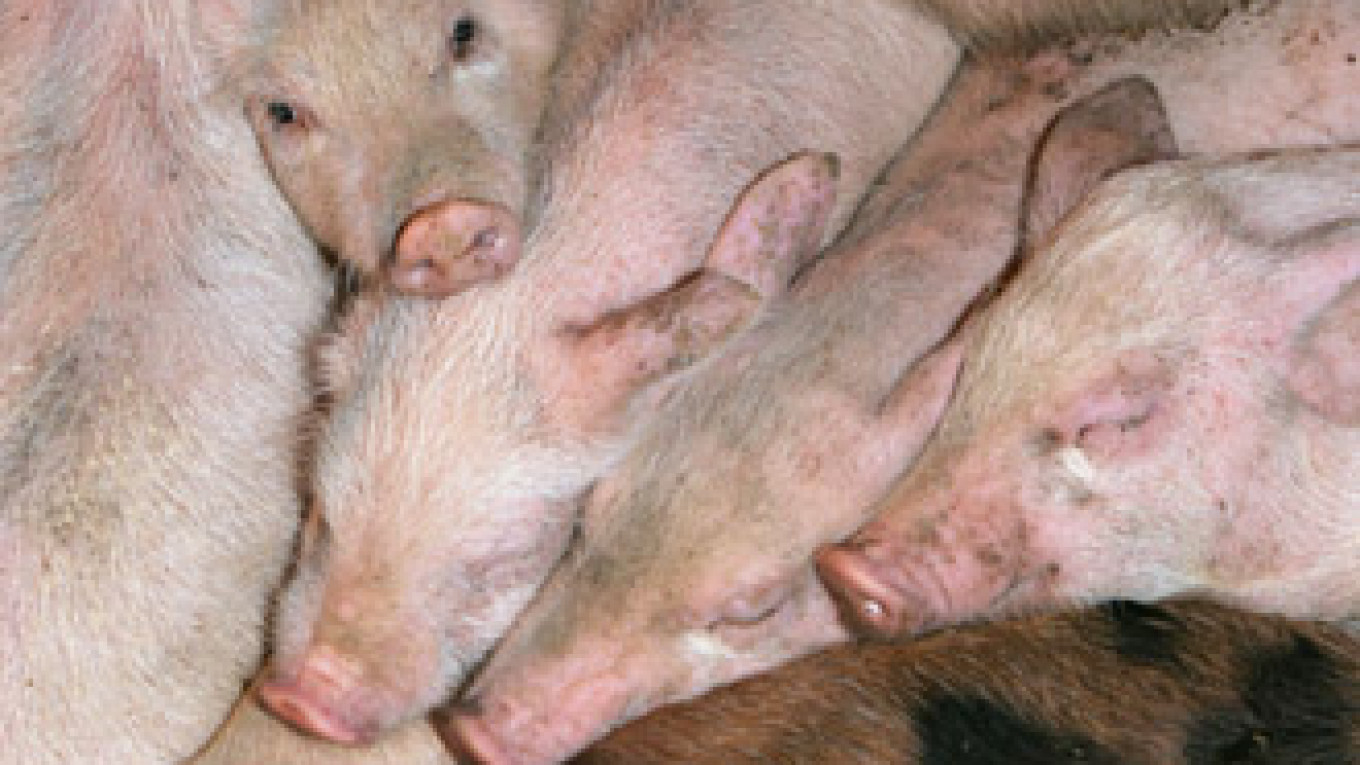
When billionaire Alexander Lebedev’s National Reserve Bank seized collateral offered against a loan from a cash-strapped borrower, a health quarantine was slapped on the security: 40,450 pigs.
“We had a court decision to take away the collateral, which is the pigs,” Lebedev, 49, said in an interview. The borrower, a farm near Samara, agreed “with the local authorities to establish a quarantine” against African swine fever. Lebedev is still waiting to collect the pigs offered against a loan of 100 million rubles ($3.5 million). Live pig costs an average of 78.4 rubles ($2.70) per kilogram, the National Meat Association says.
Russian lenders are seeking to recoup losses by accepting a range of collateral, including stakes in lingerie retailers and grocery stores. Banks have been hit by a surge in nonperforming loans, which Moody’s Investors Service estimates may rise to 20 percent of the total by year-end. The bad debt threatens to stall lending and may jeopardize economic recovery, the Economic Development Ministry says.
“It is not a viable strategy for a bank because banks aren’t doing their core business there,” said Yevgeny Tarzimanov, assistant vice president and banking analyst at Moody’s in Moscow. “They could be stuck with those assets for a number of years.”
Russian banks are characterized by “very high risk on a global comparison,” Standard & Poor’s said in a Sept. 28 report. “Problem loans” may jump to $110 billion by year-end and account for 25 percent of total lending by the end of 2010, compared with 11 percent in the middle of this year, Moody’s estimates.
“We have no idea how to build roads, milk cows or pour metal,” Vladimir Tatarchuk, co-head of corporate finance at Alfa Bank, told reporters Oct. 23. “We’re finance professionals, that’s what we do. We have no plans to develop other businesses. If we have an opportunity to sell immediately” assets taken as collateral, “we’ll do it, even if we lose some potential upside just so we can recover our money.”
Lebedev says loans secured with “strange assets” make up 5 percent of his bank’s total portfolio and as much as 20 percent at the biggest state banks.
Banks are resorting to the “strange” collateral as their only alternative to cash as companies struggle to keep up with payments. State-run banks have “less leeway” to pressure borrowers to service debt, Tarzimanov said.
“They are obviously controlled by the government, and they have a social mandate and fewer options when there is a difficult situation,” he said.
The list of unorthodox collateral filling up banks’ balance sheets is long. Sberbank received a holding of 50 percent plus one share in Wild Orchid. The lingerie retailer pledged the stake as it seeks to restructure 1.6 billion rubles of debt owed to Sberbank, said Anton Sergeyev, a spokesman at Wild Orchid.
Sberbank also owns more than 50 percent of Mosmart, according to Vitaly Podolsky, the grocer’s chief executive.
VTB has taken majority stakes in 11 alcohol producers as payment for debt and became a majority shareholder in two developers, including a project to overhaul the Dynamo football stadium.
As government-controlled banks’ balance sheets swell with nonfinancial assets, the lenders may be forced to rethink their approach to the terms under which they provide credit.
“State banks are burdened with social responsibility to a greater extent than” their private counterparts, said Zaali Tsanava, director for collecting overdue corporate debt at Alfa Bank. “But the situation is developing in such a way that state banks will have to review their policies and perhaps adopt a more stringent approach” because “even they can’t afford to give away money.”
The banks’ books are filling up with risky assets as their capital buffers dwindle. The Central Bank has stress-tested all its banks and a number of the 100 biggest lenders won’t fulfill capital adequacy requirements, First Deputy Chairman Gennady Melikyan said on Oct. 21. Capital shortages may appear within six months, he added.
Lenders will cope with “organizational risks” as they repossess nonfinancial assets pledged for loans, said Andrei Melnikov, deputy chief of the Deposit Insurance Agency.
“It’s becoming necessary for banks to run businesses they wouldn’t have dealt with a year or two ago,” Melnikov said last week. The process may act as a “diversion” from the banks’ main activity, he said.
The banking industry may face more volatility as it seeks to dispose of the collateral it seized, said Svetlana Kovalskaya, an analyst at investment bank Aton.
“The risks will increase if the economic recovery drags on and asset prices do not return to precrisis levels,” she said.
Meantime, Lebedev is still waiting to collect the pigs, which he plans to take to a slaughterhouse or another farm.
“One of the big risks is how do you protect your investment against people who don’t want to pay you back anything,” he said. “But you don’t sit and wait until the economy switches on again. You do something about it.”
A Message from The Moscow Times:
Dear readers,
We are facing unprecedented challenges. Russia's Prosecutor General's Office has designated The Moscow Times as an "undesirable" organization, criminalizing our work and putting our staff at risk of prosecution. This follows our earlier unjust labeling as a "foreign agent."
These actions are direct attempts to silence independent journalism in Russia. The authorities claim our work "discredits the decisions of the Russian leadership." We see things differently: we strive to provide accurate, unbiased reporting on Russia.
We, the journalists of The Moscow Times, refuse to be silenced. But to continue our work, we need your help.
Your support, no matter how small, makes a world of difference. If you can, please support us monthly starting from just $2. It's quick to set up, and every contribution makes a significant impact.
By supporting The Moscow Times, you're defending open, independent journalism in the face of repression. Thank you for standing with us.

Remind me later.