

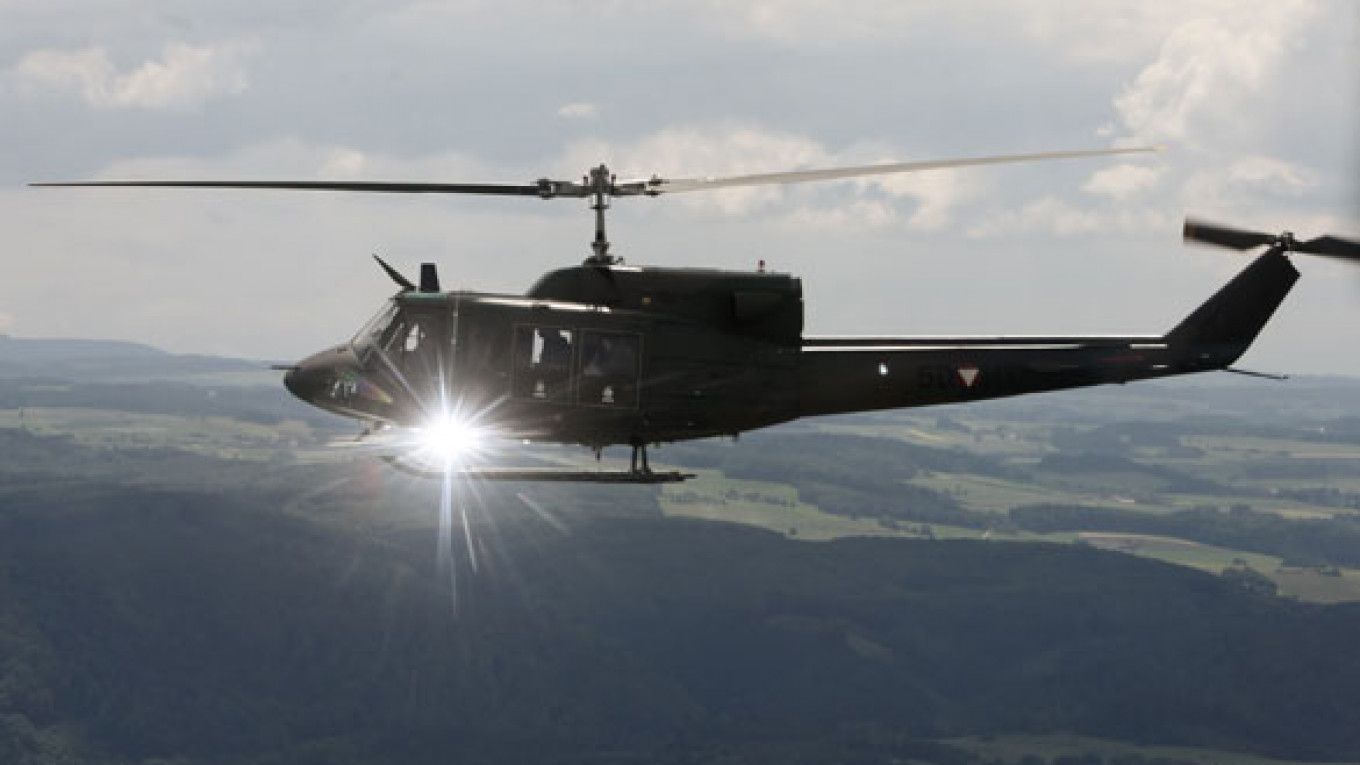
Russian Helicopters and AgustaWestland on Tuesday began construction of a helicopter factory in the Moscow region —? a 40 million euro ($49.3 million) project aimed at producing utility helicopters.
Investment will be split evenly between Russian and Italian sides, Deputy Industry and Trade Minister Denis Manturov told reporters at the groundbreaking ceremony in Tomilino, southeast of Moscow.
Capacity at the plant, which will produce AgustaWestland 139s, is projected to reach 20 units per year by 2015, starting with the first five in 2011, the companies said in a joint statement.
Russian Helicopters is a subsidiary of Oboronprom, the military branch of Russian Technologies. Oboronprom and AgustaWestland, a subsidiary of Finmeccanica, established a joint venture in July 2008.
The project is expected to pay for itself in eight years, he said. By 2016, 40 percent of components will be made in Russia, with the rest produced in Italy. The venture aims for the share of Russian components to eventually reach parity as Russian producers introduce the needed technology, Manturov said.
An order has already been made for the first 10 helicopters, he added, without giving details. The helicopter’s starting price is 8 million euros, he said.
The production facility is part of Russian Technologies’ cooperation with its strategic partner, Italy’s Finmeccanica, said Sergei Chemezov, head of the state corporation.
The AW139 is an intermediate helicopter that is used in law enforcement, corporate transport, search and rescue, emergency medical service and maritime operations.
A Message from The Moscow Times:
Dear readers,
We are facing unprecedented challenges. Russia's Prosecutor General's Office has designated The Moscow Times as an "undesirable" organization, criminalizing our work and putting our staff at risk of prosecution. This follows our earlier unjust labeling as a "foreign agent."
These actions are direct attempts to silence independent journalism in Russia. The authorities claim our work "discredits the decisions of the Russian leadership." We see things differently: we strive to provide accurate, unbiased reporting on Russia.
We, the journalists of The Moscow Times, refuse to be silenced. But to continue our work, we need your help.
Your support, no matter how small, makes a world of difference. If you can, please support us monthly starting from just $2. It's quick to set up, and every contribution makes a significant impact.
By supporting The Moscow Times, you're defending open, independent journalism in the face of repression. Thank you for standing with us.

Remind me later.