

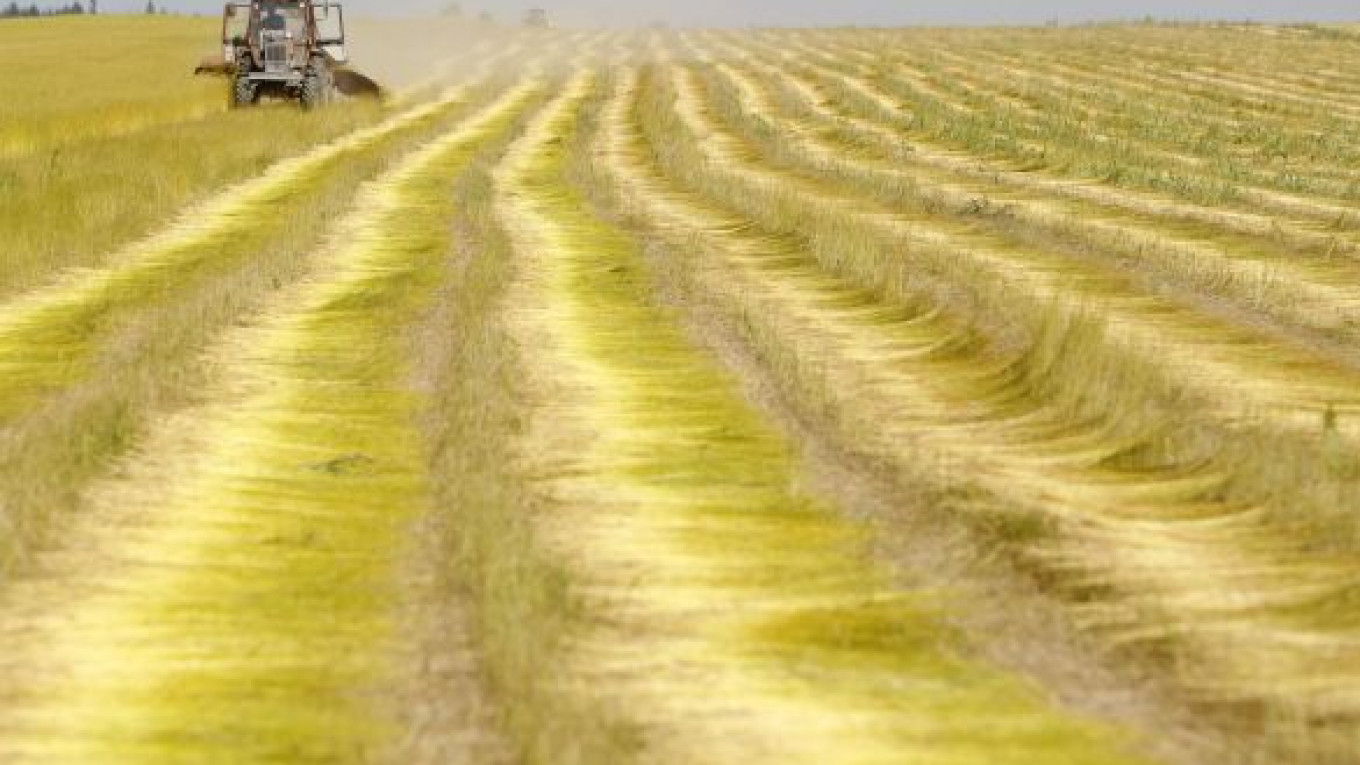
Russia’s worst drought in a decade will probably generate losses for bondholders as food prices rise and the government may be pushed to tap debt markets for funds to support farmers.
High temperatures, which rose to a record 37.4 degrees Celsius Monday in Moscow, have damaged 32 percent of land under cultivation and forced Russia to declare a state of emergency in 23 regions. Grain prices may double this year because of the drought, according to the Grain Producers’ Union.
Inflation may quicken to 8.1 percent by December, compared with the government’s annual forecast of less than 6.5 percent, said Yaroslav Lissovolik, Deutsche Bank’s head of research in Moscow. That will put pressure on the Central Bank to raise its benchmark rate by year-end for the first time since December 2008, said Natalya Orlova, chief economist at Alfa Bank.
Higher rates “may cause a correction in short-term sovereign bonds and, later, in long-term sovereign bonds,” said Yevgeny Nadorshin, senior economist at Trust Investment Bank and an adviser to Economic Development Minister Elvira Nabiullina.
The government, which plans to sell 1.2 trillion rubles ($39.3 billion) of bonds on the domestic market this year to finance its budget deficit, may increase that figure to pay for subsidies and contain the drought’s fallout, Nadorshin said.
“The risk of higher spending makes the government likely to borrow more,” he said. “This in turn creates a risk that bond yields will increase.”
So far, the government has been reluctant to pay more to sell its debt.
The Treasury last week failed to sell 30 billion rubles of federal bonds, known as OFZs, due July 2015. At a subsequent auction the same day, it sold 11 billion rubles of notes due January 2013, compared with the 15 billion rubles planned. The average yield was 6.28 percent. A week earlier the Treasury sold 11 billion rubles of 2012 notes at 5.92 percent, falling short of the 20 billion rubles offered.
“It’s highly likely that rates on bonds will increase,” said Vladimir Osakovsky, chief economist in Moscow at UniCredit Bank. The July 21 auction “supports this view.”
The government has signaled that it may pay higher rates as it floods the market with debt. Deputy Finance Minister Dmitry Pankin said in a July 19 interview that the treasury “may offer a premium” over secondary market rates at this month’s auctions.
Monday’s temperature in Moscow was the highest since Russia began keeping records 130 years ago, according to the web site of the Hydrometeorological Monitoring Service. The previous high was 36.8 C in July 1920, during the Civil War. The temperature may rise to 38 C on Thursday, according to Gidromettsentr, the state weather service.
Russia, the world’s third-biggest wheat exporter, will harvest about 80 million metric tons of grain this season, 17 percent less than last year, according to researcher SovEcon. Grain prices rose as much as 33 percent last week on drought concerns, SovEcon said on its web site.
Drought is likely to have a bigger impact on prices in Russia than in other countries, Orlova said. Food accounts for 38 percent of the consumer price index in Russia, compared with 15 percent in the United States and 32 percent in China, Alfa estimates.
A domestic economic recovery also may encourage retailers to pass on higher grain prices to consumers. Unemployment fell 0.5 point to 6.8 percent last month. Retail sales grew an annual 5.8 percent and have risen every month this year.
“This intensifies inflationary risks and justifies our expectations of higher inflationary pressure in the second half,” Orlova said.
Prime Minister Vladimir Putin’s administration may try to limit inflation by releasing grain from storage or curbing exports to distance itself from Russia’s history of volatile prices, said Chris Weafer, chief strategist at UralSib.
The inflation rate reached 120 percent in 1999 after Russia defaulted on $40 billion of domestic debt, and prices rose more than 2,000 percent in 1992, a year after the fall of communism.
“Inflation control is one of the government’s most important priorities,” Weafer said. “It is by no means a given that prices will therefore be allowed to rise as a result of the weather, even if the economic conditions warrant.”
The inflation rate fell to a record-low 5.8 percent in June, the statistics office said July 5. Last year’s record 7.9 percent economic contraction allowed the Central Bank to cut its benchmark 14 times to a record-low 7.75 percent in May as demand eased and price increases slowed.
“August will be the decisive month” for the interest-rate outlook as the inflationary impact becomes clearer, said Yulia Tseplyayeva, head of research at BNP Paribas.
A Message from The Moscow Times:
Dear readers,
We are facing unprecedented challenges. Russia's Prosecutor General's Office has designated The Moscow Times as an "undesirable" organization, criminalizing our work and putting our staff at risk of prosecution. This follows our earlier unjust labeling as a "foreign agent."
These actions are direct attempts to silence independent journalism in Russia. The authorities claim our work "discredits the decisions of the Russian leadership." We see things differently: we strive to provide accurate, unbiased reporting on Russia.
We, the journalists of The Moscow Times, refuse to be silenced. But to continue our work, we need your help.
Your support, no matter how small, makes a world of difference. If you can, please support us monthly starting from just $2. It's quick to set up, and every contribution makes a significant impact.
By supporting The Moscow Times, you're defending open, independent journalism in the face of repression. Thank you for standing with us.

Remind me later.