

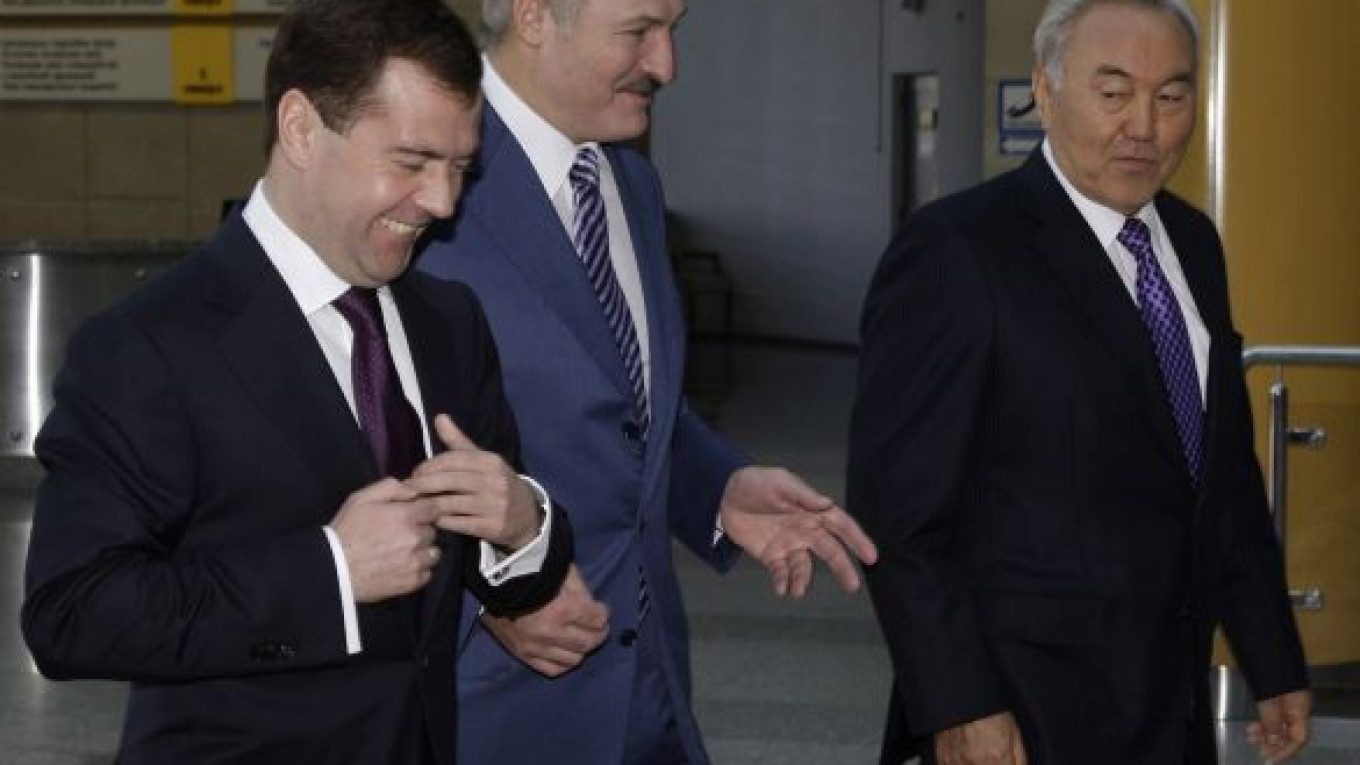
Russia, Belarus and Kazakhstan on Friday gave the go-ahead for the creation of a united customs union, whose tariff regime will be based largely on the one that Russia currently has in place.
President Dmitry Medvedev met with his counterparts Alexander Lukashenko and Nursultan Nazarbayev in Minsk on Friday, where they agreed to the creation of a unified customs tariff, which will start Jan. 1, as well as a unified customs code, which will go into effect July 1.
“This is a very significant and long-awaited event, which has come into being through very difficult negotiations,” Medvedev told a news conference after the meeting, Interfax reported.
About 92 percent of the new tariff regime is based on current Russian duties, First Deputy Prime Minister Igor Shuvalov said.
And as Russia has, on average, the highest tariffs of the group, that means that Kazakhstan and Belarus will be raising duties on a wide swathe of items.
“We had to agree with our partners on lowering certain customs tariffs on certain groups of goods, and our partners had to raise certain tariffs,” Shuvalov said, adding that Kazakhstan had to raise tariffs on more than 5,000 items.
“This is a difficult process. … It was necessary to make compromises in order to ensure all the decisions could go into effect starting Jan. 1,” he said.
But with Russia as the largest external market for both Belarus and Kazakhstan, raising tariffs remains a lucrative bet for both countries.
“The creation of the customs union of Belarus, Russia and Kazakhstan will allow the three countries to raise their gross domestic product 15 percent by 2015,” Nazarbayev said. “A common market with a GDP of $2 trillion will be attractive for investors.”
Nevertheless, there are still several sore points remaining in the formation of a unified customs tariff, said Alexei Portansky, head of the information office for Russia’s WTO bid.
“These sore points will affect the economies of each of the three countries — for example, the customs duties on cars in Belarus, which are lower than those in Russia,” Portansky told The Moscow Times.
The countries still haven’t agreed to a set of automobile tariffs, but the Russian side is concerned that the tentative plan for duties would lead to a flood of used cars from Belarus and Kazakhstan and crush the domestic auto market.
While tariffs for Belarussian dealers would jump to the same level as the Russian tariffs, duties for individuals would remain several times lower, which could result in caravans of Belarussian auto runners streaming into Russia.
A number of decisions regarding the customs union don’t correspond to the interests of Belarus in full, Lukashenko said, adding that he hoped that the decisions would nevertheless bring a balance of interests and “common results for all sides.”
Medvedev repeated his assertion that entering the customs union would not affect Russia’s plans to join the World Trade Organization.
“There are two options: Either enter [the WTO] with the customs union, which no longer exists only on paper, or each country can enter with the agreed-upon positions, but separately,” he said, adding that both options were acceptable.
But experts say the new customs union could create an entirely new set of hurdles for Russia’s accession to the WTO.
“The creation of the customs union brings certain problems. Russia has separately come a long way on its accession to the WTO. Now we must explain to our partners in the WTO how and why we’re changing our customs duties,” Portansky said, adding that Russia would have to hold additional negotiations with the organization.
The WTO confirmed that Russia could face new problems with the accession, as it would have to reach a new agreement on its customs duties.
“The creation of the customs union will make Russia’s accession to the WTO more complicated,” WTO spokesman Keith Rockwell told The Moscow Times. “Unless all the tariffs are exactly the same as what Russia had previously agreed to and there are no changes as a result of the customs union, Russia will have to go through the whole process again,” Rockwell said.
Russia has been trying to join the WTO since 1993, when it filed an application to join the General Agreement on Tariffs and Trade, the WTO’s predecessor.
But the customs union might be a more lucrative bet for Russia than WTO membership.
“Russia will benefit from the creation of the customs union much more than from its accession to the WTO, since all customs barriers reduce the country’s welfare. The customs union will also attract more foreign investors to the three countries’ common market,” said Alexei Moiseyev, an analyst at Renaissance Capital.
The group also left open the possibility of Kyrgyzstan, already a WTO member, joining the customs union soon.
Kyrgyz President Kurmanbek Bakiyev said Friday that his country would do everything necessary to join the union. “Kyrgyzstan is a member of the WTO, but this doesn’t preclude or hinder us from joining the customs union,” he said.
A Message from The Moscow Times:
Dear readers,
We are facing unprecedented challenges. Russia's Prosecutor General's Office has designated The Moscow Times as an "undesirable" organization, criminalizing our work and putting our staff at risk of prosecution. This follows our earlier unjust labeling as a "foreign agent."
These actions are direct attempts to silence independent journalism in Russia. The authorities claim our work "discredits the decisions of the Russian leadership." We see things differently: we strive to provide accurate, unbiased reporting on Russia.
We, the journalists of The Moscow Times, refuse to be silenced. But to continue our work, we need your help.
Your support, no matter how small, makes a world of difference. If you can, please support us monthly starting from just $2. It's quick to set up, and every contribution makes a significant impact.
By supporting The Moscow Times, you're defending open, independent journalism in the face of repression. Thank you for standing with us.

Remind me later.