

Click here to see photo essay
Cheburashka, the Russian team's official Olympic mascot since the 2004 Summer Games in Athens, was nowhere to be found in stores Monday -- either in Moscow or in Turin.
|
While the national team finished fourth in the medals table behind Germany, the United States and Austria, sports officials appeared even more pleased about the PR impact Russia had made on the Games.
"I have not seen any Olympic Games before where the presence of Russian symbols -- the flag, national anthem and uniform -- were felt as strongly," Vyacheslav Fetisov, head of the Federal Agency for Physical Culture and Sports, told Rossia state television Monday evening.
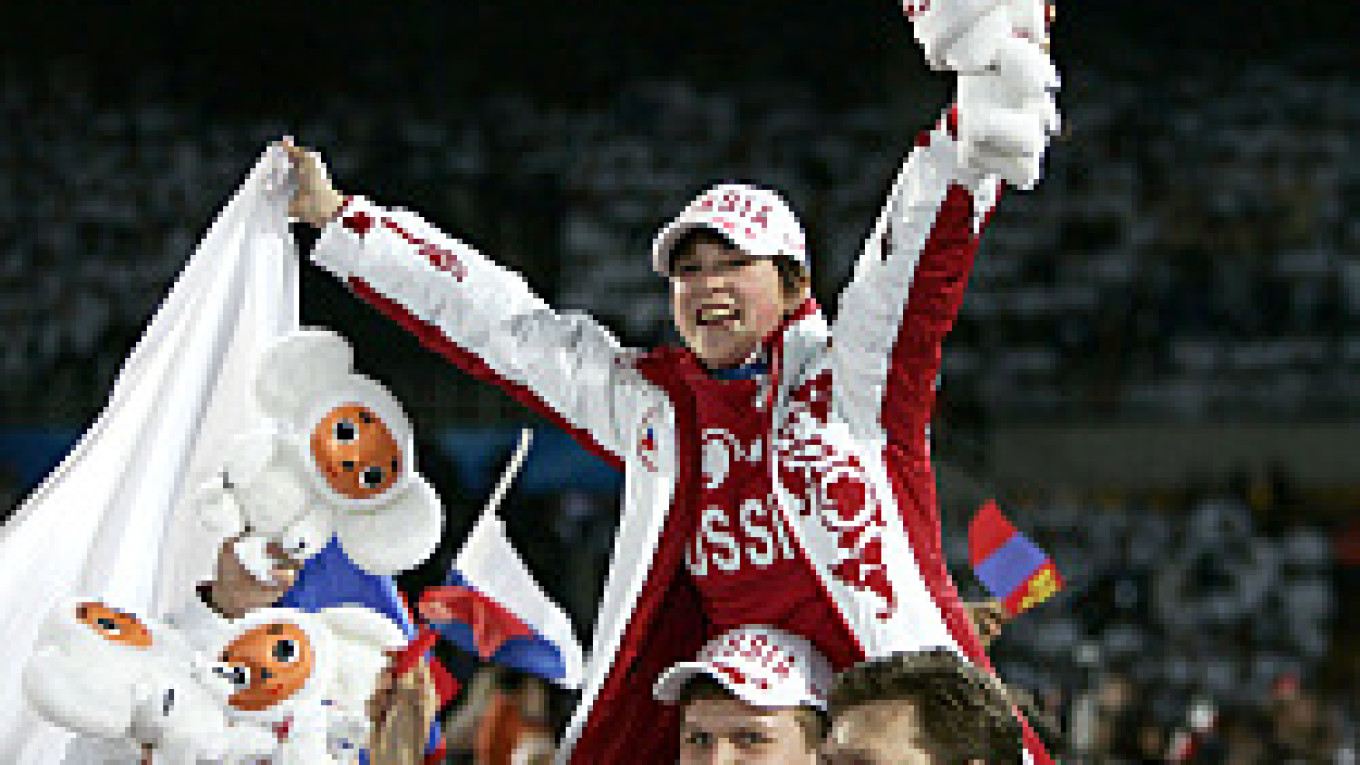
But while Fetisov was surely referring to the presence of Russian medal-winners on the podium, in Turin the team's furry little mascot seemed to have been adopted by thousands of non-Russian fans as the Games' unofficial champion.
Cheburashkas of all sizes were a huge hit in Turin, Kravets said by telephone from the Italian city on Monday, adding that at prices of between 10 euros and 35 euros they were sold out completely.
For those cheering on the Russian team from back home, the fluffy stuffed animal -- made specially in white for the Winter Olympics -- popped up everywhere.
One minute he was being tossed onto the ice rink after a performance by a Russian skater, and the next he was being cuddled by Russian athletes and fans alike.
In Moscow, eager children and their parents joined the ever-more-desperate hunt for Winter Olympic Cheburashkas, resulting in their complete extinction in BoscoSport stores across the city.
Meanwhile, in Turin, the Russian House had run out days before the games ended Sunday.
In two of Moscow's BoscoSport stores the furry creatures sold out days ago, said Andrei Shadrin, who manages the firm's store in the Kalinka-Stockmann shopping center near the Smolenskaya metro station.
"The last Cheburashka was sold five days ago. They were snapped up very quickly: A batch of 200 would go in a day and a half to two days. We would love to order more, but we can't because no more were made," Shadrin said.
"It's a shame, as we get 50 calls a day asking if we have Cheburashkas, and they get really upset when they learn there aren't any."
Some of the more determined, or desperate, Cheburashka hunters were still out scouring stores Monday.
Unable to resist their children's pleas, two men, friends from the Moscow region town of Zheleznodorozhny, arrived at the Smolenskaya store Monday afternoon to buy Cheburashkas.
Vladimir Leshchenko said his 8-year-old daughter, Katya, had avidly watched the Turin Games with the rest of the family and rooted for the Russian athletes.
But alas, no Cheburashkas were left for Katya, or for the 2-year-old son of Leshchenko's friend Igor Proskurkin, forcing both men to opt for various BoscoSport clothing items covered with pictures of the big-eared fluff. Even store assistants were wearing clothes depicting Cheburashka.
"A Cheburashka would still have been the best present," Leshchenko said wistfully. He eventually settled for a T-shirt.
Shadrin said that the ranks of Cheburashka's fans were by no means limited to children.
When asked what reasons customers gave for buying a Cheburashka, Shadrin said, "People just said they liked it, or that it was a souvenir to remember these Olympics, or that it was unique and pretty."
And even at 1,100 rubles ($40) a pop for a 35-centimeter-tall Cheburashka, "only a few customers complained that it was expensive," Shadrin said. "Many adults bought Cheburashkas as a souvenir for themselves, or as a present for a friend."
While Cheburashka turns 40 this year, his Olympic workout seems to be keeping him as youthful as ever.
First created in 1966 by children's writer Eduard Uspensky as a strange animal who came to Russia from Africa in a crate of oranges, Cheburashka later made the transition from book to film, featuring in countless Soviet-era cartoons.
The cartoons made Cheburashka and his best friend, Gena the Crocodile, so famous that not only every Russian knew them, but the two became the unwitting stars of numerous, quite off-color jokes.
A new wave of popularity came in the post-Soviet era, when the creatures' creators -- including Uspensky and several animators and book illustrators -- began touting the image abroad.
Uspensky registered his Cheburashka copyright in 1997. In 2004, he agreed to lend his Cheburashka to the Russian Olympic team, despite howls of protests from cartoonists claiming their own rights to the image.
"Hey, you're asking me a silly question when you wonder what it feels like to see Cheburashka now," Uspensky, 68, said by telephone Monday.
"It's good to see one of your creations marching across the globe. As for the future of Cheburashka, maybe he'll replace the national seal?" Uspensky said, referring to Russia's double-headed eagle.
A Message from The Moscow Times:
Dear readers,
We are facing unprecedented challenges. Russia's Prosecutor General's Office has designated The Moscow Times as an "undesirable" organization, criminalizing our work and putting our staff at risk of prosecution. This follows our earlier unjust labeling as a "foreign agent."
These actions are direct attempts to silence independent journalism in Russia. The authorities claim our work "discredits the decisions of the Russian leadership." We see things differently: we strive to provide accurate, unbiased reporting on Russia.
We, the journalists of The Moscow Times, refuse to be silenced. But to continue our work, we need your help.
Your support, no matter how small, makes a world of difference. If you can, please support us monthly starting from just $2. It's quick to set up, and every contribution makes a significant impact.
By supporting The Moscow Times, you're defending open, independent journalism in the face of repression. Thank you for standing with us.

Remind me later.