

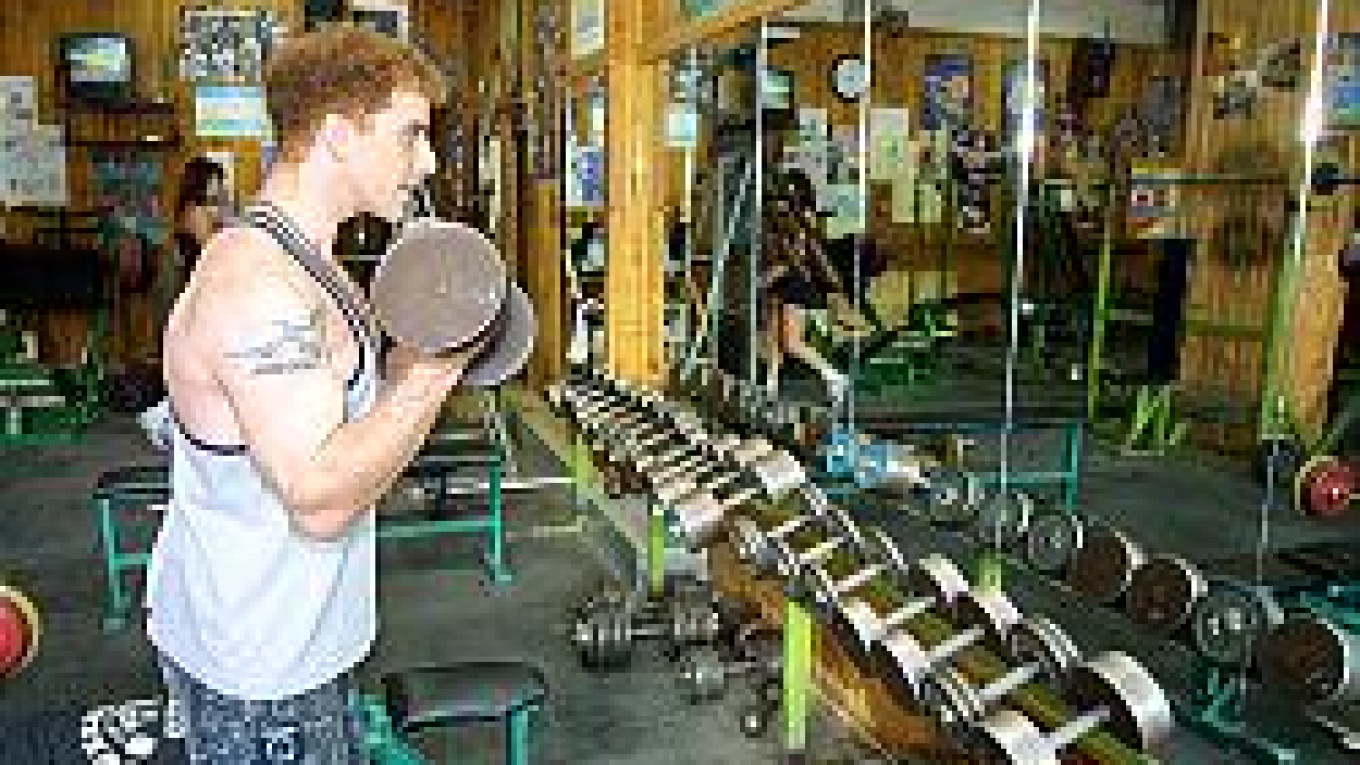
Covering 80 square meters at the bottom of Dynamo Stadium, this one-room gym has yellowing posters and magazine cutouts of bodybuilding stars such as Arnold Schwarzenegger covering its chipped wooden walls. Barbells, metal plates and workout benches of various colors and brands are strewn around the black rubber tiled floor, making walking from one end of the gym to the other a hazard. Much of the equipment is rusty or faded. Some machines squeak, others rock during use. Little has changed inside since the gym opened in 1987.
Its name may seem ridiculous when you cross Leningradsky Prospekt and peek into Gold's Gym, about 500 meters south of Dynamo Stadium. Here, a large, carpeted weight room greets you with an abundance of logically arranged and matching equipment. It is spotless. The white walls are broken up by long windows that throw natural sunlight into the gym. Uniformed trainers offer assistance. A cafe area on the second floor, where guests can relax after their workout, is about the size of Zal Chempionov.
More than a decade ago, when there were was no modern fitness centers like Gold's Gym in Moscow, Zal Chempionov was one of the better gyms around. Back then, it was home to many of Moscow's bodybuilding and fitness enthusiasts, even some champions. The wealthy worked out alongside the poor.
But Zal Chempionov was only one of hundreds of kachalki, or weight gyms, that opened in large numbers around Moscow in the late 1980s and early 1990s. Built by sport and bodybuilding fanatics, often in abandoned basements using equipment they made themselves, they were the first private fitness centers.
"Kachalki were popping up all over Moscow like mushrooms back then," said Valery Gevargiz, a trainer and manager at Zal Chempionov since 1990. "You could find a gym in almost every building, it seemed. There was a real bodybuilding and fitness craze at that time."
After more than a decade in existence, these no-frills gyms are facing new challenges that make their continued existence less certain.
First, wealthy members disappeared with the opening of elite clubs in the early 1990s. And now, as modern sports clubs geared toward the middle class begin to emerge, kachalki are again losing a portion of their clientele.
"We have lost about 30 percent of our clients over the last few years," said Gevargiz. "There are so many new gyms opening today that membership fees at these clubs are slowly dropping and becoming affordable to more people."
Not only are the kachalki suffering declining revenues, but their costs are also rising. As many such gyms were tucked away in basements, owners could often carry on their business without registration for years. But as the government cracks down on unregistered businesses, kachalki owners have to formalize their operations and pay taxes. And that is taking its toll on many.
"We have been lucky to operate for so many years without having to pay rent," said one owner, who opened his small gym in an abandoned basement in 1995. "But know we will have to formalize everything and pay about $10,000 a year in rent. They are killing us."
Yury Pevotkin, who registered a gym several years ago, said he barely makes a profit after taxes. He said the hassle of attending to accounting and inspection issues combined with small profit has led many owners to simply close their gyms.
Pevotkin added that many owners are former athletes like himself who opened gyms more as a hobby -- and now, forced to run their hobby as a business, they are throwing in the towel.
But though they are often designated as a poor man's club, kachalki have developed their own atmosphere that still brings in those who can afford even Moscow's more prestigious fitness clubs.
"You won't find too many athletes at elite gyms," said Igor Petrukhin, a longtime bodybuilder who hosts the Zhelezny Faktor sports program on NTV Plus. "There are too many unfamiliar people watching and standing around. Many people go to elite gyms just to talk and not work out. It is an uncomfortable environment for serious athletes. Therefore, many still go to kachalki."
Although Gevargiz said that is a bit of an exaggeration, he added that many successful athletes from the regions on their way to competitions in Europe still come to the gym.
But some notable Moscow athletes do train at kachalki. Among them is Oleg Makshantsev, a former national bodybuilding champion. In an interview, Makshantsev said that when training for competitions he prefers to work out at Ironman, his own 150-square-meter kachalka filled with black generic Russian equipment and posters of world bodybuilding champions -- despite free membership to elite gyms.
"The equipment at these expensive gyms is great, but you just can't concentrate there," he said. "Many people aren't there to train. Membership at elite clubs is more like a status symbol."
"You can't seriously work out at elite clubs," agreed Mikhail, one of Zal Chempionov's regulars. "You have girls walking around, there is perfume in the air, it's a place to show off how wealthy you are. How can you focus on training in an environment like that?" The owner of a computer store, he said elite clubs are too high-priced for him.
According to Gold's Gym trainer Natalya Suvorova, athletes who have moved on to better-equipped clubs still enjoy returning to their old kachalki. "I know some bodybuilders who can't live without going there two or three times a month to train," she said. "Psychologically, it is at a different level. People there work out really intensively."
Suvorova, a Russian fitness champion who trained several years at kachalki, said the atmosphere at basement gyms can be more aggressive. In the smaller and more familiar surroundings, athletes feel freer to push each other to train harder, occasionally cursing and yelling at one another. For elite clubs, such behavior may be out of place.
"Here, things are very civilized," Suvorova said of Gold's Gym.
Kachalki have a similar crowd and look and function in some ways as a social organization. Owners may work out alongside members and let good athletes and friends train for free. Pevotkin said some 20 percent of members don't pay, while Makshantsev said that number is about 30 percent at Ironman.
The number of members at kachalki is relatively small, ranging from 60 to 100 individuals and many know one another. Owners say many are locals, though some travel across Moscow to visit a club. Many are long-term members unlikely to ever move on to modern gyms regardless of the cost, Gevargiz said.
Dima, a 42-year-old who has been working out at Zal Chempionov since 1987, said he will stay put.
"It has become a habit for me to come here," he said. "I like the gym and the equipment here is good enough. I don't need anything more."
"I have to admit that I liked the atmosphere there," said Olga Slutsker, president of World Class fitness center, who opened her club after working out for two years in kachalki.
"People really knew each other, it was a small community."
A Message from The Moscow Times:
Dear readers,
We are facing unprecedented challenges. Russia's Prosecutor General's Office has designated The Moscow Times as an "undesirable" organization, criminalizing our work and putting our staff at risk of prosecution. This follows our earlier unjust labeling as a "foreign agent."
These actions are direct attempts to silence independent journalism in Russia. The authorities claim our work "discredits the decisions of the Russian leadership." We see things differently: we strive to provide accurate, unbiased reporting on Russia.
We, the journalists of The Moscow Times, refuse to be silenced. But to continue our work, we need your help.
Your support, no matter how small, makes a world of difference. If you can, please support us monthly starting from just $2. It's quick to set up, and every contribution makes a significant impact.
By supporting The Moscow Times, you're defending open, independent journalism in the face of repression. Thank you for standing with us.

Remind me later.