

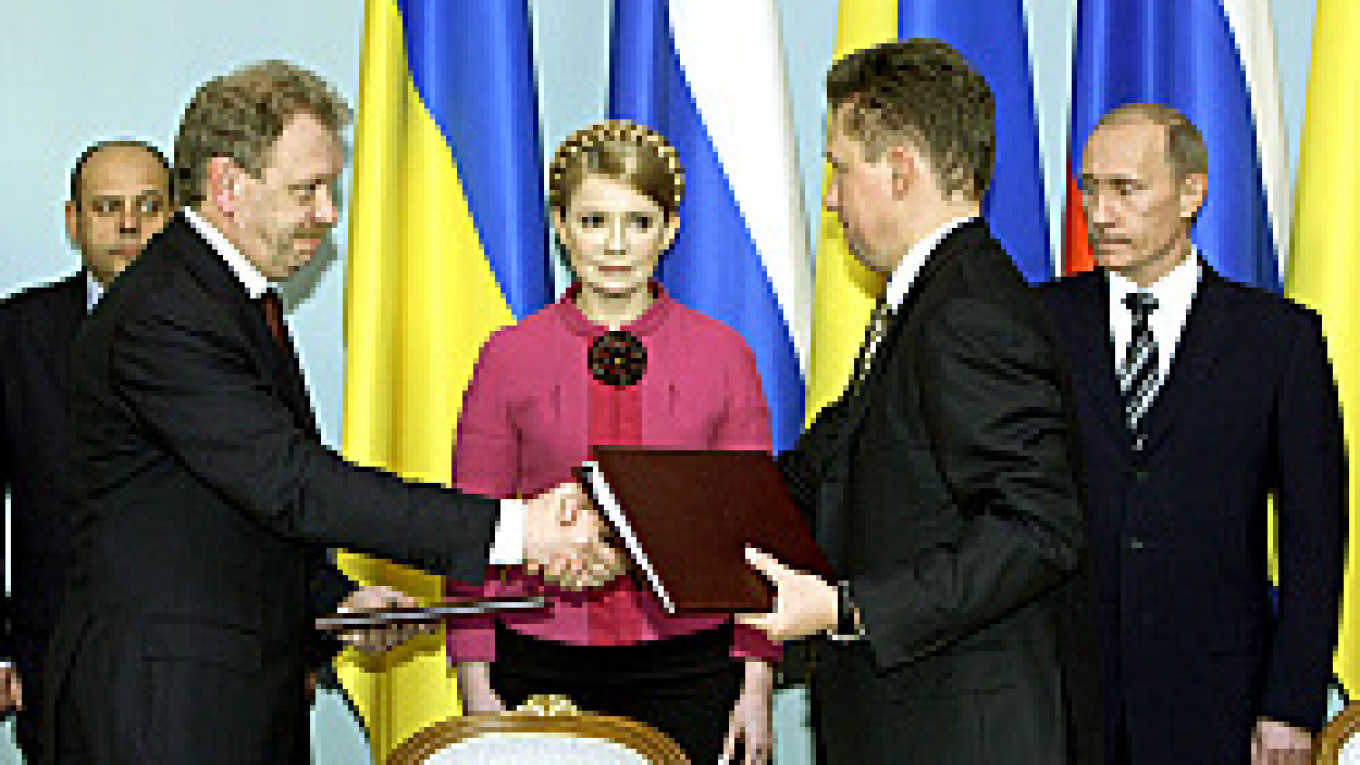
Officials at the signing ceremony in Moscow said gas would start flowing again soon across Ukraine to Europe, but the European Union said it would not consider the crisis over until its monitors register gas arriving at the bloc's borders.
Under the deal, Ukraine will buy Russian gas at a 20 percent discount to European market prices in 2009, while Kiev agreed to retain preferential transit fees for Russia this year before both sides switch to a market-based price formula from 2010.
"Gazprom received an order to start deliveries through all routes indicated by our Ukrainian partners and in full volumes," Prime Minister Vladimir Putin told a joint news conference with his Ukrainian counterpart, Yulia Tymoshenko.
The deal was signed by the chief executive of Russian gas export monopoly Gazprom, Alexei Miller, and the head of Ukrainian state energy firm Naftogaz, Oleh Dubyna.
The exact price was not disclosed, though Interfax quoted Tymoshenko as saying it would be less than $250 per 1,000 cubic meters -- more than the $179.5 Kiev paid last year but less than Russia's previous demand of $450.
"This agreement is a 10-year deal, as well as a second contract on transit that also assumes the use of a European formula for 10 years," Putin said.
The European Commission, which has expressed frustration that the row was hurting European consumers, said in a statement that it needed to know precisely when supplies would resume and that its monitors would verify when gas starts to flow.
"For the EU, the decisive moment will come when renewed supplies are registered at its borders," said Martin Riman, industry minister for the Czech Republic, which holds the EU's rotating presidency.
The deal should also restore gas for Ukrainian consumption, halted since Jan. 1, and relieve a shortage that forced output cuts at the steel and chemical plants that form the backbone of Ukraine's export-oriented economy.
"We have created an absolutely objective basis for gas prices and transit fees. This allows us to believe there will be no more debates, no more crises at the end of the year," Tymoshenko told the same news briefing.
Gazprom had previously said gas supplies would resume immediately after the signing. Once the taps are turned back on, it will take about 36 hours for the first Russian gas to cross Ukraine and enter Europe.
Putin told the news briefing that the dispute underlined the need for new supply routes for Russian energy.
"From our point of view, we need to diversify this gas flow to Europe. This concerns both the Nord Stream and South Stream [pipelines] and creating infrastructure for producing and delivering liquefied natural gas," Putin said.
The signing of a 10-year contract is likely to reassure European customers who up to now have had to endure annual wrangles over contract renewal, which carried with them the threat of supply disruptions.
Ukraine and Russia also agreed not to use intermediaries in their gas trade, Putin said. Previous deals have been complicated by the use of Swiss-based intermediary RosUkrEnergo, an opaque joint venture between Gazprom and two Ukrainian businessmen.
A Message from The Moscow Times:
Dear readers,
We are facing unprecedented challenges. Russia's Prosecutor General's Office has designated The Moscow Times as an "undesirable" organization, criminalizing our work and putting our staff at risk of prosecution. This follows our earlier unjust labeling as a "foreign agent."
These actions are direct attempts to silence independent journalism in Russia. The authorities claim our work "discredits the decisions of the Russian leadership." We see things differently: we strive to provide accurate, unbiased reporting on Russia.
We, the journalists of The Moscow Times, refuse to be silenced. But to continue our work, we need your help.
Your support, no matter how small, makes a world of difference. If you can, please support us monthly starting from just $2. It's quick to set up, and every contribution makes a significant impact.
By supporting The Moscow Times, you're defending open, independent journalism in the face of repression. Thank you for standing with us.

Remind me later.