

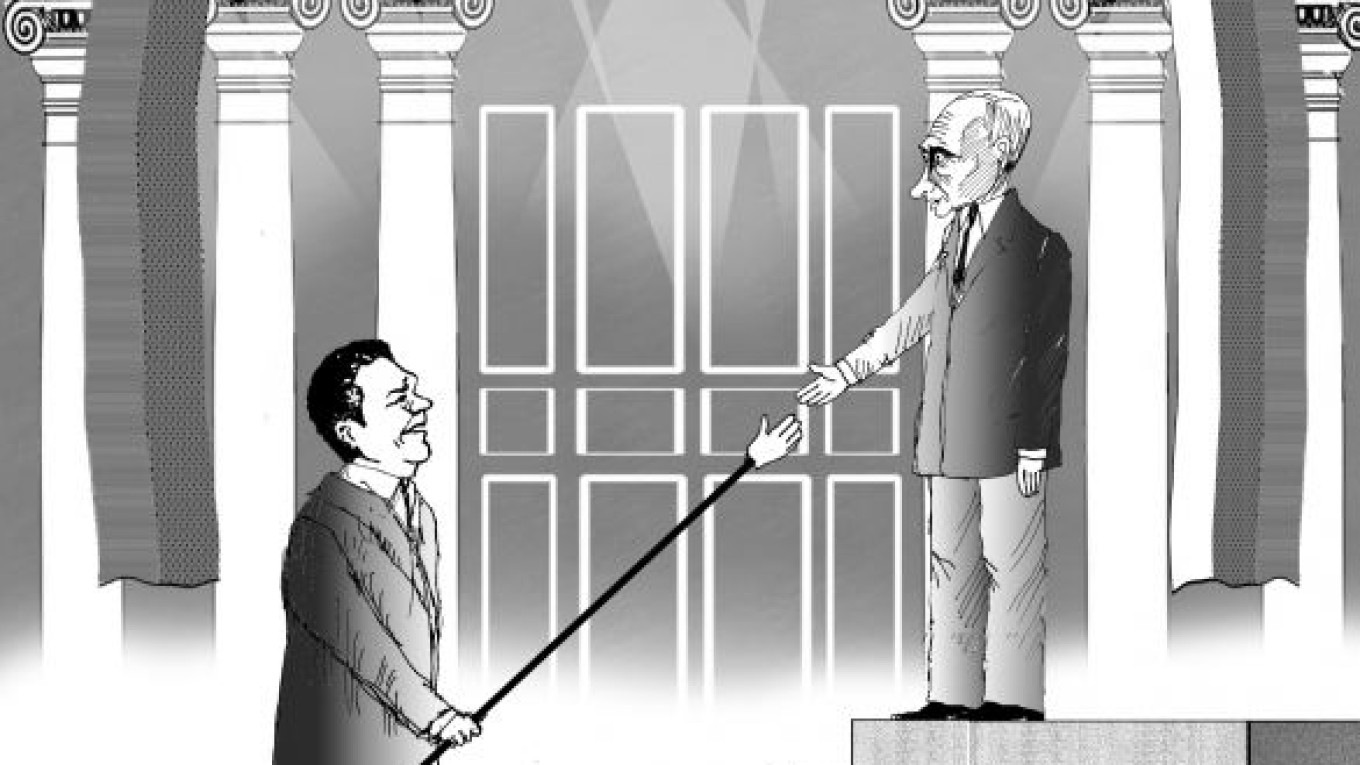
President Dmitry Medvedev’s visit to Kiev on May 17 and 18 is seven weeks away, but already rumors are circulating in both capitals that the new Ukrainian leadership will capitulate to the Kremlin on the most contentious issues. In Kiev, these rumors tend to come from opponents of President Viktor Yanukovych who are constantly trying to portray him as overly pro-Russian. In Moscow, the same rumors stress that Yanukovych leans toward Russia. The reality, however, is far more complex.
Recall that Yanukovych paid his first foreign visit to Brussels on March 1, and his Moscow trip followed on March 5. This sequence unfolded after Moscow slighted Yanukovych by sending State Duma Speaker Boris Gryzlov to head the Russian delegation at his inauguration on Feb. 25. Meanwhile, the European Union took an important symbolic step toward Yanukovych on the same day when the European Parliament adopted a resolution affirming the formal right of Ukraine to apply for EU membership, although Ukraine is far away from actually gaining membership.
In Brussels, Yanukovych succeeded in shaking off his anti-Western label, but his primary task in Moscow was to try to persuade Russian leaders that Russian-Ukrainian relations would begin to improve with his administration.
It was interesting to observe how the first summit between Yanukovych and Russia’s ruling tandem was reported by the Russian media. During their meeting, Yanukovych and Medvedev agreed to continue consultations on the presence of the Black Sea Fleet in Sevastopol, and the Kremlin-friendly media immediately responded with headlines along the lines of: “Yanukovych Reaches Agreement with Medvedev on the Black Sea Fleet!” Similarly, when Yanukovych said at the talks that he was ready to sign a law on the status of the Russian language in Ukraine, many of Russia’s media were quick to trumpet: “Yanukovych To Make Russian Second Official Language!” After returning to Kiev, however, Yanukovych said Ukrainian would remain the only state language.
When asked in Moscow about the controversial decision by former President Viktor Yushchenko to confer the title of Hero of Ukraine on Stepan Bandera, the Ukrainian nationalist who led an armed resistance movement in Western Ukraine against Soviet rule in the 1940s and 1950s, Yanukovych could offer only a vague answer because he is caught between a rock and a hard place — between the largely pro-Bandera western half of Ukraine and the largely anti-Bandera eastern half. Nonetheless, most of the Russian media left the impression that Yanukovych had already decided to revoke the title.
In Moscow-Kiev relations, Russia’s leaders often hear what they want to hear, but this has little to do with the real state of affairs. For example, when Yanukovych said, “We want to repair relations with Russia,” Prime Minister Vladimir Putin responded by saying, “Excellent! Then join the customs union with us.” But since a customs union with Russia would violate its membership terms in the World Trade Organization — a key component of Yanukovych’s overall pro-European foreign and economic policy — Yanukovych could not say “yes” to Putin’s proposal. But he didn’t say “no” either. And since Putin has a bad habit of succumbing to wishful thinking, if he doesn’t hear a definite “no,” he assumes it means “yes.”
The problem is that when Yanukovych ultimately does says “no” to Putin’s customs union proposal, Putin could very well say: “But back in March, you agreed to my proposal, Viktor Fyodorovich! Now you are going back on your word!” This disappointment and feeling of betrayal could strain relations, as it has in other circumstances. Putin’s a priori assumption that Yanukovych will — and should — agree to most or all of his proposals could seriously damage Russian-Ukrainian relations.
The question of gas prices remains the main stumbling block between Moscow and Kiev, and not surprisingly it was not discussed at the March 5 meeting. But Ukrainian Prime Minister Mykola Azarov did raise the point in the meeting with Putin on Thursday. But Putin basically said, “If you want lower prices, join our customs union.”
In exchange for some concessions from its side, Kiev would like to see Moscow renounce plans to build pipelines such as South Stream that bypass Ukrainian territory or to at least suggest a way that Ukraine could participate in those projects. But the pipeline plans have progressed too far by now to be renounced. Moscow, in turn, would like to gain at least partial ownership of the Ukrainian gas transport system, but for now Kiev is only ready to discuss this proposal as a form of concession and only with the EU playing a third-party role.
Of course, the numerous disagreements that have accumulated between Ukraine and Russia will not simply disappear with the change in presidents. And those observers are correct who point out that the current talks have done little more than to define what those differences are.
These talks have also shown that Russian politicians continue to act condescendingly toward their Ukrainian counterparts. Putin brilliantly demonstrated this during Yanukovych’s Moscow visit. In response to Yanukovych’s joke that he would be happy to send to Russia the provocateurs from the opposition who caused so many political problems in Ukraine, Putin said with his trademark sarcasm: “It would be better to send us some of your famous Ukrainian salo [salted pork fat].”
That joke will be remembered in Kiev for a long time to come, even if it ultimately proves possible to break the deadlock over the gas question.
Yevgeny Kiselyov is a political analyst and hosts a political talk show on Inter television in Ukraine.
A Message from The Moscow Times:
Dear readers,
We are facing unprecedented challenges. Russia's Prosecutor General's Office has designated The Moscow Times as an "undesirable" organization, criminalizing our work and putting our staff at risk of prosecution. This follows our earlier unjust labeling as a "foreign agent."
These actions are direct attempts to silence independent journalism in Russia. The authorities claim our work "discredits the decisions of the Russian leadership." We see things differently: we strive to provide accurate, unbiased reporting on Russia.
We, the journalists of The Moscow Times, refuse to be silenced. But to continue our work, we need your help.
Your support, no matter how small, makes a world of difference. If you can, please support us monthly starting from just $2. It's quick to set up, and every contribution makes a significant impact.
By supporting The Moscow Times, you're defending open, independent journalism in the face of repression. Thank you for standing with us.

Remind me later.