

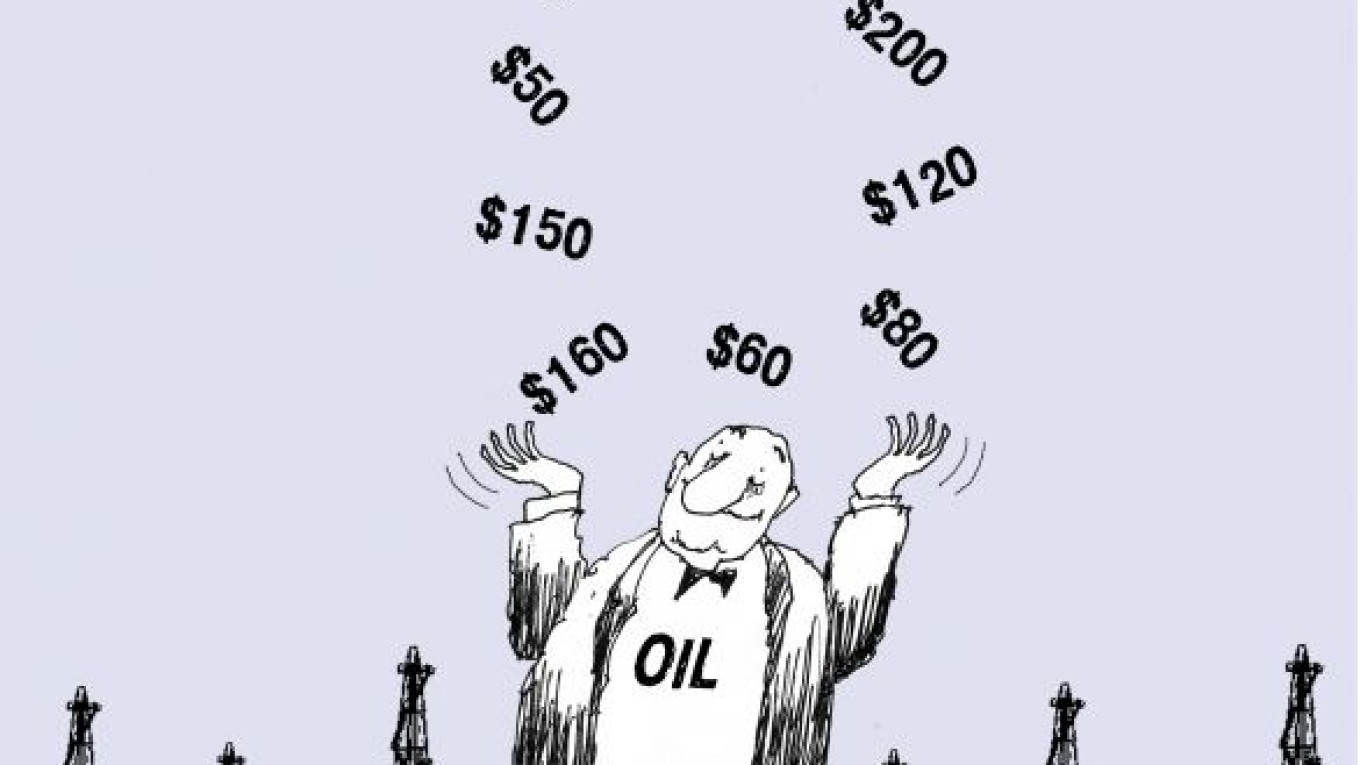
With global demand for oil rising and Libya supplying about 1 million barrels per day less than it did before the coalition bombing started on March 19, analysts at Bank of America Merrill Lynch have forecast that there is a 30 percent chance that the price of Brent crude will reach $160 per barrel in 2011.
In March, Finance Minister Alexei Kudrin said he did not rule out a short-term rise in oil prices to $150 to $200 per barrel. Many investment bankers who agree with this prediction are quick to warn that an increase in oil prices in this range could be a drag on global growth and even trigger a new economic crisis.
The experience of the past 35 years shows that researchers have at best a very limited ability to predict not only a price range for future oil prices, but even whether prices will increase or drop at all.
For Russia, the stakes are huge. Each additional dollar per barrel results in another 60 billion rubles (more than $2 billion) for the state coffers.
Almost all scholarly works written on the subject of oil price swings agree that there are so many factors that influence prices that there is no firm way of predicting them.
For example, British television showed a film in the early 1980s titled “Death of a Princess” that sparked a negative reaction among members of the Saudi royal family. Fears that Saudi Arabia would retaliate by cutting oil supplies caused the price to jump $2 per barrel almost overnight. Although the Saudi royal family cooled down shortly after the incident, the price of oil did not return to its former level.
Now oil prices are determined not so much by supply and demand — as was long thought to be the primary factor — but by financial markets. Most oil is currently traded using derivative financial instruments that are not based on the physical exchange of crude between seller and buyer. In the 1990s, physical transactions accounted for about 30 percent of oil traded, but they now number less than 1 percent.
Oil prices began soaring in 2005 when U.S. pension funds were permitted to invest in oil futures not based on the physical delivery of oil. U.S. Congress even convened a special hearing in 2008 to consider the influence that such speculation has on oil prices. It was reported that over the five previous years, institutional investors in the United States had driven up speculative demand by 848 million barrels — nearly equal to China’s 920 million barrel increase in actual demand for oil over the same period. U.S. analysts went on to calculate that each $100 million pumped into the oil market pushes the price per barrel up by 1.6 percent.
In effect, oil has become a speculative commodity whose price is determined by how investors anticipate its value will increase or decrease at a given point in the future.
That is why prices tend to reflect official projections. No sooner had Bank of America Merrill Lynch given its “bullish” prediction than the commodities market rallied and the price of oil surpassed $120 per barrel. Unfortunately, future trends are so dependent on subjective factors that prices at any given moment are impossible to predict.
Nonetheless, do analysts have at least some idea of an upper limit to prices?
The two dominant theories of the 1970s and 1980s held that oil prices were limited by the prices for alternative energy sources to crude oil or, by contrast, that the price ceiling was determined by the purchasing power of oil consumers who are also unable to reduce demand. This is partly true today.
But a new factor has entered the picture — energy efficiency. The main “energy resource” of the past 40 years was not oil but energy efficiency — the ability to save money by reducing consumption and using alternative energy sources. From 1972 to 2003, the power consumption component of global gross domestic product fell by the equivalent of 4.2 billion tons of oil, which was equivalent to the total production among all oil-producing nations in 2003.
Theoretically, then, a ceiling does exist for oil prices. But judging by the condition of the world’s financial markets, prices are still far from hitting that peak.
This comment appeared as an editorial in Vedomosti.
A Message from The Moscow Times:
Dear readers,
We are facing unprecedented challenges. Russia's Prosecutor General's Office has designated The Moscow Times as an "undesirable" organization, criminalizing our work and putting our staff at risk of prosecution. This follows our earlier unjust labeling as a "foreign agent."
These actions are direct attempts to silence independent journalism in Russia. The authorities claim our work "discredits the decisions of the Russian leadership." We see things differently: we strive to provide accurate, unbiased reporting on Russia.
We, the journalists of The Moscow Times, refuse to be silenced. But to continue our work, we need your help.
Your support, no matter how small, makes a world of difference. If you can, please support us monthly starting from just $2. It's quick to set up, and every contribution makes a significant impact.
By supporting The Moscow Times, you're defending open, independent journalism in the face of repression. Thank you for standing with us.

Remind me later.