

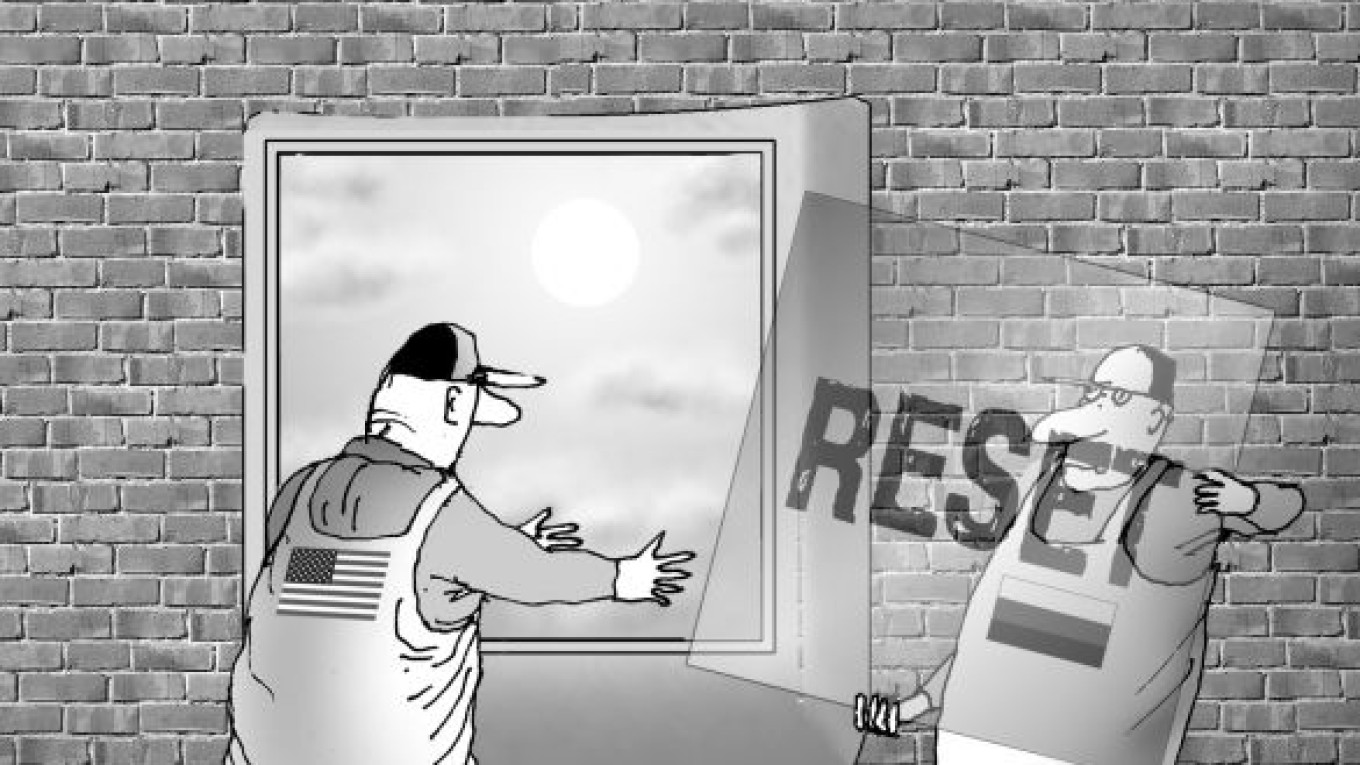
The ‘reset’ button has worked and … we are moving in a good direction,” U.S. President Barack Obama said after his fourth meeting with President Dmitry Medvedev on Nov. 15 — and with good reason. The two have vastly improved the atmosphere after the dark days immediately following Russia’s war against Georgia a year ago.
U.S. and Russian senior-level officials are more engaged with each other than they have been since the first year of the administration of former President George W. Bush. The Bilateral Presidential Commission provides a mechanism for engagement and to enforce follow-through on presidential commitments. More important, the reset is moving toward its first practical results, including the creation of a Russian transit corridor for lethal goods for U.S. and NATO forces in Afghanistan and the conclusion of a successor to the Strategic Arms Reduction Treaty that will lead to deeper reductions in both countries’ nuclear arsenals.
Yet relations remain fragile. Government officials in both countries continue to look at their counterparts’ motives with suspicion. The U.S. and Russian media still use the same old stereotypes by either depicting an authoritarian, anti-Western Russia from one side and a hegemonic, Russophobic United States from the other. Unfortunately, little attention is paid to explaining or analyzing the complex issues that divide U.S.-Russian relations.
Regarding the beginning stages of the reset, both sides need to ensure that the current wave of goodwill continues and does not end in sorrow, as similar ones did in the administrations of Bill Clinton and George W. Bush. But three main goals have to be achieved to support this foundation in U.S.-Russian relations.
First, and most urgent, a strategic framework for the bilateral relationship has to be built. Is the United States seeking long-term strategic cooperation or simply exploiting a temporary warming for tactical gain? How much time are a busy U.S. president and other senior officials prepared to devote to nourishing a complicated and often troubled relationship that does not promise quick successes? How far is each side prepared to help the other achieve its interests in exchange for help in achieving its own?
Ideally, the U.S. and Russian presidents should provide clear answers to these questions in public statements of strategy. That would energize and help discipline the bureaucracies. Barring that, the task falls to Foreign Minister Sergei Lavrov and Secretary of State Hillary Clinton. If the statements are not made, that in itself would send a powerful message that U.S.-Russian relations are a top priority for neither country. Frequent high-level contacts are no substitute for a well-crafted strategy. Then-President Vladimir Putin and Bush met face-to-face five times from their first meeting in Slovenia in June 2001 through the Moscow-St. Petersburg summit of May 2002, and we know where relations ended up at the end of their terms.
Second, the two sides need to clearly demonstrate their ability to cooperate for mutual gain. A START I follow-up treaty, although much-needed, will on its own not be enough because arms-control treaties assume a fundamental rivalry, not a partnership. The two areas that could best jump-start a substantive partnership are building civilian nuclear reactors in third countries and a joint missile defense system. Nuclear cooperation would seek to advance the ongoing civil nuclear energy renaissance by combining the two sides’ unique technologies and deep scientific talent to build more efficient and reliable reactors that are environmentally sound and proliferation-resistant. A joint missile defense system would offer a powerful symbol of the United States and Russia working together to defend the territory and vital assets of both countries from missile attack. Missile defense is clearly more problematic than civil nuclear energy because the United States is far advanced in the deployment of its own system, and the Russians understandably will resist joining as a junior partner. But a system that weds superior U.S. battle management capabilities with superior Russian missile propulsion technology would prove more capable than what is now being built.
Third, the two nations need to find a way to engage both societies more extensively. The much-maligned working group on civil society — headed by Obama’s top adviser on Russia, Michael McFaul, and Medvedev’s first deputy chief of staff, Vladislav Surkov — could play a major role by identifying issues of mutual concern and then requesting U.S. and Russian nongovernmental organizations, think tanks and universities to work together on these issues. They could include domestic problems, such as immigration, corruption, public health and education, as well as foreign policy issues, such as Iran and trans-Atlantic security. In addition, the two governments should work to facilitate issuance of visas and ease customs bottlenecks to encourage greater trade and investment and reinforce business support for improved relations.
If both sides can advance relations in these areas, this will help facilitate the transition from the first phase of reset, dominated by rhetoric, to the second phase: concrete action.
Thomas Graham was senior director for Russia on the U.S. National Security Council from 2004 to 2007.
A Message from The Moscow Times:
Dear readers,
We are facing unprecedented challenges. Russia's Prosecutor General's Office has designated The Moscow Times as an "undesirable" organization, criminalizing our work and putting our staff at risk of prosecution. This follows our earlier unjust labeling as a "foreign agent."
These actions are direct attempts to silence independent journalism in Russia. The authorities claim our work "discredits the decisions of the Russian leadership." We see things differently: we strive to provide accurate, unbiased reporting on Russia.
We, the journalists of The Moscow Times, refuse to be silenced. But to continue our work, we need your help.
Your support, no matter how small, makes a world of difference. If you can, please support us monthly starting from just $2. It's quick to set up, and every contribution makes a significant impact.
By supporting The Moscow Times, you're defending open, independent journalism in the face of repression. Thank you for standing with us.

Remind me later.