

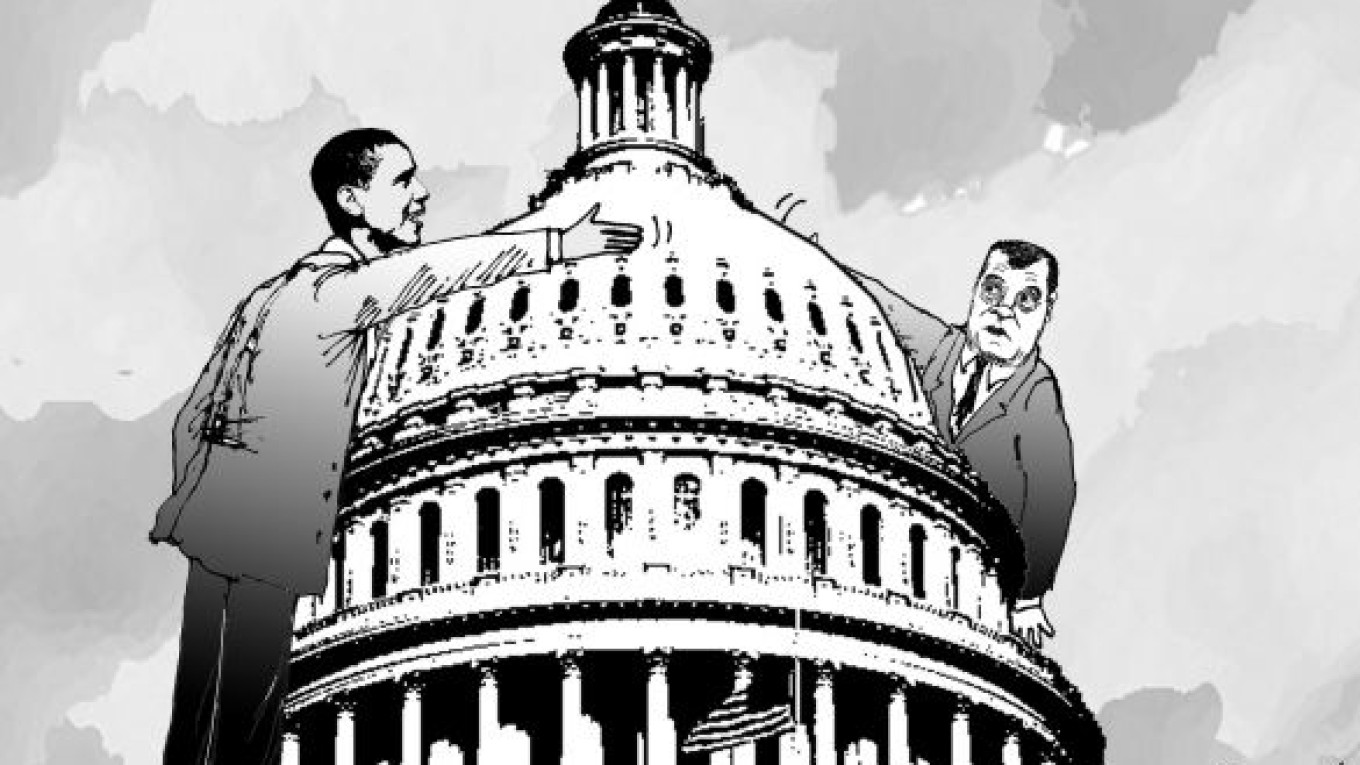
A year ago, when the administration of U.S. President Barack Obama initiated its “reset” of U.S.-Russian relations, two things were clear: First, the U.S. Congress, particularly the Senate, would have an outsized role to play in the process; and, second, the Democrats would likely have a fillibuster-proof 60 votes in the Senate, making the advancement of Obama’s major Russia policy overtures a bit easier than might otherwise be the case. A year later, the first proposition remains true, but Republican Scott Brown’s recent upset victory in the Massachusetts Senate race complicates the second since Democrats no longer have 60 seats in the Senate— the threshold that allows a party to pass legislation on a “fast track” by depriving the opposing party of its ability to filibuster. All of this means that there could be some turbulence in U.S.-Russian relations in 2010.
While the reset was partly about changing the tenor of U.S.-Russian relations, a lot of it was about policy. Congress is a decisive player on much of that policy. The Obama administration’s two major Russia initiatives — the follow-on agreement to the expired Strategic Arms Reduction Treaty, or START, and the Comprehensive Test Ban Treaty, or the CTBT — will require Senate ratification.
START, the flagship arms control agreement between the United States and Russia and the centerpiece of Obama’s reset policy, should be the easier sell in the Senate. There is broad, bipartisan consensus on the basic thrust of the treaty, which seeks to limit nuclear warheads and delivery systems on both sides in a transparent and verifiable manner. The original START agreement passed in 1992 by an overwhelming margin of 93-6, easily exceeding the 67-vote threshold required for ratification.
But things have changed a lot since 1992. The honeymoon of the early and mid-1990s in U.S.-Russian relations is long gone. Russia has backtracked dramatically on democracy and media freedom, to the consternation of many in Congress. And the Eurasian giant has, in the view of many U.S. policymakers, repeatedly bullied smaller neighbors, including a series of provocations aimed at Georgia that played a role in the outbreak of the Russia-Georgia war of 2008.
Perhaps more important, after the polarizing presidencies of Bill Clinton and George W. Bush, both of whom served two four-year terms, U.S. foreign policy has become vastly more politicized than it was a generation ago, during the era of President George H.W. Bush. It used to be that “politics stopped at the water’s edge,” but that principle seems to have stopped at the 20th-century’s edge. When George H.W. Bush called on the Senate to ratify START in 1992, five of the six “nay” votes came from his fellow Republicans; only one Democratic senator balked. Those days of large-scale aisle crossing are gone. Today, virtually every foreign policy issue — from arms control to climate change to even humanitarian assistance to Haiti — seems to be viewed by many members of both parties through the prism of campaign politics.
The upshot is that START ratification is going to be an uphill battle for the Obama administration. Substantively, many Republicans, and some Democrats, have concerns about key provisions of the accord, particularly, those pertaining to verification provisions. In addition, many senators have expressed concerns that START shouldn’t be ratified unless they can secure guarantees that the reduced U.S. nuclear arsenal will be sufficiently modernized. Politically, the Republicans, emboldened by strong state-wide victories in recent months in Virginia, New Jersey and now Massachusetts, will be disinclined to hand Obama a significant foreign policy achievement in advance of midterm elections in the fall.
Getting the CTBT ratified will be even tougher. As a candidate, Obama made the CTBT a major focal point of his foreign policy platform, promising to “build consensus behind ratification of the Comprehensive Test Ban Treaty.” That consensus was elusive in 1999, the last time that the treaty was put to a test in the Senate, and will likely be even more elusive in 2010. In 1999, ratification failed by a margin of 48-51 — well short of the requisite 67 votes. The vote went down largely along party lines, with most Democrats supporting the agreement and most Republicans opposing it. In 2010, the congressional terrain looks equally forbidding for CTBT passage.
Congress is a major factor on other Russia policy issues as well. Russian accession to the World Trade Organization is a case in point. Congressional action would be required to upgrade Russia, the largest economy not yet represented in the WTO, from the Cold War-era lows of the Jackson-Vanik amendment to establish normal trade relations, which are required to secure U.S. agreement to Russia’s accession to the WTO. Russian WTO accession seems to be on the Obama administration’s congressional to-do list in 2010, but in the current cold trade climate — Russia just banned U.S. poultry imports, valued at $800 million a year — the issue is going to be as contentious as ever. That may be why Russian officials have sent mixed signals as to whether Russia itself will pursue WTO accession aggressively.
Congressional approval would also be required for the United States to enter into a “123” agreement with Russia on civil nuclear cooperation. This important area that had progressed nicely during George W. Bush’s last year in office was put on ice after the eruption of the Russia-Georgia war.
As far as U.S.-Russian relations are concerned, 2010 is truly the “Year of Congress.” It appears less likely, however, that it is going to be the “Year of Results.”
David J. Firestein, a career U.S. diplomat who served as deputy spokesman at the U.S. Embassy in Moscow from 1998 to 2001, is director of Track 2 Diplomacy at The EastWest Institute, based in New York.
A Message from The Moscow Times:
Dear readers,
We are facing unprecedented challenges. Russia's Prosecutor General's Office has designated The Moscow Times as an "undesirable" organization, criminalizing our work and putting our staff at risk of prosecution. This follows our earlier unjust labeling as a "foreign agent."
These actions are direct attempts to silence independent journalism in Russia. The authorities claim our work "discredits the decisions of the Russian leadership." We see things differently: we strive to provide accurate, unbiased reporting on Russia.
We, the journalists of The Moscow Times, refuse to be silenced. But to continue our work, we need your help.
Your support, no matter how small, makes a world of difference. If you can, please support us monthly starting from just $2. It's quick to set up, and every contribution makes a significant impact.
By supporting The Moscow Times, you're defending open, independent journalism in the face of repression. Thank you for standing with us.

Remind me later.