

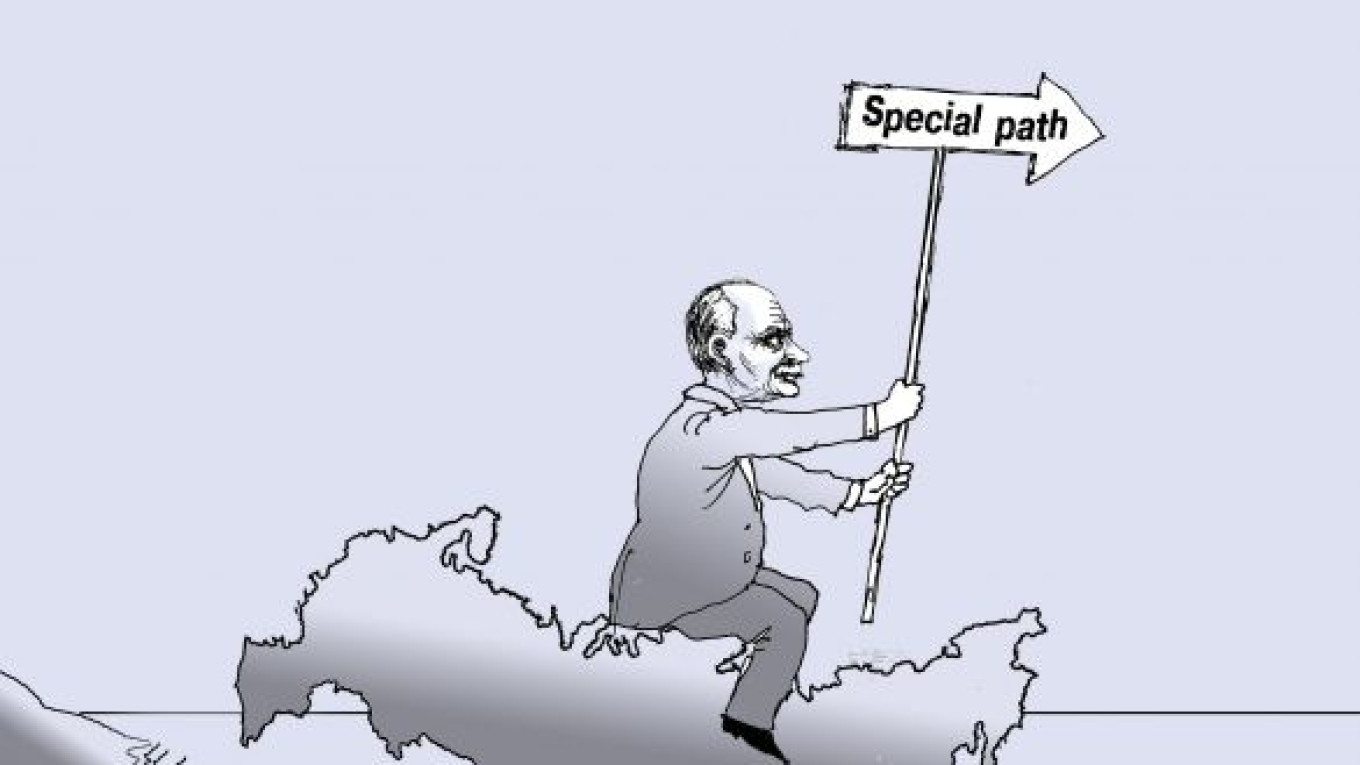
Film director and self-proclaimed monarchist Nikita Mikhalkov caused a big stir Wednesday when he released his 10,000-word political manifesto titled “Right and Truth.”
The main theme of the manifesto was that Russia needs a strong leader who will guide the country along its “special path” to become prosperous and powerful. This is nothing new. Mikhalkov has expressed these views in numerous television appearances, newspaper articles and in his films. The only possibly new aspect was his stress on “enlightened conservatism,” which jibes with United Russia’s vaguely formulated ideology that is supposed be based on “conservative values” and “conservative modernization.”
The manifesto comes several days after the Russian Union of Rights Holders — under the aegis of the Cinematographers’ Union, which Mikhalkov heads —? won the right to collect 1 percent fees from electronic devices and blank media for redistribution among rights holders — a business estimated to be worth $100 million a year.
What type of government and civil society does Mikhalkov view as ideal for Russia? To become a “geopolitical and spiritual center of the world,” Russia needs to follow its own, unique blend of enlightened conservatism. After all, “we are no Honduras,” he reminded us.
It was comforting that Mikhalkov did not mention among his inspirations Count Sergei Uvarov, who is most famous for his ideological formula “Orthodoxy, Autocracy and Nationality.” Nonetheless, Mikhalkov does include pre-revolutionary conservative, monarchist thinkers Konstantin Pobedonostsev and Konstantin Leontyev, as well as 20th-century conservative thinkers Pyotr Struve, Nikolai Berdyayev and Ivan Ilyin.
Considering Mikhalkov’s stances, these choices are not surprising, but it is important to clarify which of the philosophers’ theses Mikhalkov would like to prescribe for Russia’s future enlightened conservatism.
For example, Pobedonostsev fiercely criticized the Russian judicial system at the end of the 19th century. “When the courts are separate from the state (in our grief this has already been done), it becomes a tool of the ruling party. … A united authority is Russia’s only guarantee of truth. …? [In the West,] there are lies, fatal lies for Russia.” If Mikhalkov is suggesting that we follow Pobedonostsev’s legal and judicial conceptions, it will be quite difficult, to say the least, to create an honest and independent court system that follows the law rather than simply obeying the Kremlin’s instructions.
Leontyev opposed not only political liberalism, but also technological progress, including railways. This is also a questionable ideological foundation for advancing Russia’s modernization agenda.
Mikhalkov’s choice of Ilyin is also disturbing. At the beginning of the 1930s, while in exile in Europe, he was not devoid of certain Nazi sympathies. ?
Above all, it is not clear what exact kind of conservatism Mikhalkov prescribes to “modernize” Russia: Orthodox, monarchial or Soviet? If he meant Soviet, this is hardly inspiring, particularly considering the stagnation and deep economic degradation of the 1970s and 1980s.
Mikhalkov believes that Russians should obey the law not because they fear punishment, but because they understand the intrinsic fairness of the law — both secular and religious. Who would oppose the argument that it is better to be law-abiding than nihilistic?
The big question, of course, is how to achieve law-abidingness. Unfortunately, Mikhalkov does not answer this question. He only insists that the state must play a strong and dominant role in society.
To be sure, Russians, too, have an important role to play in building enlightened conservatism: They are assigned the role of practicing “loyalty, obeying authoritative power and respecting rank.” A peaceful union between citizens and the state is best achieved, we are told,? through “civil and church obedience, not administrative coercion.”
The construction of a constitutional monarchy has a special place in the manifesto. Strengthening the federal vertical power structure must occur alongside the strengthening of local and regional power structures. This thesis, however, goes against 19th and 20th century Russian history, when Moscow consistently viewed local power bases as “fifth wheels.”
Throughout his career as a director and a de facto political and ideological mouthpiece for the Kremlin, Mikhalkov has truly embodied one of goals in his manifesto: “to create an atmosphere of power, to produce and distribute virtual myths that will provide an identity for the nation, individual and state.”
This comment appeared as an editorial in Vedomosti.
A Message from The Moscow Times:
Dear readers,
We are facing unprecedented challenges. Russia's Prosecutor General's Office has designated The Moscow Times as an "undesirable" organization, criminalizing our work and putting our staff at risk of prosecution. This follows our earlier unjust labeling as a "foreign agent."
These actions are direct attempts to silence independent journalism in Russia. The authorities claim our work "discredits the decisions of the Russian leadership." We see things differently: we strive to provide accurate, unbiased reporting on Russia.
We, the journalists of The Moscow Times, refuse to be silenced. But to continue our work, we need your help.
Your support, no matter how small, makes a world of difference. If you can, please support us monthly starting from just $2. It's quick to set up, and every contribution makes a significant impact.
By supporting The Moscow Times, you're defending open, independent journalism in the face of repression. Thank you for standing with us.

Remind me later.