

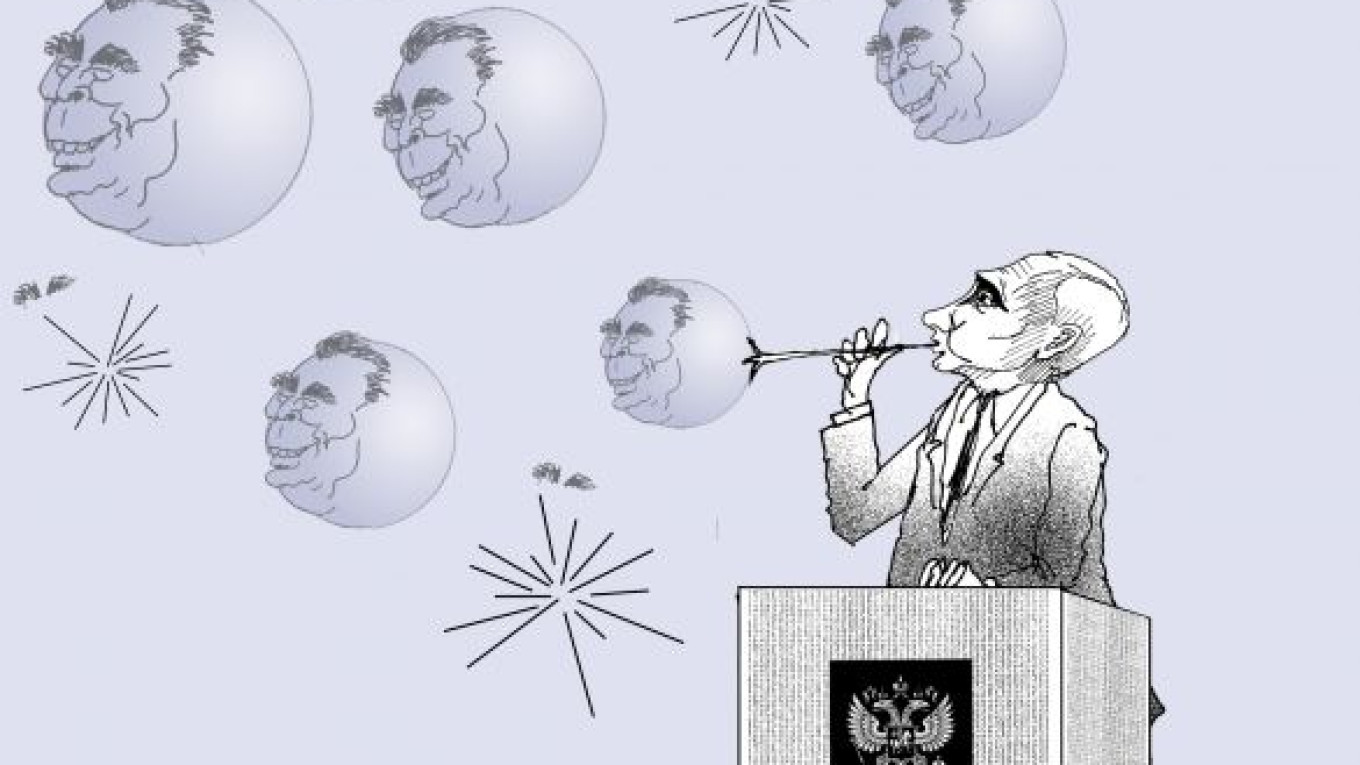
At the beginning of the second decade in control of the country, Prime Minister Vladimir Putin is becoming more and more like former Soviet leaders — not so much like Stalin, but more like Leonid Brezhnev. At an average of four hours each, Putin’s speeches before the State Duma and national television audiences have become just as amorphous and lacking substance. And like Brezhnev’s speeches, Putin’s address to the Duma on Wednesday was interrupted by applause 53 times. Like during Brezhnev’s time, Putin spoke before politicians who were members of his own party.
In the second half of the 1970s, when economic reforms had completely failed, economic growth had slowed and the country’s science and technology had fallen increasingly behind that of developed countries, the Soviet leadership didn’t speak about the country’s growing problems, falsified statistics and, as a divergence tactic, consistently promised progress and prosperity in the next 10 or 20 years.
Russians were fed rosy promises of an imminent solution to the food deficits, guaranteed housing for everyone and sustained economic growth, even while it was clear to everyone that their standards of living were only deteriorating with each passing year. The budget deficit deepened, lines for goods and services became longer, prices for basic items rose each year, and the wait to obtain an apartment or car stretched for years.
We are seeing the same Brezhnev-like stagnation today, including the official silence regarding the country’s deep economic and political problems, the manipulation of statistics and rampant alcoholism and drug abuse.
In his four-hour address to the Duma last week, Putin did not mention any of his failures during his first 10 years in office — a period in which he did not fulfill a single major promise.
Remember the famous promise of reaching Portugal’s per capita GDP by 2015? Only four years away, there is clearly no way that Russia will close the gap.
What’s more, during his Duma speech he promised to miraculously double Russia’s per capita GDP to $35,000 by 2020 from its current $15,837 (based on the International Monetary Fund’s purchasing power parity ranking). He also said Russia is bound to become one of the world’s top five economies by 2020. We already heard this promise in 2007; instead, Russia has dropped down to the No. 10 spot.
Putin did not mention that he failed to diversify the Russian economy or to reduce its dependence on exports and imports. Neither did he take any responsibility for corruption having increased tenfold during his rule. And Putin conveniently avoided answering the question of why the Russian economy is in a deep crisis, while the economies of its main BRIC rivals — India, China and Brazil — have shown steady growth.
Instead, Putin generously showered the Duma deputies and national television audience with new Brezhnev-like promises, many of which we have already heard over the past 10 years. He promises to increase life expectancy, modernize infrastructure, make the ruble a world reserve currency, turn Moscow into an international financial center and, to top them all, once again “solve the housing problem.”
Putin also relied on his tried-and-true boogeyman — the opposition — by referring to it as “elements that seek to destabilize the country” and even comparing it to “harmful bacteria in a healthy human body.” In Putin’s view, the main danger to the state is from liberals and “social demagogues,” an allusion to the Communists. He also said Russia needs to show the world that it is powerful. Otherwise, the country could fall under “foreign command.”
Putin characterizes political competition and struggle as a “quasi-political flu” that is dangerous to the state. That is a classic totalitarian and authoritarian understanding of the relationship between the state and the people.
In an unsettling coincidence, Putin addressed the Duma on the 122nd anniversary of Hitler’s birth. But this may be more than a coincidence since Putin repeated almost verbatim several of Hitler’s maxims about the state.
As the fuhrer wrote in “Mein Kampf:” “The state is a national organism and not an economic organization. The meaning and purpose of the existence of the state is to ensure that the people have enough to eat and occupy a fitting place in government.”
Hitler also insisted that the ruler should remain in power as long as possible in order to guarantee national stability and to bring ambitious, long-term programs to fruition. Sound familiar?
Vladimir Ryzhkov, a State Duma deputy from 1993 to 2007, hosts a political talk show on Ekho Moskvy radio.
A Message from The Moscow Times:
Dear readers,
We are facing unprecedented challenges. Russia's Prosecutor General's Office has designated The Moscow Times as an "undesirable" organization, criminalizing our work and putting our staff at risk of prosecution. This follows our earlier unjust labeling as a "foreign agent."
These actions are direct attempts to silence independent journalism in Russia. The authorities claim our work "discredits the decisions of the Russian leadership." We see things differently: we strive to provide accurate, unbiased reporting on Russia.
We, the journalists of The Moscow Times, refuse to be silenced. But to continue our work, we need your help.
Your support, no matter how small, makes a world of difference. If you can, please support us monthly starting from just $2. It's quick to set up, and every contribution makes a significant impact.
By supporting The Moscow Times, you're defending open, independent journalism in the face of repression. Thank you for standing with us.

Remind me later.