

"New horizons are opening up.”
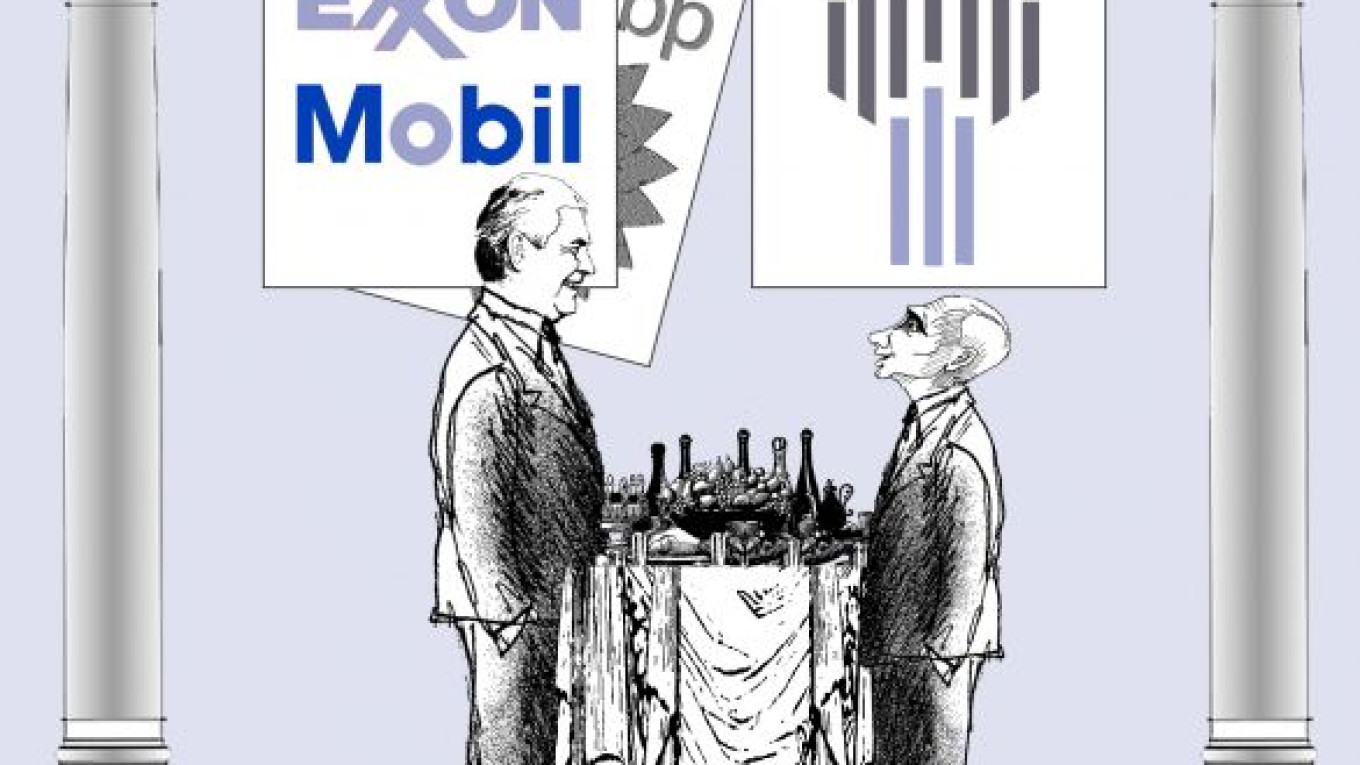
This is how Prime Minister Vladimir Putin expressed his satisfaction Tuesday in Sochi about a strategic agreement signed by ExxonMobil and state-controlled Rosneft. Under the deal, Exxon will gain access to oil and gas deposits in Russia’s portion of the Arctic Ocean and the Black Sea, while Rosneft will have the right to purchase stakes in at least six Exxon projects in the Gulf of Mexico and Texas. The investments from both sides could reach as high as $500 billion, Putin said.
But it is too early to pop open the champagne. We have seen this before. In January, an $8 billion stock swap between BP and Rosneft was announced that included plans to jointly develop the same Arctic oil sites. It would almost seem that the January signing ceremony was a dress rehearsal for this week?€™s deal. In both cases, all the attributes were present: smiles, congratulations, optimistic forecasts, Deputy Prime Minister Igor Sechin and Putin, who blessed the deal.
Nonetheless, the BP agreement collapsed in May. As if to drive home the point that Russia is a risky place to do business, BP?€™s Moscow office was raided on Wednesday, the day after the Exxon-Rosneft agreement was signed. And this was not the first raid in the company?€™s troubled history here.
The Exxon-Rosneft deal will certainly face its share of roadblocks as well. The first problem, though, is located far from Russia — the U.S.? Congress. Conservative lawmakers will likely ask the Committee on Foreign Investment ?€” a U.S. interagency government body that has the power to block foreign investment if it is considered an economic security risk ?€” to review Rosneft?€™s plans. After all, this would be the first time a state-controlled Russian company would acquire ownership stakes in U.S.-based oil and gas assets.
Notably, the BP-Rosneft deal raised U.S. security concerns early this year. Congressman Edward Markey, who quipped that BP could turn into “Bolshoi Petroleum?€? if the deal went through, warned against the strong-armed tactics of Russian state-controlled oil and gas companies, particularly since BP supplies oil to the U.S. military. This anti-Russian sentiment does not bode well for the Exxon-Rosneft agreement, which will surely get an icy reception among the more fervent Russia critics in Congress, particularly in an election year.
A 2005 attempt by China?€™s state oil company, CNOOC, to acquire California-based Unocal for $13 billion may also offer a preview of what is in store for Exxon-Rosneft. U.S. lawmakers opposed the deal on the grounds that the Chinese would gain access to sensitive U.S. deep-sea exploration and drilling technology with dual-use potential. In the end, CNOOC withdrew its bid, citing political pressure. Conservative U.S. lawmakers will probably raise similar arguments against Rosneft, which is keen on gaining access to deep-water Gulf of Mexico sites.
There are, of course, many differences between the CNOOC-Unocal and Exxon-Rosneft deals. But hardened Russia critics in Congress, most of whom are Republicans, could still try to use ?€?economic security?€? as a pretext to a achieve a larger tactical goal in an election year: to undermine the ?€?reset,?€? U.S. President Barack Obama?€™s pet project and one of his few foreign policy successes.
The Exxon-Rosneft deal is particularly important for U.S.-Russian relations because it offers a chance to upgrade the reset from a political project to a major economic one. ?€?We have been extraordinarily successful partners in moving toward reset,?€? Obama said in an interview published by Itar-Tass in early August. ?€?Now, moving forward, I think the key is economics.?€?
But for hard-core Obama opponents, the reset is easily expendable as long as it will help them discredit Obama. This, once again, underscores the danger of mixing politics and business.
The much bigger hurdle for the Exxon-Rosneft deal, however, is Russia itself and its unpredictable business environment. Recall when authorities applied pressure on Royal Dutch Shell to sell 50 percent of Sakhalin-2 to Gazprom in 2006 and pushed BP to cede its majority control of the huge Kovykta gas field in eastern Siberia to Gazprom a year later.
But Exxon itself should know the political risks of doing business in Russia as well as anyone. In mid-October 2003, then-Exxon CEO Lee Raymond and Yukos CEO Mikhail Khodorkovsky were just about to sign a deal in which the U.S. giant would buy 40 percent of YukosSibneft. Then, two weeks later on Oct. 25, Khodorkovsky was arrested on fraud and tax evasion charges.
So before Exxon CEO Rex Tillerson gets too excited about the Rosneft deal, perhaps he should have a good, long talk with BP CEO Bob Dudley, who can tell him a lot about how much Putin?€™s ?€?blessing?€? is really worth.
Michael Bohm is opinion page editor of The Moscow Times.
A Message from The Moscow Times:
Dear readers,
We are facing unprecedented challenges. Russia's Prosecutor General's Office has designated The Moscow Times as an "undesirable" organization, criminalizing our work and putting our staff at risk of prosecution. This follows our earlier unjust labeling as a "foreign agent."
These actions are direct attempts to silence independent journalism in Russia. The authorities claim our work "discredits the decisions of the Russian leadership." We see things differently: we strive to provide accurate, unbiased reporting on Russia.
We, the journalists of The Moscow Times, refuse to be silenced. But to continue our work, we need your help.
Your support, no matter how small, makes a world of difference. If you can, please support us monthly starting from just $2. It's quick to set up, and every contribution makes a significant impact.
By supporting The Moscow Times, you're defending open, independent journalism in the face of repression. Thank you for standing with us.

Remind me later.