

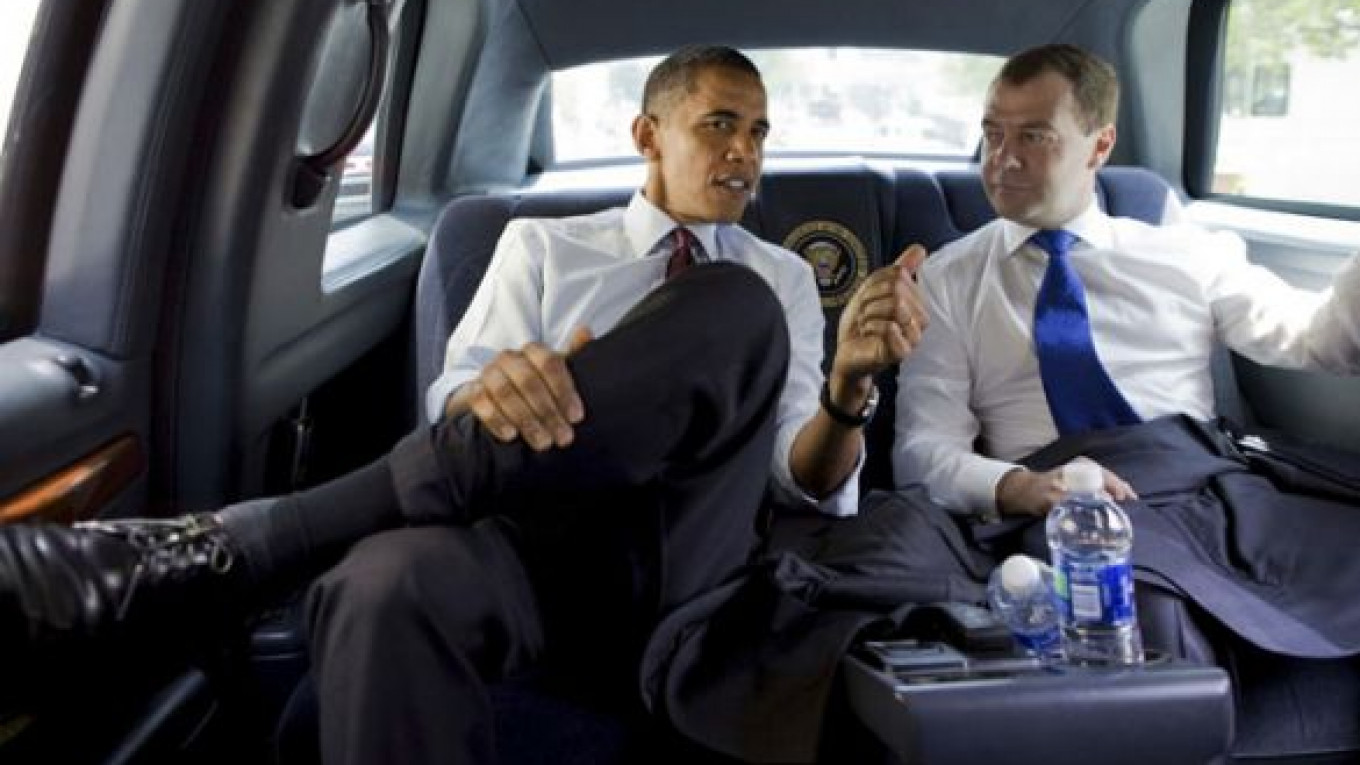
The U.S. arrest of 10 suspected Russian spies right after President Barack Obama welcomed President Dmitry Medvedev to the White House deals a stinging blow to resurgent ties and might discredit Obama, who sees the "reset" of relations as a main achievement of his administration, Russian officials said Tuesday.
Russian authorities refused to say whether the suspects were indeed "illegals," as claimed by the U.S. Justice Department in court papers filed Monday, and said they were waiting for an explanation from the United States.
"The issue was not explained to us. I hope they will explain," Foreign Minister Sergei Lavrov told journalists in Jerusalem.
The Justice Department said the suspects, detained in raids in New York, Boston and northern Virginia on Sunday, had been collecting information for the Foreign Intelligence Service for at least seven years, and possibly as far back as the early 1990s.
"The choice of timing was particularly refined," Lavrov said sarcastically, referring to the fact that the arrests occurred after Obama met with Medvedev on Thursday for a visit widely seen as the latest step in the "reset" of relations between the former Cold War rivals.
A source in Obama's administration said the president was not happy about the timing of the arrests, but investigators feared that some of their suspects might flee, The New York Times reported.
The arrests might have been spurred by an FBI sting operation on Saturday in which one of the suspects, Anna Chapman, was given a fake passport by FBI operatives posing as Russian agents to pass on to someone else. Chapman instead turned the passport over to New York police, her lawyer said in court Monday. The police visit, if leaked to the media, could have potentially blown the entire FBI operation.
The Foreign Ministry confirmed that several suspects were Russian citizens, and NTV television identified two of them as Chapman and Mikhail Semenko.
The suspects, who are not accused of espionage, have been charged with conspiracy to act as an agent of a foreign government without notifying U.S. authorities, a crime punishable by up to five years in prison. Nine of the suspects also have been charged with money laundering, which carries a conviction of up to 20 years.
An 11th suspect was detained in Cyprus on Tuesday but released on bail.
"In total, 11 defendants, including the 10 arrested, are charged in two separate criminal complaints with conspiring to act as unlawful agents of the Russian Federation within the United States," the Justice Department said in a statement.
This case is the result of a multiyear investigation conducted by the FBI; the U.S. Attorney’s Office for the Southern District of New York; and the Counterespionage Section and the Office of Intelligence within the Justice Department’s National Security Division, the statement said.
The Foreign Ministry said in a statement that it did not understand what motivated the U.S. Justice Department to publicly speak in the spirit of "spy passions dating back to the times of the Cold War." It said the "unfounded" arrests pursued "unseemly goals" that contradicted the "reset" in U.S.-Russian ties proclaimed by the Obama administration.
Putin took a low-key approach to the arrests.
"Back at your home, the police went out of control [and] are throwing people in jail," Putin told former U.S. President Bill Clinton during a meeting in Moscow. "But that's the kind of job they have. I hope that all the positive gains that have been achieved in our relationship will not be damaged by the recent event."
In Washington, the State Department said Tuesday that the spy case would not derail "reset" efforts. "We feel that we have made significant progress in the 18 months that we have been pursuing this different relationship with Russia. We think we have something to show for it," Assistant Secretary of State Philip Gordon told reporters.
But Gennady Gudkov, a former KGB counterintelligence official who serves as deputy head of the State Duma's Security Committee, said the spy allegations threaten to upset the "reset" by tarnishing Russia's image in the eyes of the American people and could have been masterminded by opponents hoping to discredit Obama.
"Now millions of Americans will think that Russia was only pretending to be a partner of the United States but is in fact still going after U.S. secrets like during the Cold War," he told The Moscow Times.
He said the timing of the arrests sharply departed from a time-honored tradition by intelligence services to lay low before, during and immediately after major foreign policy efforts by national leaders in order to avoid spoiling them.
"It looks like the work of someone who is very powerful and in the political opposition to Obama, or a hawkish military and intelligence group not happy with the reset of relations with Russia," Gudkov said.
Another former top spook, Nikolai Kovalyov, pointed to a number of discrepancies in the Justice Department's case as proof that it was an attempt to undercut Obama's "reset" effort.
In addition to the timing of the arrests, Kovalyov said details in U.S. court papers about the suspects using invisible ink, fake documents and even transferring money by burying it in a glass jar for retrieval months later were "complete nonsense" and sounded like "a cheap detective novel," Interfax reported. Kovalyov, a former director of the Federal Security Service, heads the Duma's Veterans Committee.
The Foreign Intelligence Service refused to comment Tuesday.
The Cold War era saw several high-profile spy cases, dating back to the arrests of Russian agents like the Rosenberg couple in 1951 and Colonel Rudolf Abel in 1957.
More recently, senior FBI official Robert Hanssen was detained in February 2001 and sentenced to life in prison later that year for spying for the Soviet Union and then Russia for 15 years. His involvement with Russian intelligence was described by the Justice Department in 2002 as "possibly the worst intelligence disaster in U.S. history."
Hanssen was arrested two months after then-President Putin pardoned U.S. businessman Edmond Pope, who was sentenced in 2000 to 20 years in prison on charges of collecting information about a secret Russian torpedo.
The Hanssen and Pope scandals did not prevent a brief rapprochement between Moscow and Washington later in 2001 after the Sept. 11 terrorist attacks against the United States and Putin's offer to help in the subsequent "war on terror."
A Message from The Moscow Times:
Dear readers,
We are facing unprecedented challenges. Russia's Prosecutor General's Office has designated The Moscow Times as an "undesirable" organization, criminalizing our work and putting our staff at risk of prosecution. This follows our earlier unjust labeling as a "foreign agent."
These actions are direct attempts to silence independent journalism in Russia. The authorities claim our work "discredits the decisions of the Russian leadership." We see things differently: we strive to provide accurate, unbiased reporting on Russia.
We, the journalists of The Moscow Times, refuse to be silenced. But to continue our work, we need your help.
Your support, no matter how small, makes a world of difference. If you can, please support us monthly starting from just $2. It's quick to set up, and every contribution makes a significant impact.
By supporting The Moscow Times, you're defending open, independent journalism in the face of repression. Thank you for standing with us.

Remind me later.