

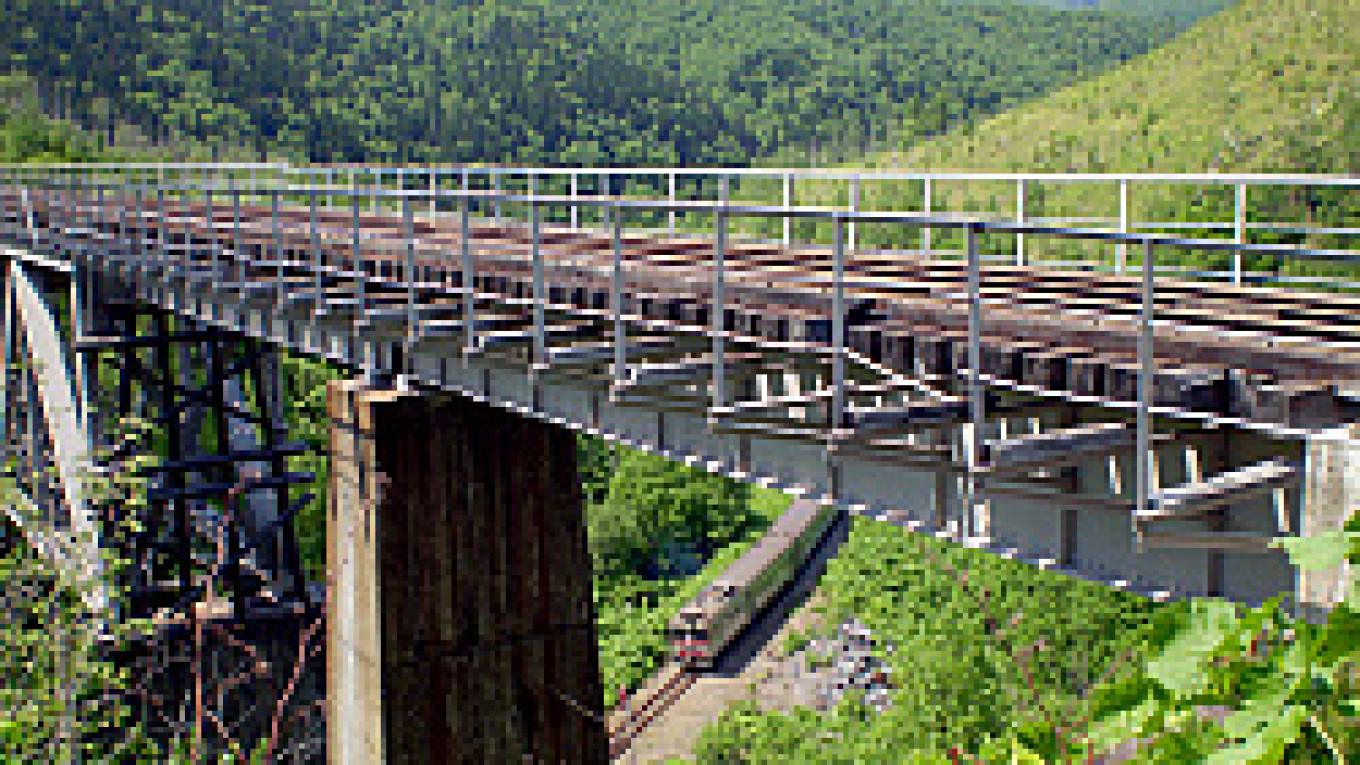
This legacy of Japanese control over part of the island, however, is not stopping Russian Railways from setting out to succeed where Josef Stalin and others have failed -- linking Sakhalin with the rest of Russia by bridge or tunnel.
"No resident of Sakhalin should feel that they are separated from the rest of the Russian Federation," Governor Alexander Khoroshavin said at a recent news conference in the Pacific island's capital, Yuzhno-Sakhalinsk.
"Developing the links to the mainland are the most important social and economic task for Sakhalin," Khoroshavin said.
The project, which would be completed by 2030, is part of a 14 trillion ruble nationwide development program from Russian Railways. The program, which could one day lead to an overland transportation corridor running all the way to Japan, was given a tentative thumbs up by Prime Minister Vladimir Putin last month.
But as yet, officials have no idea where to build the 10- to 20-kilometer link, how much it would cost and when work will start. And first, Sakhalin's peculiar history means that there are several major obstacles to overcome.
The island's history has seen it go from a Russian penal colony into Japanese hands, only to be closed to outsiders for more than 40 years after reverting to Soviet control.
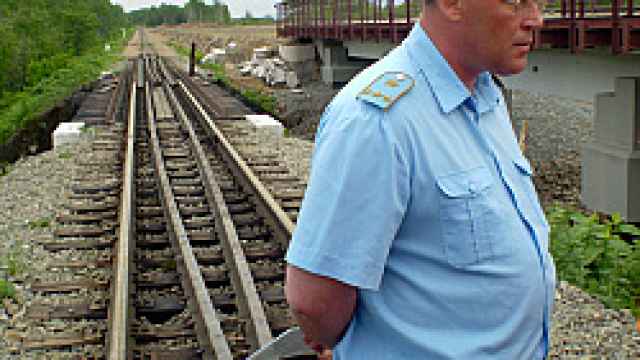 Max Delany / MT Steklyevich waiting for the first train to go over a new, 10-meter bridge, right. |  |
| |
Perched in the hills above the crumbling port town of Kholmsk, on the western shore of Sakhalin, stands a memorial to Soviet soldiers who died during a two-week war with the Japanese in August 1945 for the island.
But perhaps the most enduring legacy of the Japanese time on Sakhalin are the railway tracks that crisscross the island. A peace agreement negotiated by U.S. President Theodore Roosevelt to end Russian-Japanese fighting in 1905 handed the southern half of the island to Japan, which then embarked on a radical program to develop its infrastructure.
Now, almost 60 years after the Soviets forcibly cleared away the last Japanese residents, the Japanese railway and, more important, the narrower Japanese gauges are still being used.
The first step before any rail link to the mainland can be contemplated is to switch all the island's tracks to the Russian gauge.
Over the next seven years, 4.5 billion rubles will be spent on modernizing Sakhalin's tracks, said Sergei Tishkin, head of island's railroad, during a recent press tour to the island.
But work is slow. Several dozen kilometers outside Yuzhno-Sakhalinsk, Vyacheslav Steklyevich, deputy director for innovation and technologies on the Sakhalin railroad, waited for the first train to go over a new 10-meter bridge of iron and concrete on a recent afternoon.
Running parallel to it, aging and fragile, is the original wooden Japanese bridge built in 1940. The new rails being laid across the bridge have both the Japanese and Russian gauges and can be switched easily.
"This is the 25th bridge to be built in the past few years, and we still have more than 100 to go," Steklyevich said.
As the first train trundled slowly across the bridge, the passengers gawked out of the windows -- seemingly oblivious of the fact that they were making a little bit of history.
But many residents seem proud of the symbolic shift toward the mainland. Near Yuzhno-Sakhalinsk's main train station, a monument topped with a Russian double-headed eagle has even been erected to mark the start of work on changing the gauges.
Tsarist officials first conceived a plan to link Sakhalin to the mainland about 150 years ago. After World War II, thousands of prisoners in Soviet labor camps actually began work on a tunnel under the strait, said Yury Prosyolkov, curator of the Sakhalin railroad museum.
The project was dropped after Stalin's death in 1953, but remnants of the tunnel can still be seen, he said, standing in his memorabilia-filled museum.
Officials promise, however, that should the link be built, the advantages for the island's economy and 700,000 inhabitants would be much more than symbolic.
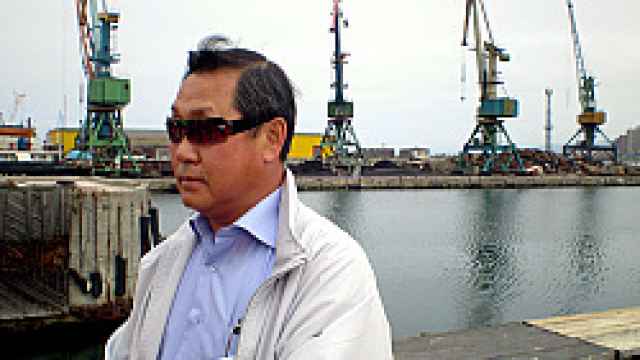 Max Delany / MT Pak at Kholmsk port, which connects the island to Vanino on the mainland. | |
| |
The Kholmsk port, complete with stray dogs and peeling paint, represents one of Sakhalin's major transportation lifelines to the mainland. It is here that trains arrive by ferry from the rest of Russia.
A set of tracks lead up to the berth, allowing train cars filled with fish, fuel and building materials to be brought ashore and converted to the island's narrower gauge.
Currently, a fleet of four ferries negotiates the 16-hour journey to the mainland port of Vanino, said the director of the town's port, Vladimir Pak, as he peered out across the Tatar Strait toward the mainland.
Traffic at the Kholmsk port has slumped since the Soviet collapse, and just a few years ago the fleet comprised 10 ferries, Pak said. Despite the multibillion-dollar oil and gas boom that has bought a host of international energy giants to Sakhalin, the railroad and port have seen little increase in traffic, Pak said.
Sakhalin Energy, the company operating the world's largest energy project, Sakhalin-2, relies mainly on ship and plane and transports only 5 percent of its total cargo by rail through Russia, company spokesman Ivan Chernyakovsky said.
"Closer integration with the mainland would be of benefit to the island, but it would only benefit us in an indirect way," he said.
Next door to the Kholmsk port, inside a cavernous warehouse, a solitary laborer shifted machinery to hoist up wagons and switch them to the island's gauge. Switching gauges costs 11,000 rubles per train car, said warehouse director Alexander Kornaukh.
Although Russian Railways is pumping in 30 million rubles in investment this year and the situation is improving, Kornaukh said, most of the machinery is Soviet and desperately in need of replacement.
In Kholmsk, a town blighted by high unemployment and few opportunities, the trains have brought more than 70 precious jobs, and Kornaukh said he was not too worried about a link to the mainland costing him his job anytime soon.
"I won't be alive to see it," he said.
The other question, he said, is who will pay local companies to convert their rolling stock to the Russian gauge. "I don't know which investors will be keen to put their money into this project," he said.
A Message from The Moscow Times:
Dear readers,
We are facing unprecedented challenges. Russia's Prosecutor General's Office has designated The Moscow Times as an "undesirable" organization, criminalizing our work and putting our staff at risk of prosecution. This follows our earlier unjust labeling as a "foreign agent."
These actions are direct attempts to silence independent journalism in Russia. The authorities claim our work "discredits the decisions of the Russian leadership." We see things differently: we strive to provide accurate, unbiased reporting on Russia.
We, the journalists of The Moscow Times, refuse to be silenced. But to continue our work, we need your help.
Your support, no matter how small, makes a world of difference. If you can, please support us monthly starting from just $2. It's quick to set up, and every contribution makes a significant impact.
By supporting The Moscow Times, you're defending open, independent journalism in the face of repression. Thank you for standing with us.

Remind me later.