

"As of Wednesday, it's been 16 years that Russia has been trying to enter the WTO, and we don't want to celebrate another anniversary," Nabiullina told a panel on Russia-EU business ties on the opening day of the 13th St. Petersburg International Economic Forum.
EU Trade Commissioner Catherine Ashton told the panel that "we have agreed WTO accession should be completed before the end of this year," although she said it wouldn't be easy.
The optimism came a day after Prime Minister Vladimir Putin said his country would return to talks with Finland over a planned increase in export duties on timber, which has been one of the main barriers to Moscow's recent accession efforts.
Russia is the only major economy outside the 153-member WTO.
"We feel we are coming to agreement with the European Union," Nabiullina said on the sidelines of the forum. "We hope to finish all the talks by the year's end."
During a one-day visit to Helsinki on Wednesday, Putin extended an invitation to his Finnish counterpart, Matti Vanhanen, to take part in the St. Petersburg Timber Forum in the fall to discuss Russia's restrictions on logging exports.
Nabiullina told reporters that the export duties remained an issue to be discussed.
"We've left the export duties for the last bit," Nabiullina said, adding that she would meet Ashton on June 24 and 25. She did not say where the meeting would take place.
At a later panel on U.S.-Russian business ties, Washington's trade representative, Ron Kirk, also said negotiations on Russia's WTO admission had progressed recently and could be over by the end of the year.
Kirk declined to talk to reporters who chased him as he left the panel hall. A man who appeared to be a member of Kirk's team pulled a Bloomberg reporter at the back of his suit in an attempt to slow him down.
Nabiullina was to hold talks with Kirk later Thursday.
Prominent businessman, however, took a less conciliatory tone, suggesting that Russia didn't necessarily need membership and that the West doesn't have a spotless trade record, either.
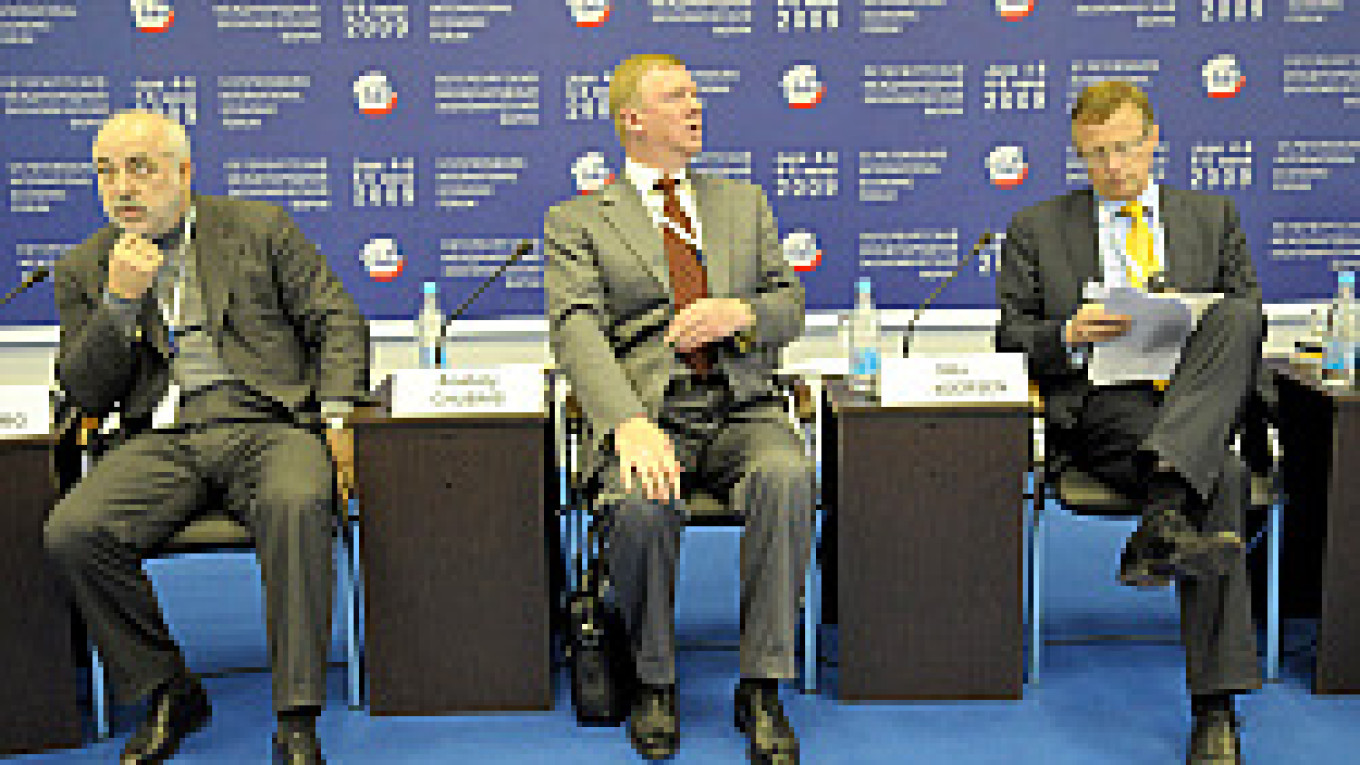
Rusnano chairman Anatoly Chubais, who also took part in the Russia-EU panel said Russia could still find ?€” and was actively pursuing ?€” alternatives to the WTO.
"In recent months, there's been active work to form a new customs union with Russia, Belarus and Kazakhstan," Chubais told the panel. "And it's possible that the process may become an alternative [to WTO]. If the new customs union is formed, a new party to the talks will appear," meaning negotiations could be further delayed.
When asked whether joining the body would hurt Russian businesses, Chubais said 80 percent of Russian companies would welcome the accession.
Metals and oil billionaire Victor Vekselberg complained about protectionist measures Russian business continues to face abroad.
"Russian big business' appearance prompts surprise and an inadequate reaction in Europe," Vekselberg, who controls Swiss conglomerate Oerlikon and Russian power holding IES, told the panel. "The tariff to connect to the power grid for a Russian company exporting electricity to Finland is eight times higher than for a local power company."
Vekselberg also criticized European banks, suggesting that they denied loans to Russian companies on the pretense that they were not "of the same quality" as Western ones. "This is protectionism. The state's role has increased significantly in Western banks lately."
The moderator, Sergei Karaganov, dean of the world economics and politics department at the Higher School of Economics, disagreed, saying European markets have become more liberalized. "Who would allow Sberbank to buy a third of Opel, say, eight months ago, before the crisis? It would have been a great scandal."
BP chairman Tony Hayward told the panel that Russia still had to liberalize its markets.
Hayward said the Russian government had to improve "the stability of the fiscal regime" and respect the property rights and the rule of law. His company is a 50/50 owner of Russia's third-largest oil firm, TNK-BP, where a management dispute overshadowed last year's St. Petersburg forum.
"We see a new type of protectionism in Russia, which is resource nationalism," Hayward said. "Protectionism means limited access of foreign investors in the so-called strategic industries," he added, apparently referring to the law on foreign investment, which requires a state commission's approval for foreign investment in 42 sectors deemed strategic.
Chubais, best known for leading the liberalization of former power monopoly Unified Energy System, said many Russian laws had to be changed entirely. "We need to change the tax, customs and budget codes," Chubais said. "The aims have changed since we adopted them in the 1990s. When we wrote the Tax Code, for instance, we had just one aim ?€” to raise taxes and not let the budget fall to pieces. Now, we need to encourage investors with the tax incentives."
Staff Writer Anatoly Medetsky contributed to this report.
A Message from The Moscow Times:
Dear readers,
We are facing unprecedented challenges. Russia's Prosecutor General's Office has designated The Moscow Times as an "undesirable" organization, criminalizing our work and putting our staff at risk of prosecution. This follows our earlier unjust labeling as a "foreign agent."
These actions are direct attempts to silence independent journalism in Russia. The authorities claim our work "discredits the decisions of the Russian leadership." We see things differently: we strive to provide accurate, unbiased reporting on Russia.
We, the journalists of The Moscow Times, refuse to be silenced. But to continue our work, we need your help.
Your support, no matter how small, makes a world of difference. If you can, please support us monthly starting from just $2. It's quick to set up, and every contribution makes a significant impact.
By supporting The Moscow Times, you're defending open, independent journalism in the face of repression. Thank you for standing with us.

Remind me later.