

The Foreign Ministry warned against jumping to conclusions about Iran’s nuclear program Monday, days after President Dmitry Medvedev hinted that more sanctions might be inevitable.
The comments apparently sought to alleviate tensions ahead of a key meeting about Iran on Thursday in Geneva after Tehran’s recent disclosure that it was building a second uranium enrichment plant, which raised new suspicions that the country was seeking to build a nuclear bomb.
The information about the second enrichment plant, being built despite United Nations’ demands that Iran stop enriching uranium, needs to be “impartially” verified and analyzed, a Foreign Ministry source said.
“We expect results from the Geneva meeting … and are counting on Iranians not to come there empty-handed,” the diplomat said, Interfax reported. “It’s not emotions but common sense that must triumph now.”
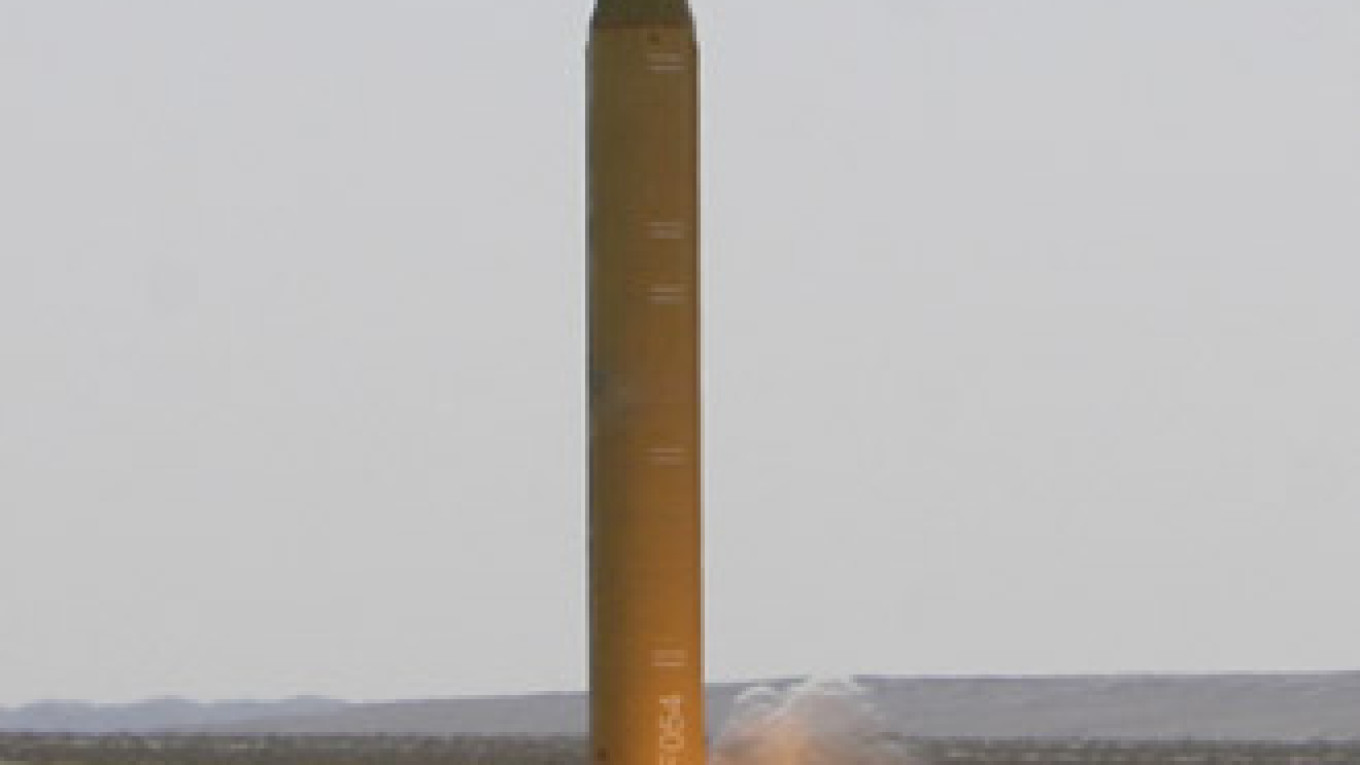
Further dismaying the international community, Iran successfully test fired its Shahab-3 missile, capable of reaching archenemy Israel, during a second day of war games Monday. The government said the military tested shorter-range missiles Sunday.
Medvedev sent a stern signal to Iran last week, saying Tehran should quickly present proof that it is not working to create a nuclear bomb or talks would give way to “other measures,” an apparent reference to further sanctions.
UN Security Council members are meeting Iranian negotiators for talks Thursday in Geneva, where they expect answers about Tehran’s nuclear efforts.
A serious deterioration of Russian ties with Iran, which might be the result of any Russian support for stronger sanctions, could cause major trouble for Moscow’s policies in the North Caucasus and Central Asia, analysts said.
For one, such frictions could upset Russia’s anti-terrorism policies in the volatile North Caucasus, said Fyodor Lukyanov, editor of Russia in Global Affairs, a government-sponsored journal. “Iran … has never been noticed to support jihad in the Caucasus,” Lukyanov said. “If relations break down abruptly, who knows what turn things will take in the future.”
If Moscow and Tehran have a falling out, it could also harm the process of dividing the Caspian Sea among five littoral states including Russia and Iran, he said. Talks have largely stalled, but the countries have avoided open confrontation so far.
“The potential for escalating the situation is much higher than it is for keeping the status quo,” Lukyanov said.
A hostile Iran could also ruin some of Russia’s clout in former Soviet Muslim nations like Tajikistan, he said. “By force of common tradition, culture and religion, Iran has certain influence over Central Asian countries, primarily Tajikistan, and it hasn’t so far used this in such a way that it would concern Russia,” Lukyanov said. “But hypothetically, it could do so.”
Viktor Mizin, a foreign policy analyst with the Institute of Strategic Assessments, said that despite Medvedev’s comments Russia would still vote against hard-hitting sanctions, and therefore its trade and diplomatic ties with Iran would remain unchanged. He noted that Russia supported the previous three rounds of sanctions against Iran without any evident damage to ties.
Some of the major examples of cooperation between the two countries include a nuclear power plant that Russia is building in Iran and is scheduled to begin operation by year-end. Russia, Iran and Qatar also created a gas troika in October 2008 in an effort to coordinate production policies and pursue joint projects. The three countries together hold about 60 percent of the world’s natural gas reserves.
U.S. President Barack Obama’s recent decision to scrap plans to deploy a missile defense system in Central Europe did not put additional pressure on Russia to back further sanctions, analysts said.
Medvedev made the gesture of warning Iran of possible sanctions last week to show that the Kremlin appreciated the discarding of the U.S. missile shield plans and was willing to engage in a dialog with the United States, Lukyanov said.
Even so, Russia will approach sanctions with caution when the time comes to convert words into actions, he said.
Mizin rejected the notion that Medvedev’s hint on sanctions was his response to Obama’s decision. Moscow is genuinely worried about the possibility of a nuclear-armed Iran, he said.
A Message from The Moscow Times:
Dear readers,
We are facing unprecedented challenges. Russia's Prosecutor General's Office has designated The Moscow Times as an "undesirable" organization, criminalizing our work and putting our staff at risk of prosecution. This follows our earlier unjust labeling as a "foreign agent."
These actions are direct attempts to silence independent journalism in Russia. The authorities claim our work "discredits the decisions of the Russian leadership." We see things differently: we strive to provide accurate, unbiased reporting on Russia.
We, the journalists of The Moscow Times, refuse to be silenced. But to continue our work, we need your help.
Your support, no matter how small, makes a world of difference. If you can, please support us monthly starting from just $2. It's quick to set up, and every contribution makes a significant impact.
By supporting The Moscow Times, you're defending open, independent journalism in the face of repression. Thank you for standing with us.

Remind me later.