

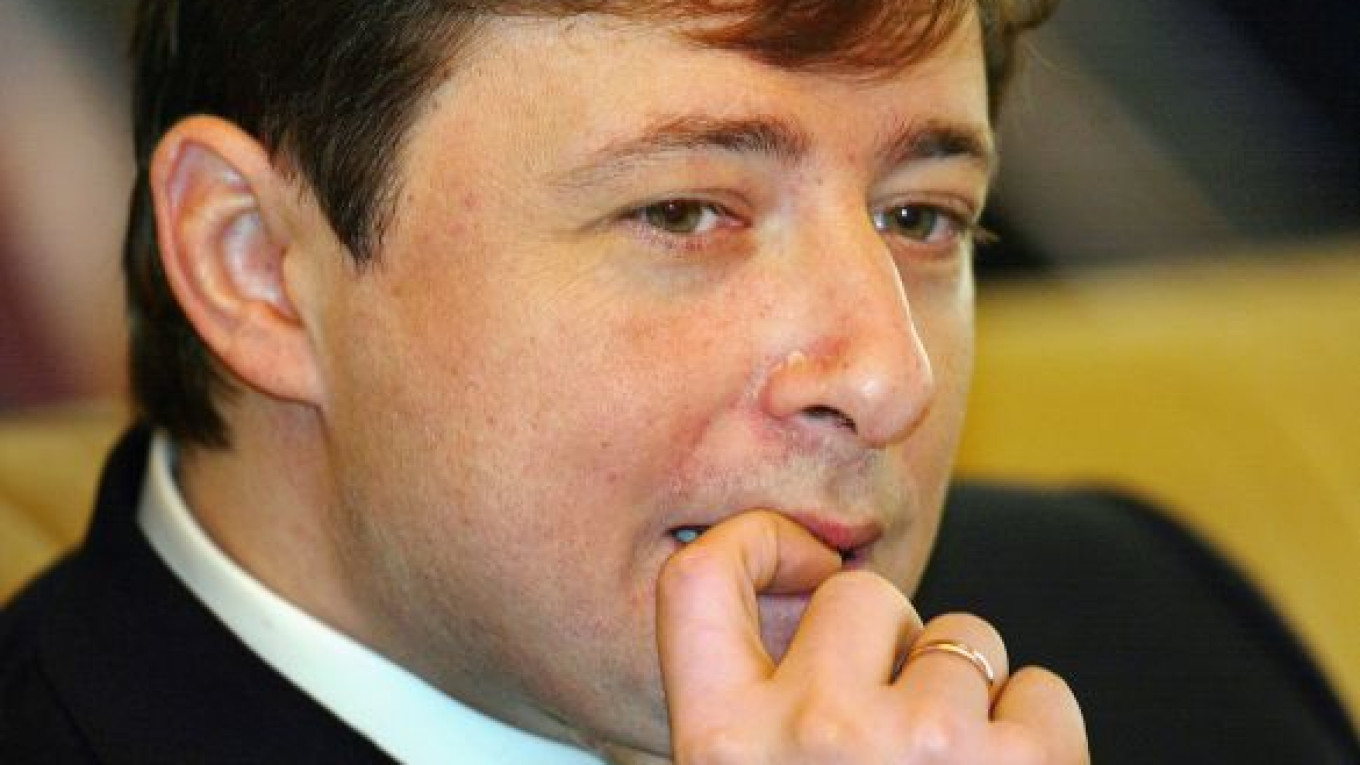
Conflict-torn republics in the North Caucasus will be united in a new federal district overseen by newly appointed Deputy Prime Minister Alexander Khloponin, President Dmitry Medvedev said Tuesday.
The surprise announcement redraws the seven so-called "super regions" established by then-President Vladimir Putin in May 2000 to reassert federal authority over provinces that had largely enjoyed autonomy in the 1990s.
The shift also serves as an indication of how seriously the Kremlin is treating the threat of escalating violence in the North Caucasus, which includes Chechnya.
But the appointment of Krasnoyarsk Governor Khloponin, a weathered politician with a past in big business, suggests that the Kremlin wants to shift its focus away from the seemingly never-ending fight against insurgents to building a more stable political system there, political analysts said.
"First, I've changed the system of federal districts that exists in our country," Medvedev said in announcing the changes during a meeting with Khloponin in the Kremlin on Tuesday evening.
The president said the new North Caucasus Federal District would include the republics of Dagestan, Chechnya, Ingushetia, Karachayevo-Cherkessia, Kabardino-Balkaria and North Ossetia and the Stavropol region — all of which were part of the Southern Federal District previously. The capital of the new district will be located in the Stavropol region's resort of Pyatigorsk.
The Southern Federal District will encompass the regions of Krasnodar, Astrakhan, Rostov and Volgograd, along with the republics of Adygeya and Kalmykiya.
Medvedev also said he had signed a decree Tuesday appointing Khloponin as his envoy in the North Caucasus Federal District and, simultaneously, to the post of deputy prime minister. The government will now have seven deputy prime ministers and two first deputy prime ministers.
Medvedev also accepted Khloponin's resignation as Krasnoyarsk's governor and promoted his deputy Edkham Akbulatov to the post of acting governor.
Medvedev said Khloponin would have authority over economic issues related to the North Caucasus Federal District and oversee top personnel decisions and the activities of law enforcement agencies there.
Medvedev said North Caucasus authorities have learned how to fight insurgents and criminals but lacked experience in rooting out corruption, clamping down on economic crime and nurturing economic development. He said he hoped that Khloponin would use his experience as a successful governor to improve the social and economic situation in the North Caucasus.
The president also sent a bill to the State Duma on Tuesday allowing Khloponin to jointly serve as a Cabinet member and an official with the presidential administration.
Khloponin, a former chairman of the Norilsk Nickel metals giant who won gubernatorial elections in the Taimyr autonomous district in 2001 and in the Krasnoyarsk region the following year, said Tuesday that he would use "economic methods" to tackle the many problems that have accumulated in the North Caucasus.
Medvedev hinted that he would appoint a new North Caucasus tsar during his state-of-the-nation address in November. Political pundits named several potential candidates, but Khloponin was not among them. The Kremlin and Krasnoyarsk administration released statements ahead of Tuesday's meeting that said Khloponin had been invited to the Kremlin to participate in a presidential meeting dedicated to education and demography with other senior officials.
Medvedev previously had never indicated that he might create an eighth federal district.
Chechen President Ramzan Kadyrov expressed hope Tuesday that the creation of the new federal district would boost local economic development.
"It is a relatively small, compact territory, and we want to hope that this reform will help to solve problems of economic growth quickly," he told Interfax.
Senior officials in United Russia, where Khloponin is a member of the party's Political Council, made similar noises Tuesday.
While violence has surged in recent months in the North Caucasus, particularly in Ingushetia and Dagestan, Khloponin most likely will concentrate on other grave problems that contribute to instability there, including bad governance, corruption and a poor investment climate, said Nikolai Silayev, a Caucasus analyst at the Moscow State Institute of Foreign Relations.
But Silayev criticized the Kremlin's "manual management" approach in the reform, calling its a quick fix instead of much-needed systemic changes.
"Moscow once again wants to solve a problem by creating a new structure and appointing a man with extraordinary powers to run it," he said.
He said the federal government has done little to change deeper rooted problems of nepotism in state appointments in the North Caucasus and pervasive corruption in the law enforcement and justice systems.
Igor Bunin, head of the Center for Political Technologies, praised Khloponin as incorruptible and said he was the best possible politician for Moscow-based businessmen with interests in the North Caucasus to deal with.
"Khloponin is not a general. He is a politician. He is rich, and he will not take bribes," Bunin said. "He will approach problems, including those related to security, as a politician, not as a military man."
Boris Nemtsov, a former deputy prime minister and opposition leader who knows Khloponin well, described him as "a smart and sensible person who can easily understand any new task.”
Nemtsov, however, voiced doubt over whether Khloponin would be able to do much in the troubled region. “He would need to be given very broad authority over the situation there, but I doubt that he will get that," he said.
Khloponin, 44, was born in Colombo, the commercial capital of what is now Sri Lanka, and graduated with a degree in finance from Moscow's Finance Academy. He is widely considered on of Russia's most effective regional bosses. Krasnoyarsk, which is among the richest regions because of aluminum production, beat Moscow and St. Petersburg in terms of investment in 2007.
Staff writer Alexander Bratersky contributed to this report.
A Message from The Moscow Times:
Dear readers,
We are facing unprecedented challenges. Russia's Prosecutor General's Office has designated The Moscow Times as an "undesirable" organization, criminalizing our work and putting our staff at risk of prosecution. This follows our earlier unjust labeling as a "foreign agent."
These actions are direct attempts to silence independent journalism in Russia. The authorities claim our work "discredits the decisions of the Russian leadership." We see things differently: we strive to provide accurate, unbiased reporting on Russia.
We, the journalists of The Moscow Times, refuse to be silenced. But to continue our work, we need your help.
Your support, no matter how small, makes a world of difference. If you can, please support us monthly starting from just $2. It's quick to set up, and every contribution makes a significant impact.
By supporting The Moscow Times, you're defending open, independent journalism in the face of repression. Thank you for standing with us.

Remind me later.