

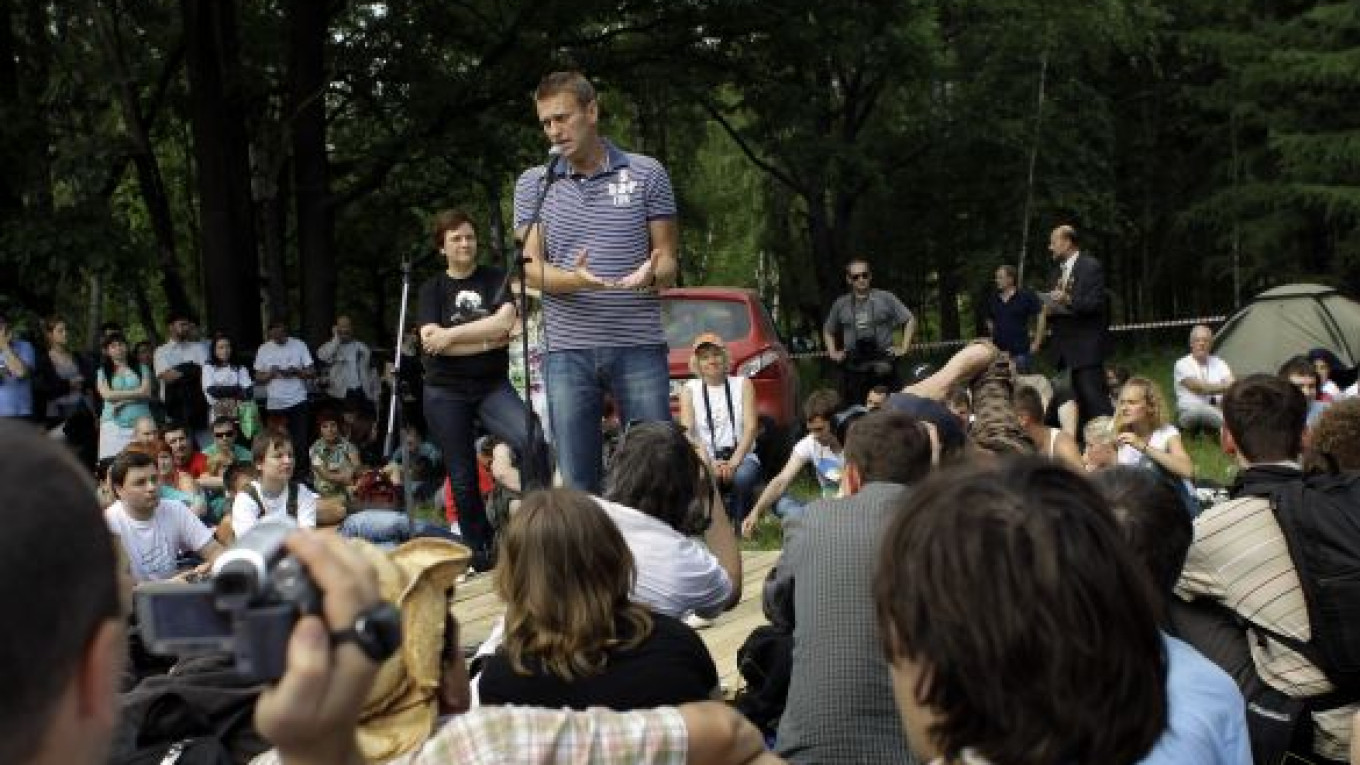
KHIMKI, Moscow Region — Not even the organizers could really explain what the four-day Anti-Seliger camp was all about. But something was in the air, with even Alexei Navalny, the anti-corruption blogger whose political star is rising, dropping by for a presentation.
The Khimki forest campout, which wrapped up Monday, attracted a motley crew of activists, including liberal-leaning celebrities like rock critic Artemy Troitsky and television star Leonid Parfyonov.
The event reflects an ongoing shift in the country's public landscape, where the marginalized political opposition is gradually being replaced by grassroots civil society activists such as Navalny, whistleblower par excellence.
Whether this evolution will spill over into political mainstream remains to be seen, however. If Anti-Seliger is any indication, the new activists still have a ways to go because only 2,000 attended the event.
The campout was organized by environmental activists led by Yevgenia Chirikova, who headed the unsuccessful campaign to save the Khimki forest from partial destruction to make way for an $8 billion federal highway. The Kremlin ordered that the road proceed in December after months of rumination.
An environmental slant was evident at the camp last week, with visitors at one point "chasing away" a bulldozer attempting to destroy some trees nearby. But the event was vaguely billed as a place for "everyone supporting the protection of nature and the development of civil society," according to its web site.
Still, its name provided a good hint of what to expect. Seliger is the state-funded youth camp at the Tver region's Lake Seliger, a posh annual event that educates pro-Kremlin youth on innovation, healthy lifestyle and effective ways to support the government. This year's camp has a budget of 178 million rubles ($6.3 million) and expects to see 15,000 visitors.
Anti-Seliger's budget stood at a measly 600,000 rubles, Chirikova told Gazeta.ru on Monday, adding that food was provided free of charge by the opposition Yabloko party. Contributors ranged from pensioners to businessmen, she said in a separate interview with the news site.
The cash covered transportation costs and accommodations for hundreds of people, including environmentalists, bloggers, musicians, students, politicians and artists. Chirikova put the number of guests at 2,000, although media estimates ranged from 500 to 3,000.
Fears that the authorities ?€” known for banning opposition events on bureaucratic pretexts ?€” would break up the camp proved unfounded. Police officers deployed to the site maintained order without cracking down on the activists, and even fraternized a bit when their superiors weren't looking.
Speculation swirled at the camp that Kremlin deputy chief of staff Vladislav Surkov had personally instructed Moscow region authorities to leave the camp alone. The Kremlin had no immediate comment on the issue ?€” or on the camp itself. But Stanislav Belkovsky, a one-time Kremlin insider, dismissed the rumor.
Chirikova conceded that the camp was no match for Seliger, but said it was only the start.
"It is not a short-term goal. The war can't be won overnight. In 1941, many believed that Moscow would fall, but who won?" she said in an interview at the camp, referring to the battle for Moscow during World War II.
Navalny's visit was, perhaps, most telling of all, because this was the first time he participated in a major public event since making a name for himself with his anti-corruption efforts last year.
Navalny, a former Yabloko member who has toyed with moderate nationalism, has left the door open to engaging in politics and has been mentioned as a possible presidential candidate. The visit to the Khimki forest was another link in the chain for him, said Belkovsky, an independent political analyst who attended the camp.
"There weren't too many people at Anti-Seliger, but those who came were significant. He'd lose the respect of his fan base if he stayed away," Belkovsky said by telephone Monday.
He added that Navalny had no chance of participating in the 2012 presidential election but might run in the next one in 2018.
Navalny, who, perhaps predictably, gave a lecture to the campers on how to fight corruption, praised the camp on his blog, writing that "Anti-Seliger was clean, had a high level of organization and was filled with lots of good people."
Gatherings like the Khimki forest event are the way to unite now-isolated civil society groups, Belkovsky said.
The organizers may have succeeded all too well, because some right-wing activists, including nationalism champion Alexander Potkin, also dropped by, despite being personae non grata in the liberal and leftist communities.
But the atmosphere remained charged and amiable enough to lead some visitors to dub the event the "Russian Woodstock." Concerts by several rock bands, including Vasily Shumov's Tsentr and Gleb Samoilov's Matrix, gave credence to the comparison.
Among the more unexpected guests was A Just Russia head Sergei Mironov, the long-time Federation Council speaker who fell from grace last month, being forced to trade the speaker's position for a regular seat in the State Duma.
Mironov showed a loyalist streak, urging participants to join in a dialogue with the authorities. His Sunday speech, however, roused less enthusiasm than that of television host Parfyonov, who was greeted by loud applause even before he spoke.
Parfyonov said in an interview that he did not come to the forest for political reasons. Nevertheless, he gave a presentation on the lack of media freedom in the country.
Parfyonov was joined on stage by Dozhd television host Valery Panyushkin and Kommersant reporter Oleg Kashin, whose history is a case study on the problems of Russian journalism. In November, Kashin was beaten up by unidentified thugs and spent days in a coma. Investigators say he was beaten for his critical articles, which included several about the destruction of the Khimki forest, and President Dmitry Medvedev personally promised him to bring the attackers to justice. No one has been arrested, and Kashin has been sued by people linked to the Seliger camp after he implicated them in the attack.
Parfyonov said he did not believe that the Khimki forest could be saved. Many participants seemed to share his pessimism, both on the forest and grassroots activism in general.
"While some people like to make victory cheers, the circle of civil society activists in Russia is rather small," said Ella Pamfilova, head of the Russia office of Transparency International.
"You have to get at least 50,000 people on the street to get attention," said opposition leader Boris Nemtsov.
But Vladimir Pribylovsky, head of the Panorama think tank, predicted that this year's camp was only the beginning. "It reminds me of 1985, not 1989," he said, in reference to the start of Mikhail Gorbachev's perestroika, which had swept the nation by 1989 and led to the Soviet collapse and Russia's rebirth two years later.
A Message from The Moscow Times:
Dear readers,
We are facing unprecedented challenges. Russia's Prosecutor General's Office has designated The Moscow Times as an "undesirable" organization, criminalizing our work and putting our staff at risk of prosecution. This follows our earlier unjust labeling as a "foreign agent."
These actions are direct attempts to silence independent journalism in Russia. The authorities claim our work "discredits the decisions of the Russian leadership." We see things differently: we strive to provide accurate, unbiased reporting on Russia.
We, the journalists of The Moscow Times, refuse to be silenced. But to continue our work, we need your help.
Your support, no matter how small, makes a world of difference. If you can, please support us monthly starting from just $2. It's quick to set up, and every contribution makes a significant impact.
By supporting The Moscow Times, you're defending open, independent journalism in the face of repression. Thank you for standing with us.

Remind me later.