

To commemorate the date, a bronze statue was to be unveiled opposite the Institute for Military Medicine near the Dynamo metro station. A month later, however, there is still no sign of a sculpture. RIA-Novosti quoted the Russian Institute of Medical-Biological Problems' professor Yevgeny Ilin as saying there had been delays in receiving necessary permits because of officials' "bureaucratic procrastination."
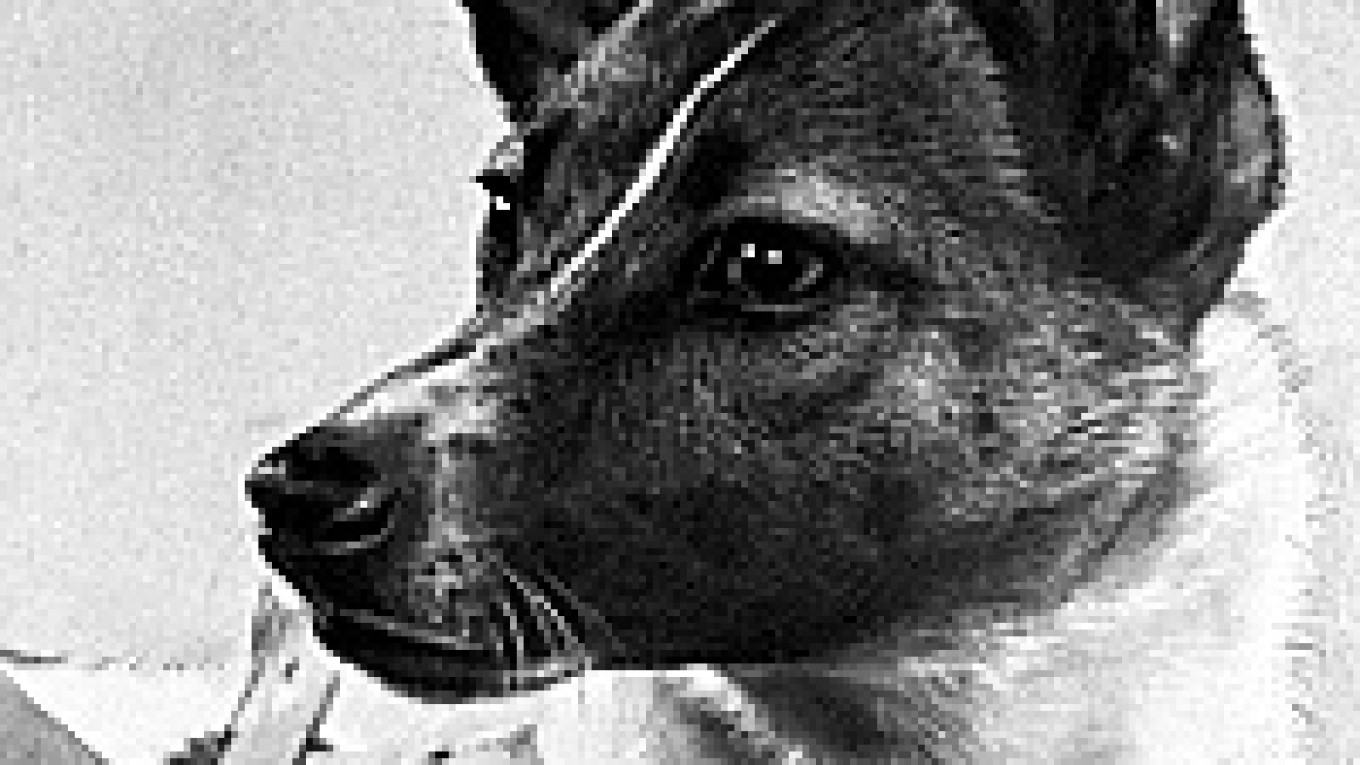
Before her flight, Laika had been a stray on the streets of Moscow. Along with two other dogs, she was trained to withstand the stresses of space travel. Scientists hoped to adapt the dogs to the confinement of a small cabin by keeping them in increasingly smaller cages for up to 20 days. While the two other dogs were used in preliminary testing, Laika -- dubbed "Muttnik" by the U.S. press -- was the dog destined to stardom.
One month earlier, after the successful orbital flight of Sputnik 1, Soviet leader Nikita Khrushchev had ordered that a second spacecraft be launched in commemoration of the 40th anniversary of the 1917 Bolshevik Revolution on Nov. 7. The team of scientists was given only four weeks to design and build a craft that would keep the Soviet Union one step ahead of its Cold War rival by sending a living passenger into space.
This rush meant that at the time of Laika's flight, scientists had not yet developed the mechanisms necessary to bring her space vehicle back to Earth. Laika was never meant to return from space; the life-support system on board was designed to sustain her for only one week. A malfunction caused the cabin to overheat, however, and Laika perished after no more than seven hours in space.
The media coverage that followed Laika's flight focused largely on its political implications in the context of the space race. In the Soviet Union, her death wasn't even officially acknowledged until a week later. In Britain, the National Canine Defense League called for dog owners to observe a minute's silence.
Still, Laika became an icon, appearing in novels and comic books, on cigarette packets and stamps. Despite her tragic end, she helped prove that a living being could survive in conditions of zero gravity, thus paving the way for human spaceflight.
A Message from The Moscow Times:
Dear readers,
We are facing unprecedented challenges. Russia's Prosecutor General's Office has designated The Moscow Times as an "undesirable" organization, criminalizing our work and putting our staff at risk of prosecution. This follows our earlier unjust labeling as a "foreign agent."
These actions are direct attempts to silence independent journalism in Russia. The authorities claim our work "discredits the decisions of the Russian leadership." We see things differently: we strive to provide accurate, unbiased reporting on Russia.
We, the journalists of The Moscow Times, refuse to be silenced. But to continue our work, we need your help.
Your support, no matter how small, makes a world of difference. If you can, please support us monthly starting from just $2. It's quick to set up, and every contribution makes a significant impact.
By supporting The Moscow Times, you're defending open, independent journalism in the face of repression. Thank you for standing with us.

Remind me later.