

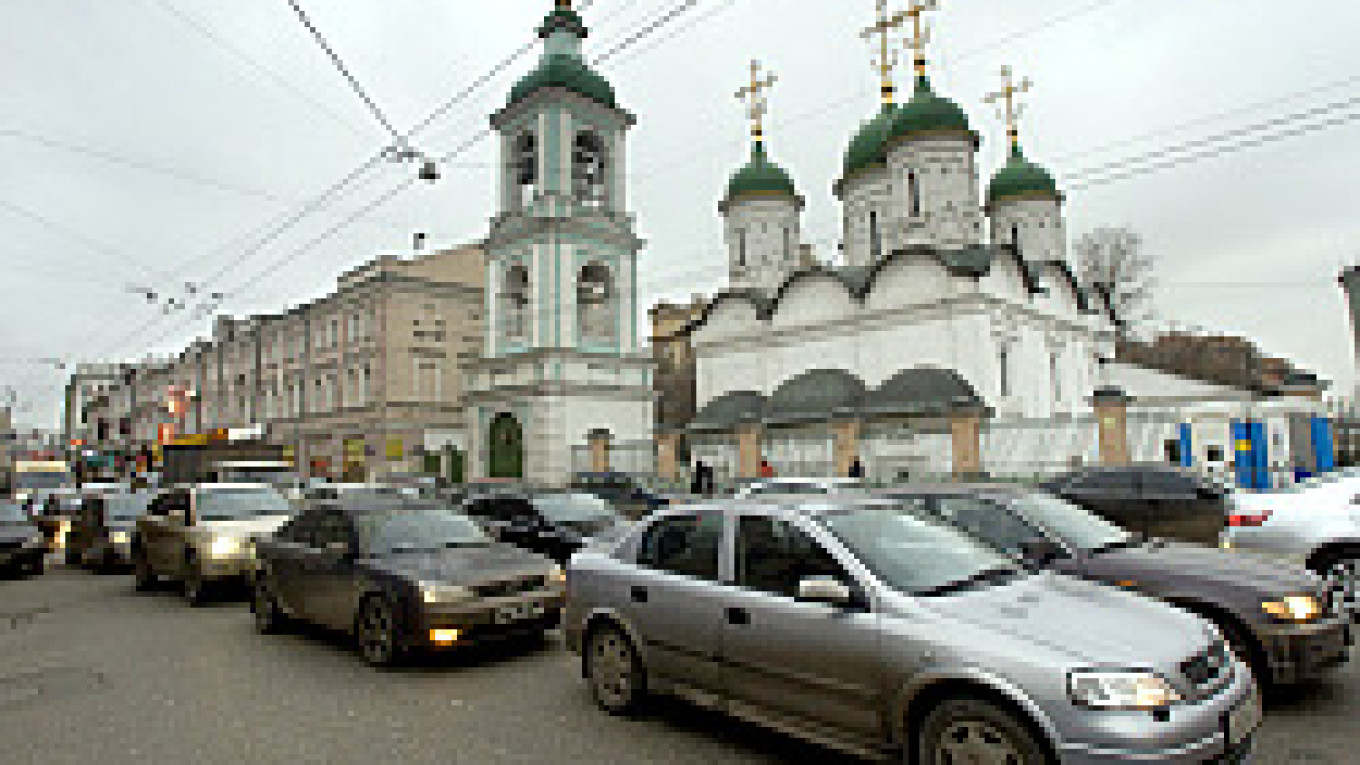
While car ownership in Russia tripled between 1990 and 2007, much of the infrastructure, ranging from traffic lights to buses and metro trains, is still at Soviet levels.
The situation has prompted foreign firms to stream into the city in the hope of cutting profitable modernization deals with City Hall. But those hopes have not materialized as quickly as expected, said participants in a recent conference on city transportation at the German Embassy.
"There are attempts to solve the problem, but there is no master plan," said Michael Abel of Siemens Intelligent Traffic Solutions.
As examples, Abel cited the absence of special bus lanes and of paid parking, as well as "inappropriate" traffic regulation systems.
Another grave issue is the lack of cooperation between City Hall and the Moscow region authorities.
Addressing the same conference, which was organized by the Moscow Club of German Architects and Engineers, Sergei Nikolayev, a first deputy head of City Hall's transport department, said city authorities are focusing on expanding public transport, especially the metro. "We need to create alternatives to private transport," Nikolayev said.
The metro, the city's fastest carrier with an average speed of just above 40 kilometers per hour, is currently operating at the brink of capacity. Yet 2.5 million people living within the city limits do not have convenient access to the metro, Nikolayev said. Authorities are planning a massive extension program, which includes the fragment of a second ring line that should bring those numbers down.
First Deputy Mayor Pyotr Biryukov said last month that the metro, which currently comprises more than 260 kilometers, needs to be expanded to 420 kilometers.
"To fulfill this task by 2015, we need almost 1.2 trillion rubles ($43 billion)," Biryukov said. The money, he said, should be split evenly between the city and the federal budgets.
For some people, like Roland Lipp, only radical solutions will help.
Lipp, a German engineer, has been making headlines with his peculiar concept for an elevated highway network.
The gigantic plan, dubbed Strassenhaus, or street house, involves the construction of apartment blocks that will serve as pylons for what Lipp promises to be a congestion-free and pollution-free motoring zone.
Lipp, a trained chemical engineer who says he once worked on the production of radar-absorbent plastic composites in East Germany when the Soviets wanted to build a stealth aircraft like the U.S. F-117 Nighthawk, has high hopes that a pilot program will soon emerge in southern Moscow.
"The decree is on [Mayor Yury] Luzhkov's desk, he only has to sign it," Lipp said.
The 10-kilometer project linking the city's third and outer ring roads along Varshavskoye Shosse would cost up to 5 billion euros ($6.3 billion), all of which would come from private investors, Lipp said.
City Hall, he added, will only have to cover the costs for the design.
City Hall spokesman Yury Aidinov said he had no information on when Luzhkov would sign the decree. "This is in the process of being considered," Aidinov said.
Boris Drozdov, an analyst with the Institute of Information Technology, a government think tank, said Lipp's plan was "revolutionary fantastic" and that it was hard to say whether it would ever be built.
"The paper might lay [on Luzhkov's desk] very long," Drozdov said. "In Moscow everything is very complicated."
Lipp, however, was adamant that his concept was the only realistic way out: "The situation is catastrophic and cannot be solved by normal means. Only extraordinary solutions will bring us forward," he said.
Yet Abel, the Siemens engineer, said the most promising path is to focus on making above-ground public transport more efficient. "There is no more room in the metro, but there is in buses and trams," he said.
During a visit to Munich in October, Luzhkov and Siemens representatives discussed revamping the city's 17-tram line into a modern design with new trains and tracks that would not interfere with cars, Abel said.
Nikolayev, the City Hall transport department official, said another hurdle is the poor discipline of local motorists.
"There is a culture of legal nihilism on our roads," said Nikolayev, invoking a phrase coined by President Dmitry Medvedev to describe rampant corruption in the country. "People have no qualms driving along tram tracks."
A Message from The Moscow Times:
Dear readers,
We are facing unprecedented challenges. Russia's Prosecutor General's Office has designated The Moscow Times as an "undesirable" organization, criminalizing our work and putting our staff at risk of prosecution. This follows our earlier unjust labeling as a "foreign agent."
These actions are direct attempts to silence independent journalism in Russia. The authorities claim our work "discredits the decisions of the Russian leadership." We see things differently: we strive to provide accurate, unbiased reporting on Russia.
We, the journalists of The Moscow Times, refuse to be silenced. But to continue our work, we need your help.
Your support, no matter how small, makes a world of difference. If you can, please support us monthly starting from just $2. It's quick to set up, and every contribution makes a significant impact.
By supporting The Moscow Times, you're defending open, independent journalism in the face of repression. Thank you for standing with us.

Remind me later.