

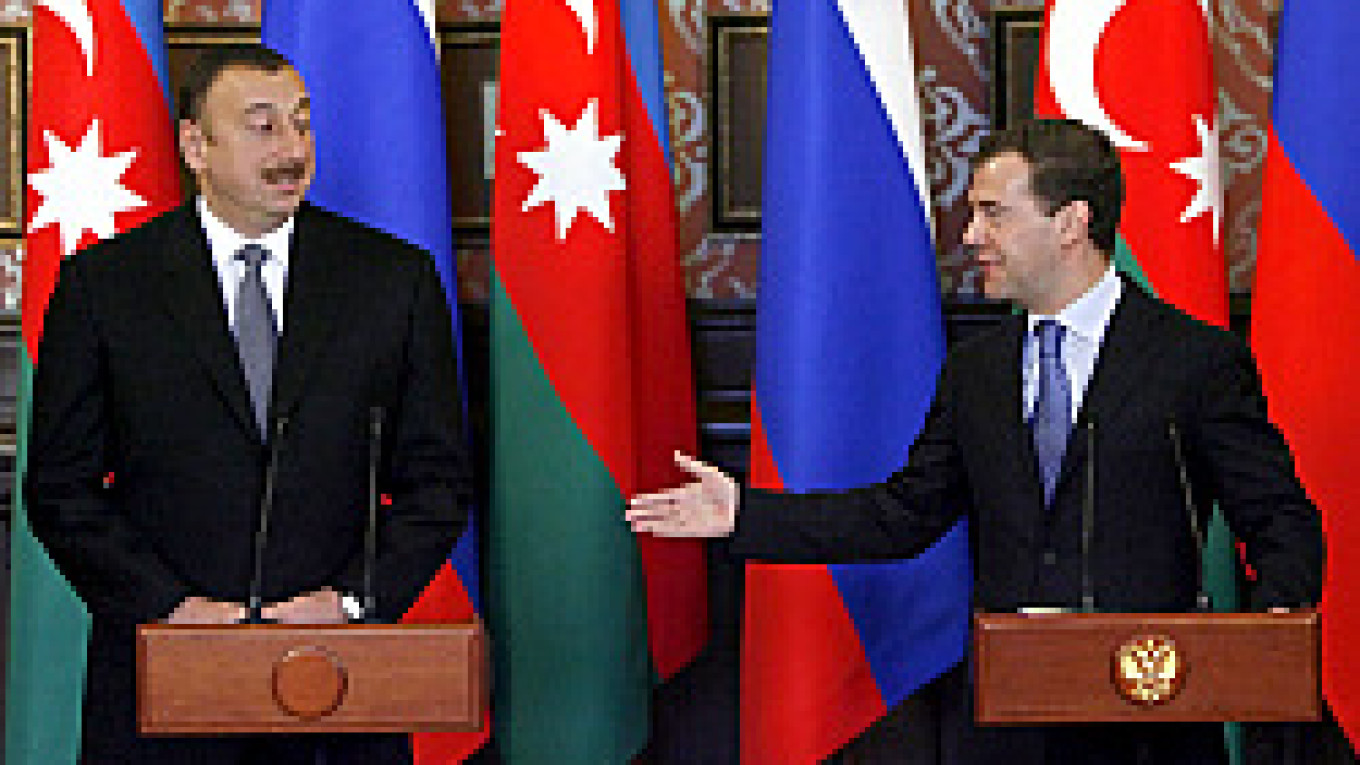
The possibility surfaced a day after Aliyev met with President Dmitry Medvedev, who said there was a good chance for the countries to strike a gas accord. Last month, Gazprom and the State Oil Company of Azerbaijan, or Socar, agreed to start talks on Russia buying Azeri gas with "delivery at the border" as soon as next year.
The meeting came as Moscow has been trying to shore up support from other Caspian Sea gas suppliers to buck the Nabucco pipeline, which would bypass Russia but faces a number of obstacles to construction.
"It's very disappointing to have no opportunity to produce the gas that we have because transit issues haven't been resolved," Aliyev said in an interview with the Vesti state-television channel. "The main thing is to come to an agreement about the possible transit and sale of gas between Russia and Azerbaijan and move forward."
A Gazprom spokesman said Sunday that he could not immediately comment on the transit option.
The European Union would likely welcome the emergence of a new supplier from the east, albeit one dependent on Russian pipelines, especially since the completion of Nabucco remains in doubt.
The backers of Nabucco, a number of EU energy companies, plan to fill the pipeline with gas from Turkmenistan -- across the Caspian Sea from Azerbaijan -- or Iran. But the project has faced numerous problems, including disagreement over how to divide the energy-rich sea and suspicion in the West of Iran's nuclear program.
Transiting foreign gas would not be unusual for Gazprom, which until the end of last year carried Turkmen gas for sale to Ukraine. Those supplies were handled by RosUkrEnergo, a trader half owned by Gazprom.
Alexander Nazarov, an analyst at investment company Metropol, said it was not immediately clear what Azerbaijan would gain from a transit deal for European exports, since it would not make much more money than it would from direct sales to Gazprom.
During the talks in Moscow, Aliyev signaled that he had no objections to contributing to Nabucco as well -- if it's ever built.
"Provided the terms are good, we would be able to supply a portion of our gas in that direction," Aliyev said. "But it's difficult to say when this project will move from a standstill."
Initial supplies from Azerbaijan to Russia would be far smaller than the flow from Turkmenistan, with flows capped by the pipeline's current capacity of 5 billion cubic meters per year. Gazprom and Socar agreed last month to inspect the link, which Gazprom used to export gas to Azerbaijan before 2007, to determine the amount of investment required for any repairs.
Turkey buys and transits a total of 7 bcm of Azeri gas per year.
Azerbaijan has the potential to raise output by another 12 bcm to 14 bcm per year from the second phase of the Shah Deniz field, which is led by Norway's StatoilHydro, Aliyev said. The field will produce that much more once the company finds a market and a transit route for the gas, he said.
StatoilHydro's chief of exploration and production, Peter Mellbye, said earlier this month that the company was considering exports through Russia and Iran. Azerbaijan has not been able to agree with Turkey on expanding the current transit to Greece.
Recent frictions over relations with Armenia have dimmed any hope for a future deal with Turkey. Alarmed that Turkey may lift an economic embargo against Armenia, Aliyev punctuated his displeasure by ignoring a summit in Ankara earlier this month attended by U.S. President Barack Obama. Turkey imposed the embargo in the 1990s as a show of support for Azerbaijan in its efforts to win back possession of the pro-Armenian separatist enclave of Nagorno-Karabakh.
Aliyev also said any gas agreement should not be subject to revisions, apparently wary of Russia's ongoing dispute with Turkmenistan over a cut in purchases. Turkmenistan has said a Gazprom unit failed to give it adequate warning before cutting the amount of gas it would accept, leading to a pipeline rupture earlier this month.
Prime Minister Vladimir Putin met with his top energy deputy, Igor Sechin, and Gazprom chief Alexei Miller on Thursday and told them to step up talks with Central Asian suppliers after Turkmenistan signed a tentative supply deal with Germany's RWE, a member of the Nabucco project.
"The agreement must be such that it isn't subject to revisions by any of the parties later," Aliyev said.
A Message from The Moscow Times:
Dear readers,
We are facing unprecedented challenges. Russia's Prosecutor General's Office has designated The Moscow Times as an "undesirable" organization, criminalizing our work and putting our staff at risk of prosecution. This follows our earlier unjust labeling as a "foreign agent."
These actions are direct attempts to silence independent journalism in Russia. The authorities claim our work "discredits the decisions of the Russian leadership." We see things differently: we strive to provide accurate, unbiased reporting on Russia.
We, the journalists of The Moscow Times, refuse to be silenced. But to continue our work, we need your help.
Your support, no matter how small, makes a world of difference. If you can, please support us monthly starting from just $2. It's quick to set up, and every contribution makes a significant impact.
By supporting The Moscow Times, you're defending open, independent journalism in the face of repression. Thank you for standing with us.

Remind me later.