

A growing chorus of senior government officials and ordinary citizens have publicly denounced a ban on U.S. adoptions proposed by pro-Kremlin State Duma deputies.
The criticism, including from two Cabinet ministers and the president's human rights ombudsman, seemed to jeopardize the measure, which has been widely condemned by human rights experts.
It also laid bare disagreements within the government about how to respond to the United States' so-called Magnitsky Act, which calls for sanctions on Russian rights abusers and was signed into law on Friday.
The adoption ban was proposed by deputies on Monday as an amendment to legislation that bars Americans deemed to have mistreated Russian abroad from traveling or working in Russia.
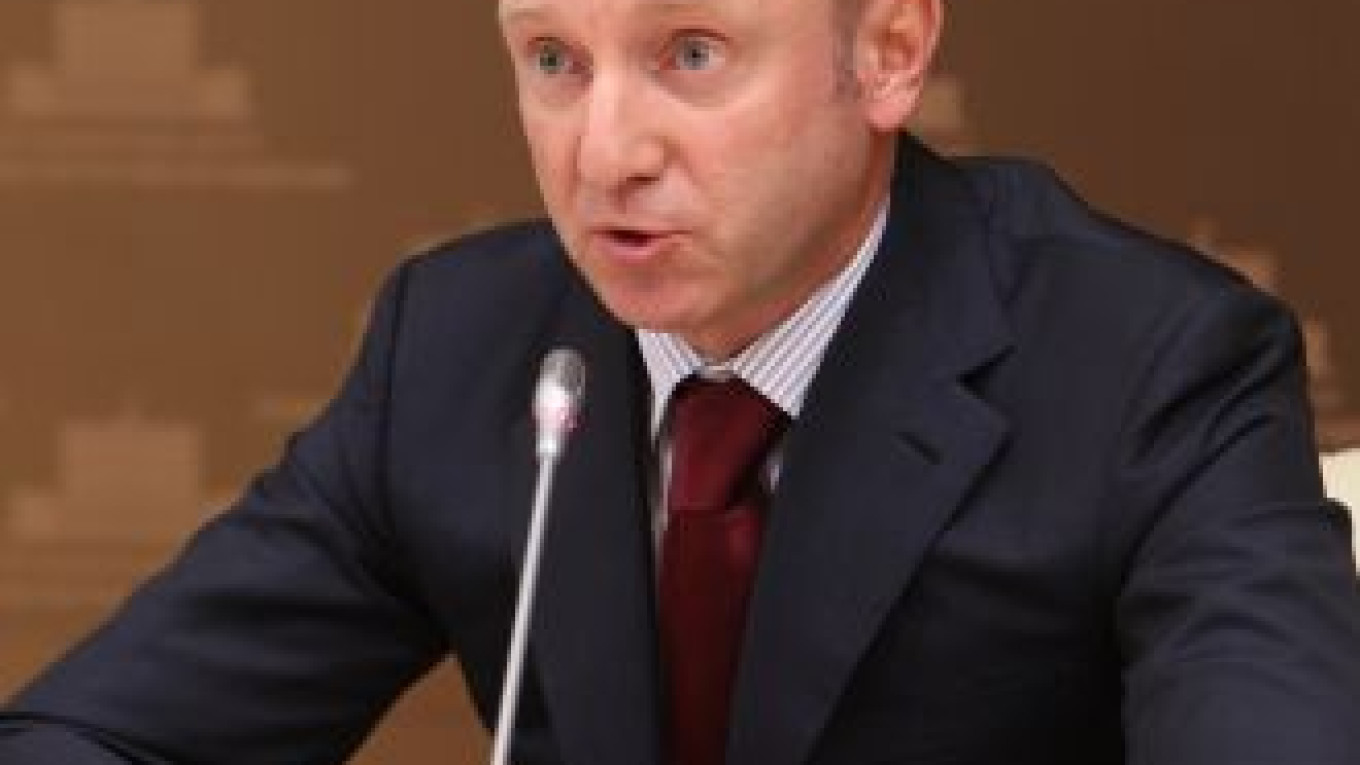
But by Tuesday, the measure had earned the scorn of several senior officials, including Foreign Minister Sergei Lavrov, Education and Science Minister Dmitry Livanov, and a key Duma deputy.
"I think it's incorrect. International adoption as an institution has a full right to exist. The most important thing is to do it in a civilized manner," Lavrov told journalists, according to a transcript on the Foreign Ministry's website.
Earlier, Livanov had tweeted that the logic of an "eye for an eye" was incorrect in this case because the proposal could hurt Russian children unable to find adoptive parents in Russia.
Deputy Yelena Mizulina, head of the Duma's Family, Women and Children Committee, called the ban "incorrect" and "unjust" in comments carried by Interfax on Tuesday.
"I, of course, can't support such an amendment. If it will be adopted, I will not vote for the 'anti-Magnitsky' bill in its second reading, though I supported it in its first reading," she said.
Existing legislation stipulates that orphans only become eligible for foreign adoption once they have been considered and declined for adoption by Russian families. Experts say there is often a greater willingness to take children with disabilities from foreigners wanting to adopt.
Russia is a signatory of the United Nations Convention on the Rights of the Child, which requires that signatories "recognize that inter-country adoption may be considered" if a child cannot be suitably cared for in his home country.
A new bilateral adoption agreement between the United States and Russia designed to improve monitoring and reduce instances of abuse went into affect on Nov. 1. Children's rights ombudsman Pavel Astakhov on Tuesday accused the United States of failing to abide by the deal.
President Vladimir Putin hasn't yet decided whether to support the ban, his spokesman told the Russian News Service on Tuesday. Last week, Putin called for a "sensible" and "restrained" response to the Magnitsky Act.
Meanwhile, public anger over the proposal continued to grow, with at least three online petitions gathering thousands of signatures. The number of signatories to a petition on Novaya Gazeta's website jumped from about 3,000 to more than 24,000 on Tuesday.
"But the most important thing is that [the proposal] will take hope for a better life away from thousands of Russian children, including children with seriously illnesses and disabilities," wrote the authors of a separate open letter to Duma deputies posted on Dozhd TV's website.
About 800 Facebook users signed up to picket outside the Duma beginning at 9 a.m. on Wednesday.
"The deputies will be arriving at work at this time. I propose that we surround the Duma from all sides. Let them look into the eyes of those who are ashamed of them before they pass this savage law," a text on the event's Facebook page read.
A cartoon circulated by Russian Internet users depicted an official using a child as a human shield against an American police officer holding a copy of the Magnitsky Act like a pistol.
"Now slowly put your idiotic law on the ground," the official says.
A wide spectrum of political elites also pounced on the proposed ban. "It's absolutely not OK, and furthermore, it's absolutely cynical and even shameless," said Russia's human rights ombudsman Vladimir Lukin, Interfax reported.
"This means that if the Americans suddenly repeal their law, we'll start giving them children. What on earth is that? It's child trafficking, it's monstrous, and it's a national disgrace," he said.
Billionaire and former presidential candidate Mikhail Prokhorov called it "shameful" and "short-sighted" in a blog post, while former Finance Minister Alexei Kudrin told reporters that children had no place in the legislation, Interfax reported.
Deputies are expected to vote on the bill in its second reading on Wednesday. If approved, it would go effect on Jan. 1, according to the text introduced last week.
About 105,000 children lived in state-run institutions in Russia last year, according to government statistics. Americans have adopted 45,112 Russian children since 1999. Nineteen have died, including Dmitry Yakovlev, who died of heatstroke after he was left in a hot car.
Related articles:
A Message from The Moscow Times:
Dear readers,
We are facing unprecedented challenges. Russia's Prosecutor General's Office has designated The Moscow Times as an "undesirable" organization, criminalizing our work and putting our staff at risk of prosecution. This follows our earlier unjust labeling as a "foreign agent."
These actions are direct attempts to silence independent journalism in Russia. The authorities claim our work "discredits the decisions of the Russian leadership." We see things differently: we strive to provide accurate, unbiased reporting on Russia.
We, the journalists of The Moscow Times, refuse to be silenced. But to continue our work, we need your help.
Your support, no matter how small, makes a world of difference. If you can, please support us monthly starting from just $2. It's quick to set up, and every contribution makes a significant impact.
By supporting The Moscow Times, you're defending open, independent journalism in the face of repression. Thank you for standing with us.

Remind me later.