

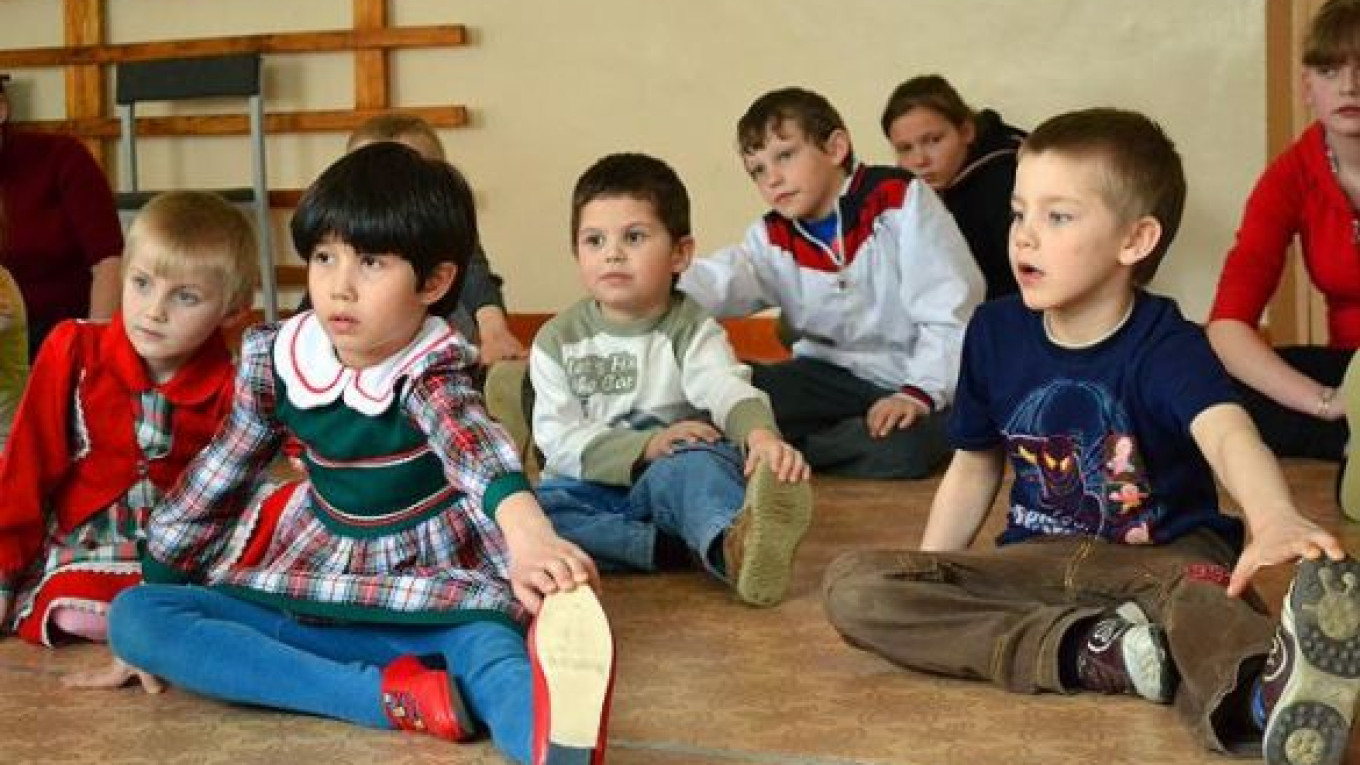
State Duma deputies stepped up Russia's retaliatory response to the so-called Magnitsky Act on Monday by introducing a measure that would ban U.S. citizens from adopting Russian orphans.
The move was roundly condemned by children's rights advocates, who warned that a blanket ban on U.S. adoptions would disproportionately affect orphans with mental and physical disabilities.
It also seemed to signal a further souring in the U.S.-Russian relationship, which has suffered since Vladimir Putin's return to the presidency in May.
The measure would ban U.S. citizens from adopting Russians and bar agencies that facilitate such adoptions from operating in Russia. It would also nullify a bilateral agreement aimed at improving oversight and reducing abuses that was signed last year and went into effect on Nov. 1.
"It's pure politics and an attempt at blackmail," said Alexander Gezalov, head of the Successful Orphans project. "Children are not rockets or torpedoes" for governments to use against each other, he said.
The Duma's Constitution and State Affairs Committee approved the ban as an amendment to a bill that would sanction Americans deemed to have mistreated Russian citizens abroad.
The bill, dubbed alternately the "anti-Magnitsky bill" and the "Dima Yakovlev bill," was introduced last week by leaders of all four Duma factions on the heels of the U.S. Senate's approval of the Magnitsky Act, which sanctions Russians believed to be involved in human rights abuses.
U.S. President Barack Obama signed the Magnitsky Act into law on Friday.
The proposed adoption ban appeared to have widespread support among Duma deputies, and Deputy Speaker Sergei Neverov said a majority would back it, Interfax reported.
If approved, it would go into effect on Jan. 1. The Constitution and State Affairs Committee recommended that a second reading of the bill take place Wednesday.
Russian officials have long complained that American officials don't do enough to protect the tens of thousands of Russian adopted children living in the United States.
An angry statement released by the Foreign Ministry on Thursday contained five cases in which Americans received "light" sentences for crimes against Russian children.
"All these cases are evidence that within the American justice system, unfortunately, the principles of responsibilities and adequate punishment are not always observed when it comes to crimes against adopted Russian children," the statement read.
Russian lawmakers were particularly angered by the case of 21-month-old Dmitry Yakovlev, who died of heatstroke in July 2008 after his adoptive father left him in a hot car for nine hours.
The father, Miles Harrison, was later acquitted by a Virginia court of involuntary manslaughter.
"What bothers us most aren't the tragedies, although they are the scariest thing that could happen, but rather authorities' reaction to them — exoneration. That's the bad part," Putin told a group of lawmakers on Thursday, adding that he supported deputies' efforts to called attention to the abuses, RIA-Novosti reported.
The number of Russians adopted by foreigners fell from 4,536 in 2007 to 3,400 last year, according to official statistics. The United States adopts more than any other country.
Nineteen adopted Russian children have died in the United States in the past decade.
About 1,220 adopted children died in Russia in the 15 years after the Soviet breakup, 12 of whom where killed by their parents, according to RIA-Novosti.
Children's rights ombudsman Pavel Astakhov, a close Putin ally, was the only high-level official to criticize the amendment Monday.
Astakhov said scrapping the existing adoption agreement would create "colossal difficulties" in monitoring the welfare of Russians who have already been adopted, Interfax reported.
But he reiterated Russia's longstanding goal to eliminate all foreign adoptions.
The U.S. State Department rejected the comparison between the Magnitsky Act and the proposed ban.
"I think it stretches the imagination to see an equal and reciprocal situation here," spokesman Patrick Ventrell said at a press briefing on Friday in Washington, according to an online transcript.
Child welfare experts contacted by The Moscow Times were unanimous in their condemnation of a blanket ban on U.S. adoptions, with many saying that such a ban would hit the most vulnerable orphans.
Orphan numbers in Russia have dropped since their post-Soviet highs in the 1990s, but there were about 650,000 registered orphans of all ages in the country at the beginning of this year, according to official statistics.
While many said that adoptions within Russia were preferable to foreign adoptions, few saw any reason to deny a child the chance of a new life if it was on offer.
"You've got the child's future, and you've got a citizen of another country who can give the child a happy future," said Marina Gordeyeva, director of the Foundation for the Support of Children in Need.
The lack of supervision of Russian children adopted by U.S. families has been one of the key criticisms leveled by the Kremlin. But Dina Magnat, who is raising two adopted children aged 7 and 12, said that once she and her husband collected their children from the orphanage, they had no further contact with state supervisory authorities.
The whole adoption process for her was relatively straightforward and inexpensive, she added.
"As an adoptive parent, I am against any ban on adoptions," she said. "It's all politics, and they are all bastards."
Any moratorium on adoptions to the U.S. would not only affect those in Russia's mainstream system of orphanages but would disproportionately hit orphans with mental and physical disabilities who are warehoused in Soviet-era orphanages institutions located in remote rural areas.
Existing legislation stipulates that orphans only become eligible for foreign adoption once they have been considered and declined for adoption by Russian families. And there is often a greater willingness to take children with disabilities from foreigners wanting to adopt.
"Children with disabilities will end up in families less often than they could do [if U.S. adoptions are banned]," said Yelena Fortuna, founder of the Kinsfolk magazine for adoptive parents. "In Russia someone with disabilities by default cannot live a normal life," she said.
There are traditionally few attempts by local authorities to find homes for disabled children.
As many as 99 of Russia's 143 orphanages for mentally and physically disabled children do absolutely no work to return children to families, according to research conducted by the Levada Center and family-based charity Rostok in 2010.
The Belskoye Ustye orphanage for the mentally and physically disabled, tucked away in a small village about a hundred kilometers from the regional capital of Pskov, has never had a child adopted by Russian parents, said director Yelena Vashchenka.
Two young girls, both aged 5, however, were recently adopted by U.S. couples and the orphanage now regularly receives photographs and reports on how they are progressing.
While many staff were hostile to the foreigners, Vashchenka said she was happy that the children received the opportunity for a new life.
"It's not all as bad in America as they show on television," she said.
Related articles:
A Message from The Moscow Times:
Dear readers,
We are facing unprecedented challenges. Russia's Prosecutor General's Office has designated The Moscow Times as an "undesirable" organization, criminalizing our work and putting our staff at risk of prosecution. This follows our earlier unjust labeling as a "foreign agent."
These actions are direct attempts to silence independent journalism in Russia. The authorities claim our work "discredits the decisions of the Russian leadership." We see things differently: we strive to provide accurate, unbiased reporting on Russia.
We, the journalists of The Moscow Times, refuse to be silenced. But to continue our work, we need your help.
Your support, no matter how small, makes a world of difference. If you can, please support us monthly starting from just $2. It's quick to set up, and every contribution makes a significant impact.
By supporting The Moscow Times, you're defending open, independent journalism in the face of repression. Thank you for standing with us.

Remind me later.