

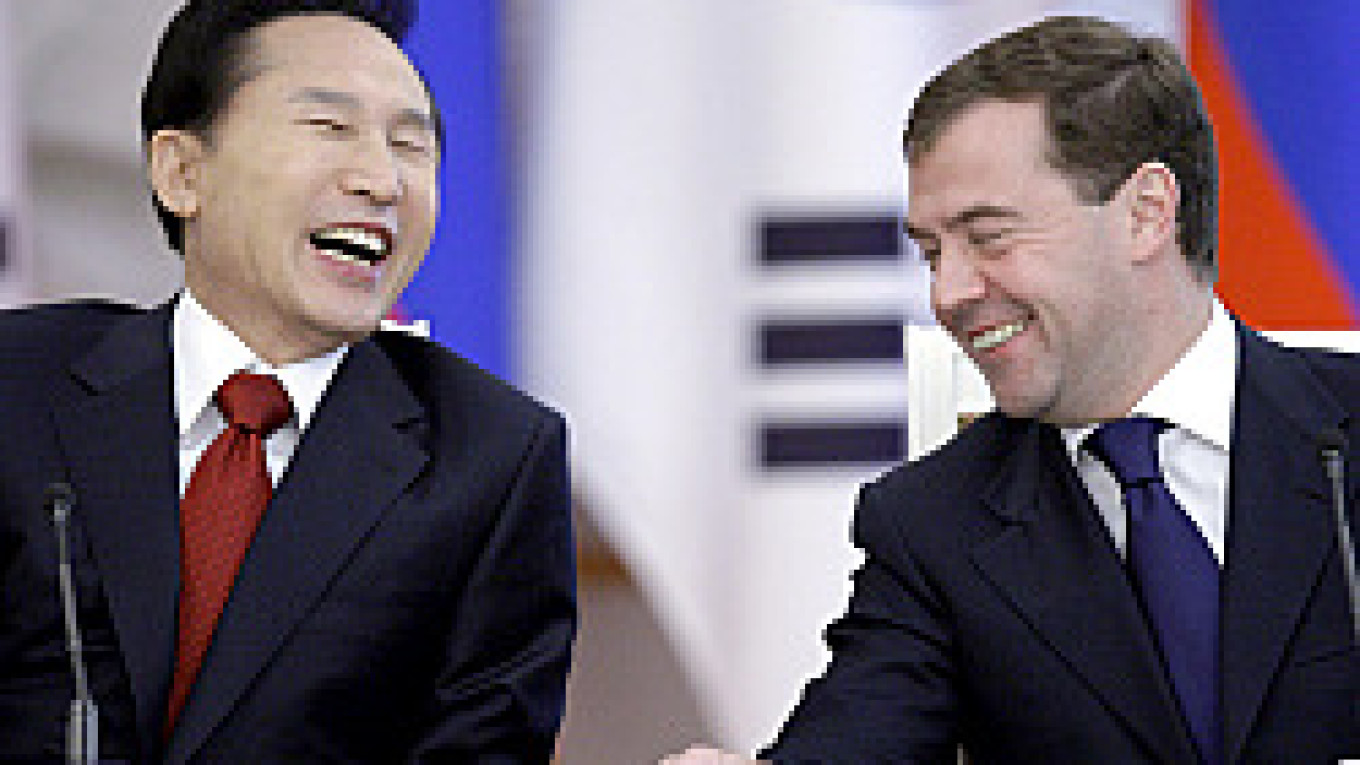
President Dmitry Medvedev and South Korean President Lee Myung-bak oversaw the signing of a preliminary agreement between gas export monopoly Gazprom and South Korea's state-run Kogas to send 10 billion cubic meters of natural gas to South Korea over a 30-year period starting in 2015, a Gazprom spokeswoman said.
"Close cooperation between the two countries will help liven up the North Korean economy and will also greatly contribute to the establishment of peace and stability in northeastern Asia on the whole," Lee said at the Kremlin.
The gas contract comes as Russia's ties with the West remain strained and the Kremlin is looking for more energy projects in Asia.
Both companies have yet to determine the route for gas deliveries, but Gazprom spokesman Sergei Kupriyanov said Monday that Russia had offered to lay the pipeline via North Korea, a relatively cheap but risky option considering Pyongyang's unpredictable policies, analysts say. Six-party nuclear talks involving Russia, the United States, China and Japan have also stalled recently.
Asked whether North Koreans have given consent to the project, Kupriyanov said, "We've had contacts with them."
Analysts were divided over the feasibility of the North Korean route.
Valery Nesterov, an energy analyst at Troika Dialog, said any such projects would be risky because of the country's unpredictable future in the midterm. "It's hard to imagine a gas pipeline running through North Korea," he said.
A similar project to construct a railroad between Russia and South Korea through North Korea has also been stuck for years. North Korea and South Korea lack a formal peace agreement, following their 1950-1953 war.
But Alexei Makarkin, an analyst with the Center for Political Technologies, said it would be hard for the North Korean leadership to forgo economically beneficial projects.
"There are concrete economic tasks in North Korea, and if it continues its isolationist policy the situation might explode," he said.
North Korea could earn $100 million a year from the gas pipeline project, Bloomberg cited South Korea's Ministry of Knowledge Economy as saying.
If talks with North Korea fail, Russia will sell the fuel to South Korea in the form of liquefied natural gas, or LNG, the statement said.
A final agreement between Moscow and Seoul is expected in 2010, when a study on the route is completed.
The gas contracts are estimated at $90 billion, given the current prices, but Kupriyanov declined to put an exact price tag on the agreement, saying the talks would continue.
The $3 billion pipeline will run from Vladivostok on the Pacific coast, Reuters cited the ministry as saying, suggesting that Gazprom would use gas from Sakhalin island for the project.
Lee gave high marks to the Russian government, saying in comments released by the Kremlin that the country's stable economic development was "the only positive event in the world" amid the current financial crisis, and pledged that Monday's talks would be a turning point in the nations' ties.
Medvedev and Lee adopted a joint declaration, agreeing to move the bilateral relations to the level of a "strategic partnership."
"We've agreed to speed up political dialogue, first and foremost at the highest level; facilitate the development of contacts among ministries, departments and business representatives; and no doubt facilitate contacts between our citizens," Medvedev said.
They also discussed steps to help North Korea dismantle its nuclear program, Lee said.
He also said the two presidents agreed that Korean businesses would help develop Siberia and the Far East, including deposits on Kamchatka. Medvedev praised the growth in trade, saying turnover was $15 billion last year and could reach $20 billion by the year's end.
Lee offered help in preparations for the Asia-Pacific summit in Vladivostok in 2012 and the Winter Olympic Games in Sochi in 2014 and invited Medvedev to visit South Korea.
On Tuesday, Lee is scheduled to visit the Khrunichev State Research and Production Space Center, which is building a launch vehicle, known as KSLV-I, for South Korea.
A Message from The Moscow Times:
Dear readers,
We are facing unprecedented challenges. Russia's Prosecutor General's Office has designated The Moscow Times as an "undesirable" organization, criminalizing our work and putting our staff at risk of prosecution. This follows our earlier unjust labeling as a "foreign agent."
These actions are direct attempts to silence independent journalism in Russia. The authorities claim our work "discredits the decisions of the Russian leadership." We see things differently: we strive to provide accurate, unbiased reporting on Russia.
We, the journalists of The Moscow Times, refuse to be silenced. But to continue our work, we need your help.
Your support, no matter how small, makes a world of difference. If you can, please support us monthly starting from just $2. It's quick to set up, and every contribution makes a significant impact.
By supporting The Moscow Times, you're defending open, independent journalism in the face of repression. Thank you for standing with us.

Remind me later.