

Flows from Central Asia's top gas producer to Russia stopped on Thursday following the blast, which Turkmenistan said had happened because Gazprom Export cut imports without sufficient warning, which led to the rupture.
"This accident happened due to a unilateral and egregious violation by Russian company Gazprom Export of agreements and rules of natural gas purchases," the Turkmen Foreign Ministry said in a statement Friday.
Gazprom, Russia's gas export monopoly, declined to comment on the Turkmen accusations, but the company has said the accident will not affect customers in Europe.
Analysts said Gazprom would benefit from a halt of Turkmen gas flows at a time when it is suffering from a drop in gas demand in Europe. Turkmenistan was exporting up to 70 million to 80 million cubic meters of gas per day via the link before the blast cut shipments completely.
Kommersant reported Friday that Russia began a "gas war" with Turkmenistan after Ashgabat called an international tender to build a pipeline, hurting relations as Gazprom expected the contract.
The tender for the East-West link from the biggest gas field in the Commonwealth of Independent States came as a surprise for Russia, which held high-level energy talks with Turkmen officials last month.
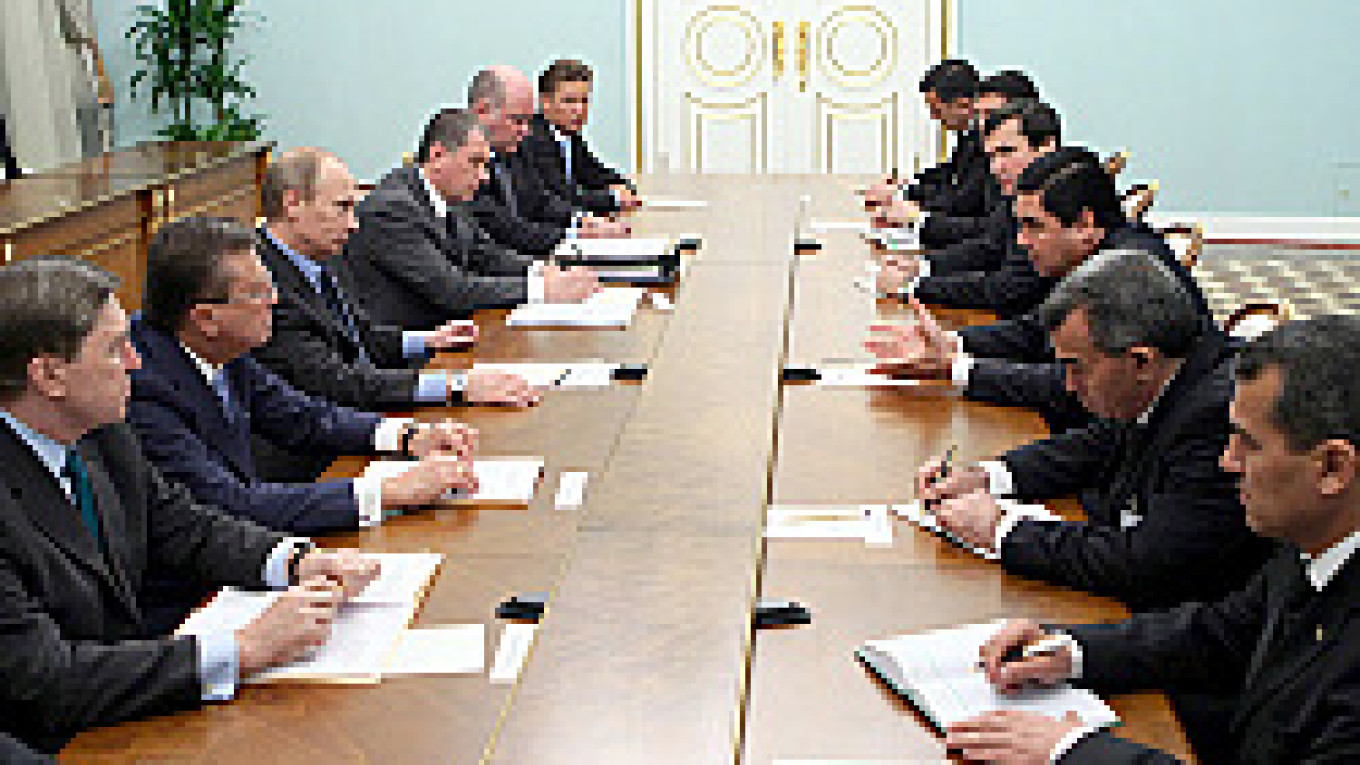
Turkmen President Gurbanguly Berdymukhammedov met with President Dmitry Medvedev and Prime Minister Vladimir Putin, as well as top energy officials, on March 25 for talks that failed to generate any significant agreements.
Sergei Prikhodko, Medvedev's top foreign policy aide, said at the time that the presidents discussed the importance of reliable gas deliveries but postponed until their next meeting the signing of an accord on the East-West gas pipeline, which could cost $1 billion to build.
The link is widely seen as a potential challenge to the Western-backed Nabucco pipeline, which seeks to bring gas from Central Asia to Europe, bypassing Russia.
As diplomacy intensified over the dispute, Foreign Minister Sergei Lavrov flew to Ashgabat on Friday to attend a scheduled ministerial conference.
In his opening remarks at the conference, Berdymukhammedov made no direct mention of the matter, instead focusing on broad energy security issues.
"It is principally important to ensure the reliability, stability and security of [energy supplies]," he said as Lavrov and other foreign ministers from ex-Soviet states listened.
Berdymukhammedov said Turkmenistan would hold an international conference to discuss energy security this month. He and Lavrov shook hands afterward and looked cordial but made no other remarks.
The pipeline blast occurred on Turkmenistan's border with Uzbekistan, but the extent of the damage was unclear. It was the second accident in the former Soviet Union this month, and analysts said aging infrastructure may be to blame, a claim that Turkmenistan denied.
"Turkmenistan has modernized a significant part of its energy sector since independence," the Foreign Ministry said.
(Reuters, MT, Bloomberg)
A Message from The Moscow Times:
Dear readers,
We are facing unprecedented challenges. Russia's Prosecutor General's Office has designated The Moscow Times as an "undesirable" organization, criminalizing our work and putting our staff at risk of prosecution. This follows our earlier unjust labeling as a "foreign agent."
These actions are direct attempts to silence independent journalism in Russia. The authorities claim our work "discredits the decisions of the Russian leadership." We see things differently: we strive to provide accurate, unbiased reporting on Russia.
We, the journalists of The Moscow Times, refuse to be silenced. But to continue our work, we need your help.
Your support, no matter how small, makes a world of difference. If you can, please support us monthly starting from just $2. It's quick to set up, and every contribution makes a significant impact.
By supporting The Moscow Times, you're defending open, independent journalism in the face of repression. Thank you for standing with us.

Remind me later.