

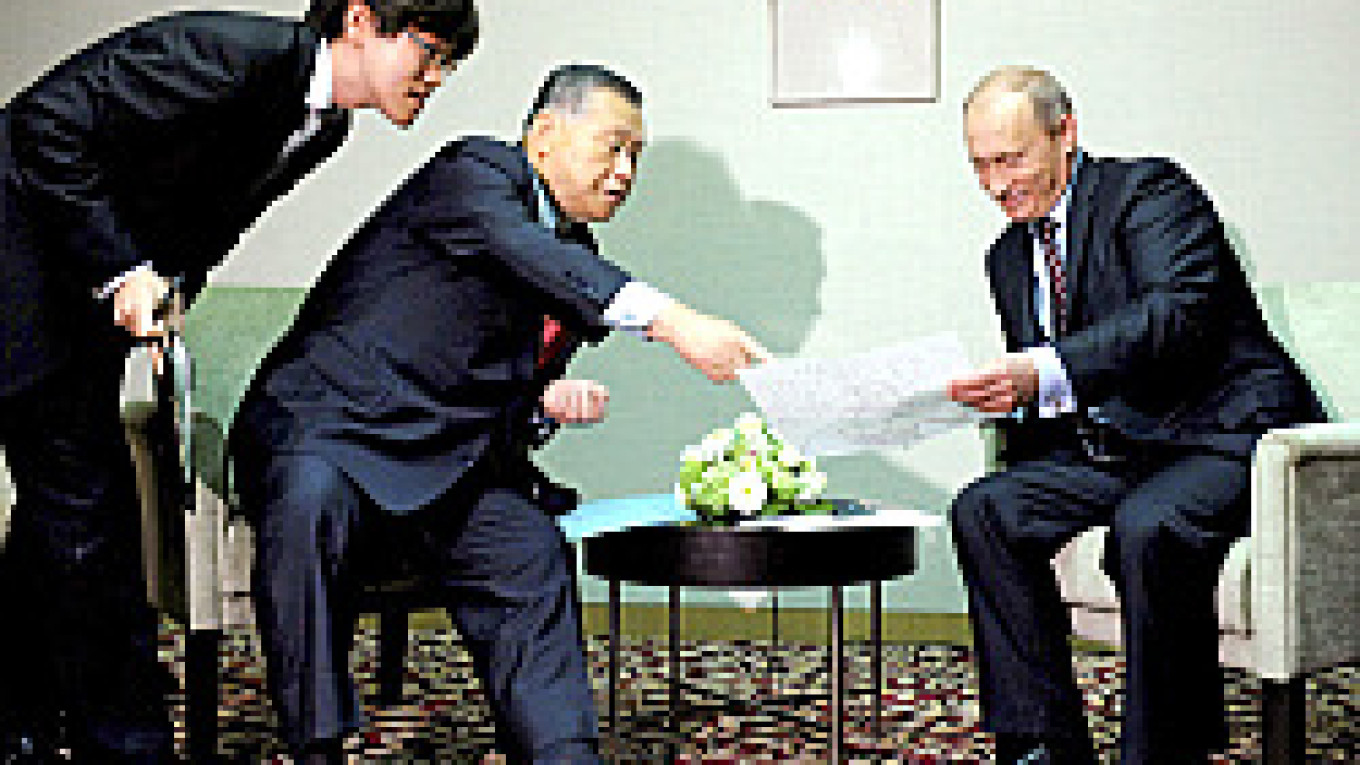
In a raft of other deals, Gazprom enlisted the support of two Japanese energy companies to study options for exporting future gas output from the Far East.
The chief of the state nuclear corporation Rosatom, Sergei Kiriyenko, and Japanese Foreign Minister Hirofumi Nakasone signed a long-awaited, broad agreement on nuclear power cooperation allowing joint uranium mining, nuclear reactor construction and treatment of spent nuclear fuel for a period of at least 25 years.
The new accord, which has to be ratified by both countries' parliaments to take force, replaces the deal that the Soviet Union signed with Japan in 1991, which mostly provided for joint research. Japan had balked at signing the revised agreement since 2007 because of concerns that its technology might find a way to the Russian defense industry.
Russia has done its homework.
"Over the last two years, we drew a clear divisive line between the civilian and military portions of the nuclear industry," Kiriyenko said.
The agreement will allow new contracts worth "billions of dollars" to supply uranium fuel for Japanese nuclear power stations, Kiriyenko said. Russia also invited Japanese companies such as Mitsui and Marubeni to mine uranium in Yakutia, he said.
Vladislav Bochkov, a Rosatom spokesman, said the agreement would advance cooperation between Rosatom and Toshiba, which agreed in March to study an option of jointly constructing a uranium-enrichment plant in "Japan or another country" that would use the Russian technology. They also expressed interest last year in a broader cooperation in building nuclear reactors and equipment for them.
Russia found partners in another important industry -- gas. Gazprom signed a memorandum of understanding with Japan's Economy, Trade and Industry Ministry; Itochu Corporation; and Japan Petroleum Exploration Company, or Japex, to study options for handling future gas from the fields off Sakhalin Island and in Yakutia.
Gazprom is building a pipeline to carry some of the gas to the Pacific port of Vladivostok and is entertaining the idea of building a plant there to liquefy the gas in order to ship it by tankers, Putin said.
As another plan, Gazprom is going to study whether it would be more effective to build a gas-processing plant instead and export its products, the company said in a statement Tuesday.
Gazprom chief Alexei Miller said the company received proposals from Mitsui last month about joining forces in developing the huge Chayandinskoye field in Yakutia. Gazprom will study them, Miller said.
A Message from The Moscow Times:
Dear readers,
We are facing unprecedented challenges. Russia's Prosecutor General's Office has designated The Moscow Times as an "undesirable" organization, criminalizing our work and putting our staff at risk of prosecution. This follows our earlier unjust labeling as a "foreign agent."
These actions are direct attempts to silence independent journalism in Russia. The authorities claim our work "discredits the decisions of the Russian leadership." We see things differently: we strive to provide accurate, unbiased reporting on Russia.
We, the journalists of The Moscow Times, refuse to be silenced. But to continue our work, we need your help.
Your support, no matter how small, makes a world of difference. If you can, please support us monthly starting from just $2. It's quick to set up, and every contribution makes a significant impact.
By supporting The Moscow Times, you're defending open, independent journalism in the face of repression. Thank you for standing with us.

Remind me later.