

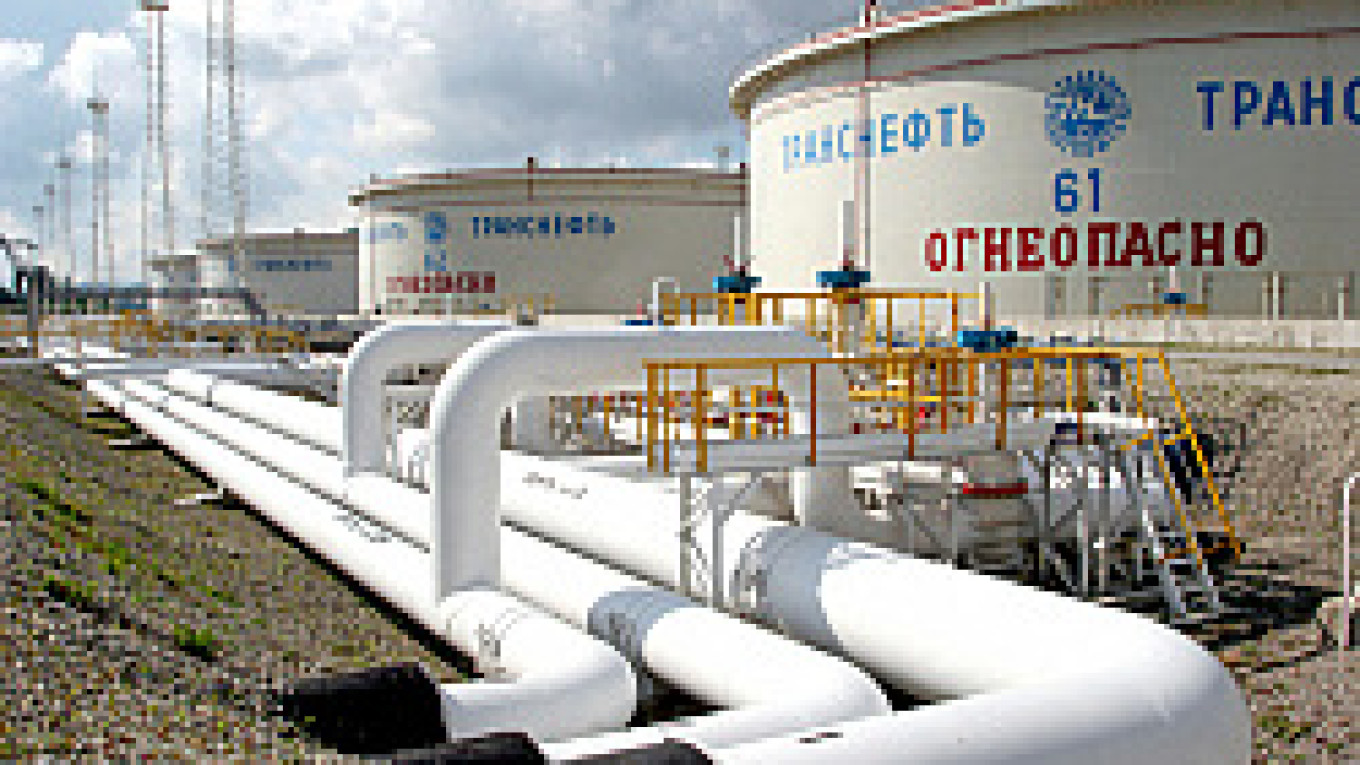
The Federal Tariffs Service said Tuesday that it had allowed oil pipeline monopoly Transneft to raise its oil dispatching fee to 15.41 rubles per ton per 100 kilometers, but gave no comparison or figure for the new overall tariff.
The dispatching fee is a special charge for coordination, which along with the pumping fee constitutes the overall tariff for shipping oil by pipelines inside and outside Russia, the world's second-largest oil exporter after Saudi Arabia.
Analysts said the dispatching fee rose by 19.6 percent based on Transneft's latest disclosure of the fee at 12.89 rubles at the end of last year.
"Our calculations show that this translates into a growth of about 11.7 percent in the average tariff, given the approximate 40/60 split between the pumping and dispatching components," said Alex Burgansky, from Renaissance Capital.
Transneft declined to disclose the increase of the average fee and said it would fulfill the service's decision no matter how unpopular it could be with oil firms.
"We are a state company and [the tariffs service] is a state agency. We have to fulfill their decisions," Transneft vice president Mikhail Barkov said.
The tariffs service said Transneft needed fresh money to pay interests on the debt it raised to build a new link to Asia, a major project meant to connect Russian oil fields with Asian markets by the end of 2009.
Analysts at Troika Dialog said the move would further boost costs for oil companies, which are already complaining that a heavy tax and tariff burden prevents them from investing in new fields to support declining oil output.
Poor oil output performance has become a major concern of the government, which has offered a series of tax breaks to oil companies to revive production growth. It has said it would consider more tax breaks in the future.
Transneft is usually allowed to revise its fees at the end of each year, and they already rose by 19.4 percent from January.
The government usually requests the state-controlled firm to cap hikes at below inflation levels to avoid further spurring prices across other industries.
Inflation has reached 9.3 percent since the start of the year, already exceeding the government's initial forecast of 8 percent for the whole of 2008. In 2007, inflation exceeded the target by a wide margin, reaching 11.9 percent.
Finance Minister Alexei Kudrin said Wednesday that he was not prepared to comment on the tariff service's decision.
With services and material prices soaring, Transneft has already more than doubled its spending for its Asian pipeline, estimated at more than $14.4 billion to build only the first stretch.
Some firms, like LUKoil, are not planning to use it because they do not have oil fields in the region, but will nevertheless have to pay the new fee.
But a Western trader said oil companies were likely to find a way to compensate for the losses. "It is consumers who will eventually bear the costs," he said.
A Message from The Moscow Times:
Dear readers,
We are facing unprecedented challenges. Russia's Prosecutor General's Office has designated The Moscow Times as an "undesirable" organization, criminalizing our work and putting our staff at risk of prosecution. This follows our earlier unjust labeling as a "foreign agent."
These actions are direct attempts to silence independent journalism in Russia. The authorities claim our work "discredits the decisions of the Russian leadership." We see things differently: we strive to provide accurate, unbiased reporting on Russia.
We, the journalists of The Moscow Times, refuse to be silenced. But to continue our work, we need your help.
Your support, no matter how small, makes a world of difference. If you can, please support us monthly starting from just $2. It's quick to set up, and every contribution makes a significant impact.
By supporting The Moscow Times, you're defending open, independent journalism in the face of repression. Thank you for standing with us.

Remind me later.