

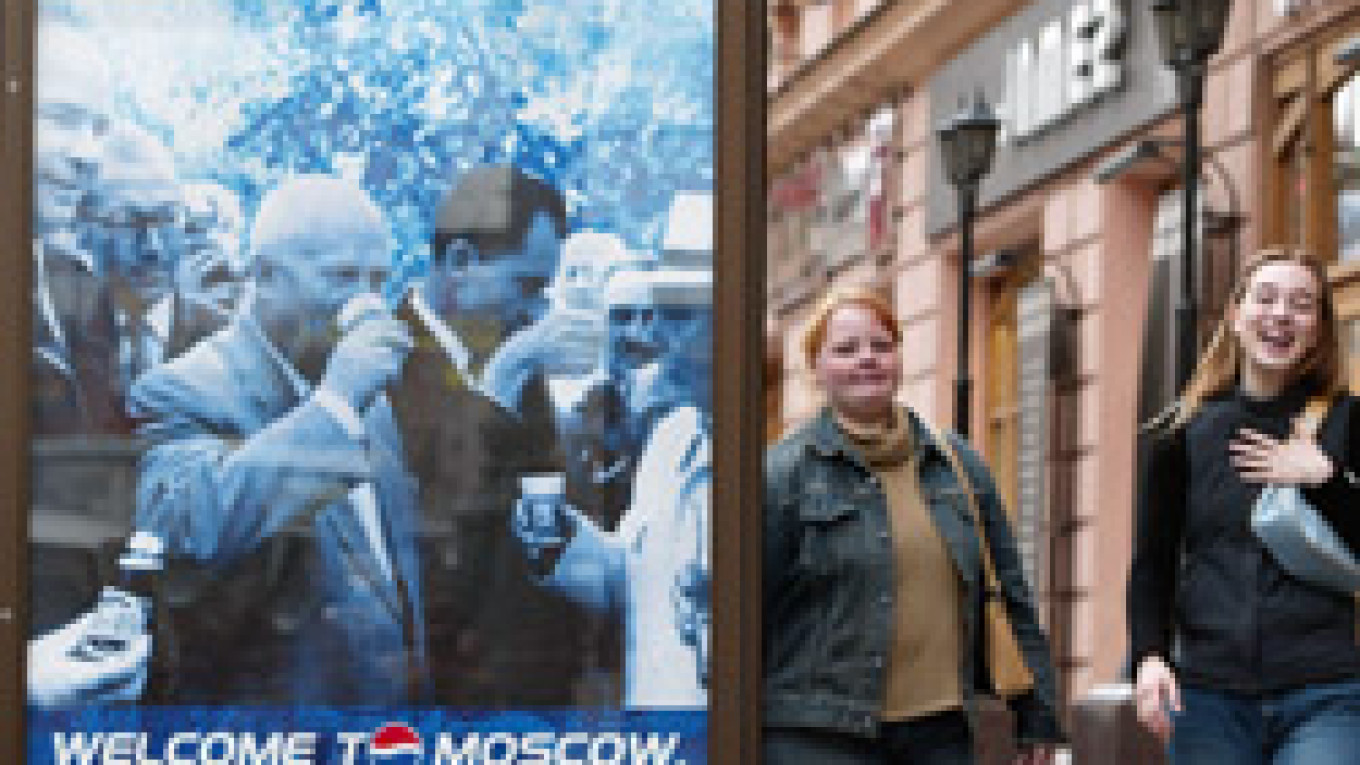
Russia and the United States will celebrate the anniversary next week of the first “capitalist food product” to appear in the Soviet Union, 50 years after leader Nikita Khrushchev famously quaffed a cup of Pepsi at the American National Exhibition in Moscow.
The festivities will coincide with a three-day visit to Moscow by U.S. President Barack Obama, who will be joined by a host of business leaders including Indra Nooyi, chief executive of PepsiCo, and Donald Kendall, the co-founder and former CEO who offered Khrushchev a taste of the carbonated soft drink.
?€?When Mr. Khrushchev first drank Pepsi, it was a really good start in the relations between Washington and Moscow,?€? Kendall said in a telephone interview Thursday. ?€?Now, as everyone talks about pushing the restart button after Obama’s coming to power, Pepsi-Cola may become a symbol of new relations again.?€?
Both governments have signaled that they are planning to mark the anniversary, with First Deputy Prime Minister Igor Shuvalov slated to attend the opening Wednesday of PepsiCo?€™s eighth Russian plant and U.S. Ambassador John Beyrle hosting a reception Thursday to commemorate the exhibition.
The six-week American National Exhibition, which began on July 24, 1959, became the first chance for Soviet citizens, who had almost no opportunities to travel abroad, to get a glimpse of what life was like in the United States. Some 2.7 million people came to see American cars, clothes, arts and design. PepsiCo is sponsoring an exhibit of photographs from the fair, which will be displayed at the U.S. Embassy beginning Thursday.
The exhibition was also attended by Richard Nixon, then-U.S. vice president, who sparred with Khrushchev in the so-called Kitchen Debate on the virtues of communism and capitalism.
?€?I still remember Nixon bringing Khrushchev to our kiosk,?€? Kendall, 88, recalled in the interview. ?€?I offered him some Pepsi-Cola made in the U.S. and some made in Russia, as we brought carbonating machines with us. Khrushchev drank at least half a dozen cups of Pepsi, then turned to reporters and said the Pepsi-Cola made in Moscow was better than Pepsi made in the U.S.?€?
PepsiCo only managed to open its first plant in the Soviet Union 15 years later, however, after relations with the United States worsened in the wake of the Cuban missile crisis.
Kendell said Alexei Kosygin, then chairman of the Council of Ministers, played a crucial role in bringing Pepsi to Russia.
?€?Mr. Kosygin asked me to take him to the U.S., so I brought him on a tour around the country and showed him our plants and other companies?€™ production sites,?€? Kendall said. ?€?He was very excited about that.?€?
In 1972, PepsiCo and the Soviet government signed an agreement envisioning the construction of 10 Pepsi plants all over the Soviet Union, including in Kazakhstan and Ukraine, and giving the soft drinks producer a monopoly on importing and sales of the Stolichnaya vodka made in the U.S.S.R.
PepsiCo opened its first plant in the Black Sea port of Novorossiysk in 1974, producing 0.33-milliliter bottles that sold for 45 kopeks — about two and a half times the cost of a loaf of bread.
?€?Even though the plant was an official Pepsi-Cola plant, we didn?€™t have much of a say in the decision making on its management, marketing and sales,?€? Kendall recalled. ?€?Everything was run by the Soviets, and we could only check the quality of the product.?€?
Kendall subsequently founded the first U.S.-U.S.S.R. Trade and Economic Council and received the George F. Kennan Award in 1989 for his contribution to improving U.S.-Soviet relations.
PepsiCo currently operates seven plants, including in Samara, St. Petersburg and Yekaterinburg. The $180 million for the plant opening on Wednesday in the Moscow region town of Domodedovo will be able to produce 2.1 billion liters of PepsiCo products per year, including Pepsi-Cola, Lipton Ice Tea, Adrenalin Rush and other beverages.
?€?The changes that have happened in Russia are unbelievable, and Prime Minister Vladimir Putin has done a superb job in changing many things for foreign investors,?€? Kendall said. ?€?And even though there are some problems in U.S.-Russia relations, we have to work through the political wars. This is a good time to push a restart button, and, well, probably drink some Pepsi.?€?
A Message from The Moscow Times:
Dear readers,
We are facing unprecedented challenges. Russia's Prosecutor General's Office has designated The Moscow Times as an "undesirable" organization, criminalizing our work and putting our staff at risk of prosecution. This follows our earlier unjust labeling as a "foreign agent."
These actions are direct attempts to silence independent journalism in Russia. The authorities claim our work "discredits the decisions of the Russian leadership." We see things differently: we strive to provide accurate, unbiased reporting on Russia.
We, the journalists of The Moscow Times, refuse to be silenced. But to continue our work, we need your help.
Your support, no matter how small, makes a world of difference. If you can, please support us monthly starting from just $2. It's quick to set up, and every contribution makes a significant impact.
By supporting The Moscow Times, you're defending open, independent journalism in the face of repression. Thank you for standing with us.

Remind me later.