

The country's courts may finally be heeding orders from the Kremlin to end a crackdown on the business community, judging by the recent surprise ruling to not jail gravely ill entrepreneur Natalya Gulevich after her conviction on fraud charges.
The judiciary has come under increasing pressure from rights activists, the media and the government to cease its harsh treatment of business owners after a string of high-profile deaths in pretrial detention — most notably that of Hermitage Capital lawyer Sergei Magnitsky in 2009.
Many courts around the country have stubbornly resisted, but Gulevich's unexpected release suggests that change may finally be under way. Still, many other ill suspects remain under arrest, and it is unclear whether they will receive the softer treatment that President Dmitry Medvedev has promised.
Gulevich was convicted of large-scale fraud late Monday by Moscow's Tagansky District Court.
While the verdict was widely expected, the sentence was decidedly less so. Gulevich got off with a three-year suspended sentence and a fine of 1 million rubles ($32,000), as well as an order to pay back a bank loan of 590 million rubles ($26.5 million at the time) that sparked the case in 2008.
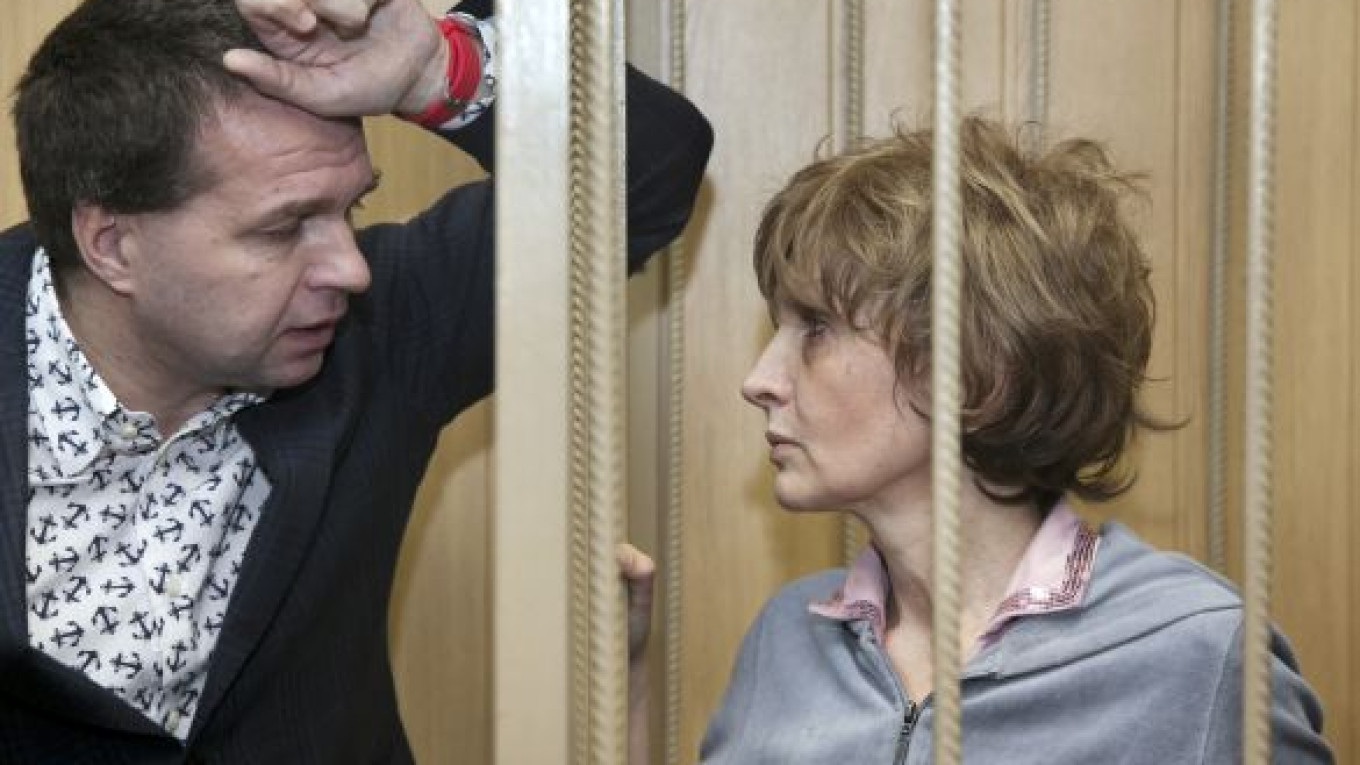
A released by RIA-Novosti showed an exhausted 50-year-old Gulevich — whose kidneys are failing and whose bladder has stopped functioning — looking haggard as she listened to the judge deliver his verdict.
She then rubbed her wrists when her handcuffs were removed and walked out of the defendant's cage with a smile.
"Fortune favors the brave," she told reporters afterward. A catheter tube inserted into her bladder stuck out from under her jacket.
Magnitsky's death in pretrial detention in 2009 — officially blamed on untreated health problems — sparked a public outcry that was boosted by the similar death of businesswoman Vera Trifonova in the same Moscow prison last year.
Last January, the government eased rules for releasing ill suspects, and in March, Medvedev signed a law eliminating prison terms as mandatory punishment for a range of economic crimes.
But 50 people still died in pretrial detention in Moscow this year, according to a report by leading rights activists — including Lev Ponomaryov and Lyudmila Alexeyeva — presented to Moscow judges in late November, Novaya Gazeta .
Surprising Sentence
Nothing pointed to a lenient sentence for Gulevich.
The Tverskoi District Court extended her detention several times. In one instance, a judge postponed a hearing for several hours and forced several reporters to leave before it began.
The judges have always sided with investigators, who said Gulevich's health problems were not on a government-approved list of illnesses that qualify a suspect for release. They also insisted that she was not charged over her entrepreneurial activity — a murky legal trick often used to prosecute business people in defiance of the Kremlin's orders.
Gulevich said she filed nearly 100 appeals with investigators during the probe, but all of them went unanswered, except one, which was rejected.
Human rights activists, including Valery Borshchyov of the Kremlin's human rights council and Maria Kannabikh, who sits on the Public Chamber, had repeatedly asked that Gulevich be freed ahead of conviction, but to no avail.
The court made a token move to ease her conditions last November, when it offered to release her on bail, but it set the sum at 100 million rubles ($3.3 million), an all-time record in Russia. Gulevich could not afford the bail and remained behind bars.
The businesswoman is accused of failing to repay a 590 million ruble loan to Nomos-Bank in 2008. Investigators say she never intended to return the money.
But Gulevich maintained her innocence and accused the bank of illegally seizing the assets of her group of companies, Status, while she was in the process of paying back the loan.
She appealed Monday's sentence in the Moscow City Court, said her lawyer, Andrei Shtanko. No date for a hearing was set.
"The worst she can be accused of is providing inaccurate information to the bank to get a loan," Shtanko said by telephone Tuesday.
The bank's press secretary Alexander Dmitriyev said by e-mail Tuesday that "Gulevich's claims that she had been executing her loan are contrary to facts."
He did not elaborate and refused to comment on the verdict.
Gulevich is not the only one to leave prison while facing prosecution. Paralyzed former notary Vladimir Orlov, charged with attempted murder, was released from pretrial detention and placed under house by a Moscow court in mid-December.
But not every gravely ill suspect, be it in an economic case or any other type of crime, is lucky enough to be released.
Theft suspect Georgy Mekvevrishvilitheft remains at a Moscow prison hospital despite serious bowel problems and a festering stomach wound.
Better known is businessman Stanislav Kankia, 47, who has suffered at least five brain hemorrhages during his 20 months of imprisonment in three Moscow detention centers, according to his wife, Valentina Kankia.
"Are you hoping that I die?" the angry Kankia asked the judge and the prosecutor at a hearing in late November, his voice badly slurred from the brain hemorrhages.
Three Moscow courts have denied Kankia's 10 appeals for release with a written pledge that he not to leave the city, his lawyer Vladimir Bunakov said outside a hearing last month.
All judges sided with the investigators and prosecutors, who said Kankia — jailed since June 2010 — might flee or pressure witnesses.
In late November, seven activists, including Alexei Kozlov, a businessman-turned-celebrity for blogging about his time behind bars, and his wife, prominent journalist Olga Romanova, an open letter online to Medvedev in support of Kankia.
Borshchyov of the Kremlin rights council also supports Kankia's plea for release, his wife said. Medvedev has never commented on the case.
Little Influence
In November 2010, after Kankia's second brain hemorrhage, which he sustained in pretrial detention, a doctor at Moscow's Butyrka detention center "warned that Kankia could die at any minute," his lawyer said.
The diagnosis failed to influence the courts.
Kankia, 47, stands accused of defrauding 134 secondary school students who worked for his charity, Otchizna (Fatherland), which promotes computer literacy, and were paid for their work by the city government. He faces up to 10 years in prison.
Prosecutors insist that Kankia siphoned off sums ranging from 10,000 to several tens of thousands of rubles from bank cards that the children were issued between 2007 and 2009.
But prosecutors have failed to even specify the total sum of damages, Bunakov said. Kankia's wife accused employees of Sberbank, which issued the cards, of being behind the theft.
Two employees at the Sberbank branch in question, Meshchansky, were convicted in October of stealing 9.6 million rubles ($308,000) from pensioners with accounts at the bank. The employees, as well as two accomplices from the Pension Fund, were jailed for three years each, Kommersant at the time.
"It may be that they [Sberbank workers] had some dirty business and they presented [Kankia to investigators] as a distraction," Valentina said.
Inquiries e-mailed to Sberbank on Nov. 18 and 23 went unanswered. A spokeswoman said Dec. 5 that the requests were "being processed," but no response was ever made.
The drama is playing out against the backdrop of Kankia's health problems. He sustained his last brain attack in September, when doctors at a civil hospital recommended that he be kept there.
But instead, prison officials transferred him to a medical ward at Moscow's Matrosskaya Tishina pretrial prison — the very place where Hermitage's Magnitsky and businesswoman Trifonova died.
Kankia's representatives have reported no outright mistreatment, but his lawyer Bunakov said a prison hospital cannot provide sufficient care because it has "no conditions for rehabilitation."
"The main mistake of the investigators is that they arrested an innocent person," Bunakov said. "The court is forced to go along with this decision and will have to justify Kankia's arrest by ruling him guilty."
Indeed, Russian judges regularly side with investigators and prosecutors. Only 1.4 percent of trials in Moscow end in acquittals, Moscow City Court spokeswoman Anna Usachyova last week. Celebrity lawyer Igor Trunov reported in 2009 that in Europe, by comparison, the figure stands between 15 and 20 percent.
A Message from The Moscow Times:
Dear readers,
We are facing unprecedented challenges. Russia's Prosecutor General's Office has designated The Moscow Times as an "undesirable" organization, criminalizing our work and putting our staff at risk of prosecution. This follows our earlier unjust labeling as a "foreign agent."
These actions are direct attempts to silence independent journalism in Russia. The authorities claim our work "discredits the decisions of the Russian leadership." We see things differently: we strive to provide accurate, unbiased reporting on Russia.
We, the journalists of The Moscow Times, refuse to be silenced. But to continue our work, we need your help.
Your support, no matter how small, makes a world of difference. If you can, please support us monthly starting from just $2. It's quick to set up, and every contribution makes a significant impact.
By supporting The Moscow Times, you're defending open, independent journalism in the face of repression. Thank you for standing with us.

Remind me later.