

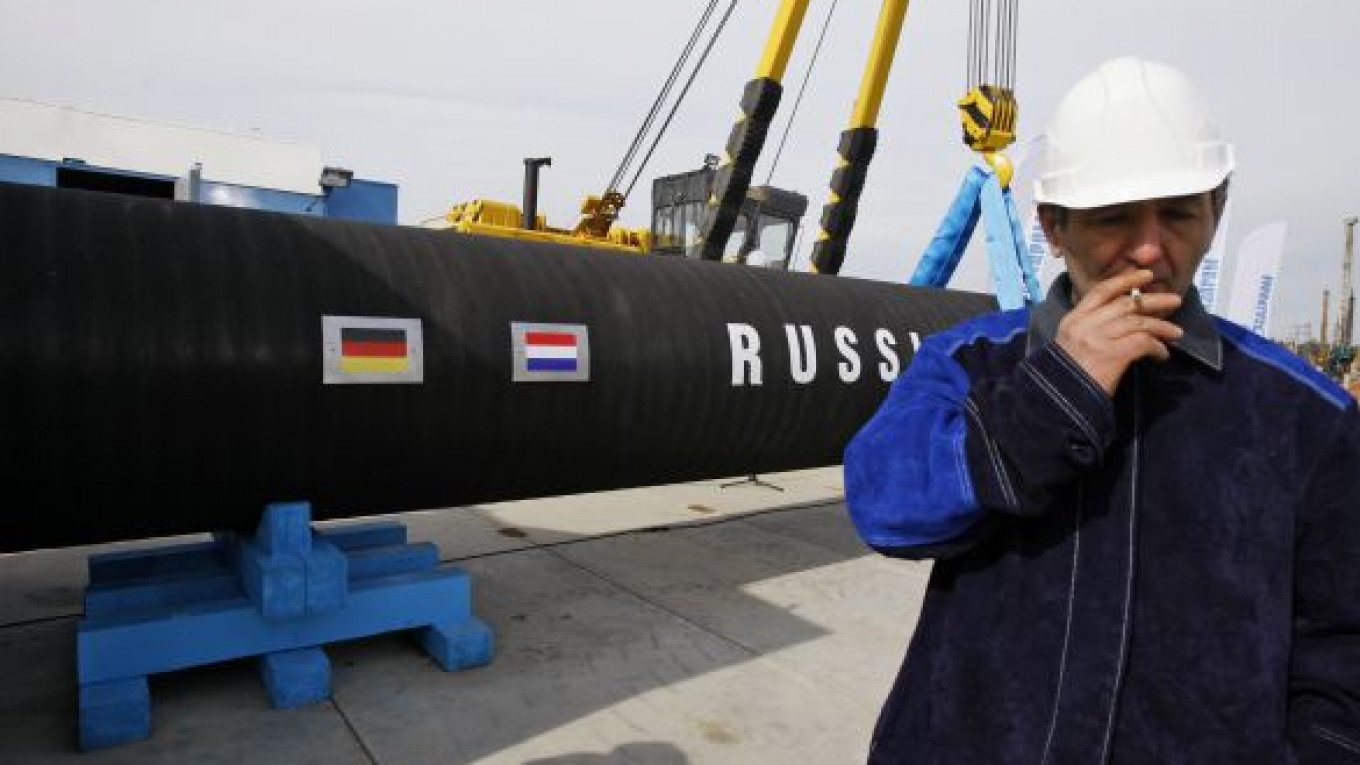
PORTOVAYA COMPRESSOR STATION, Leningrad Region — The second phase of the mammoth Nord Stream pipeline went into operation Monday, increasing Gazprom's options for selling its natural gas to Europe.
Unlike for the first line, no country leaders turned out for the ceremony, but President Vladimir Putin received perhaps the biggest ever tribute for his distinct role in the Gazprom-led project.
Gazprom chief Alexei Miller described the completion of the second ?€” and as yet the final ?€” phase as a present to Putin, who celebrated his 60th birthday Sunday.
"There is symbolism in the fact that we're bringing the capacity to its fullest during the days of Vladimir Putin's birthday," Miller said, addressing an audience that included former German Chancellor Gerhard Schroeder, now chairman of Nord Stream's board. "It's a gift of sorts to the author of the idea."
The second of the twin pipelines brings the combined capacity to 55 billion cubic meters of gas annually to consumers in such countries as Germany, France, Denmark, the Netherlands, Belgium, the Czech Republic and Britain.
Nord Stream expects that the pipelines will carry more than 10 billion cubic meters of gas this year, company spokesman Jens Mueller told The Moscow Times. The second line simply took half of the gas the first one had been transporting, he said.
Gazprom looks to export about 150 bcm of gas to Europe this year.
Miller said that Nord Stream shareholders concluded earlier that day that it was feasible and commercially viable to add a third and a fourth line to the project. They agreed that a separate company would execute any further expansion, Nord Stream said in a statement. The shareholders will decide on their participation by the end of March, which will also be the deadline for incorporating that company.
Gazprom holds 51 percent in Nord Stream AG, the Swiss-based joint venture that operates the route. Germany's BASF and E.On Ruhrgas own 15.5 percent each, while Holland's Gasunie and France's GDF Suez split the rest.
When the first phase of Nord Stream opened in November, President Dmitry Medvedev, German Chancellor Angela Merkel, Dutch Prime Minister Mark Rutte and his French counterpart Francois Fillon were on hand for the grand opening in Germany, where the pipes resurface after going under the sea near Portovaya.
Putin, Merkel, Rutte and French President Francois Hollande spoke only in video messages this time around, extolling the cooperative effort and the advantages of such clean fuel as gas.
Putin also noted that the route was free of transit risks.
Russian deliveries to Europe suffered several breakdowns over the last decade during standoffs with Ukraine and Belarus over energy supplies to those transit countries.
Before the first of the Nord Stream pipelines began operating, 80 percent of Russian gas exports to Europe ran across Ukraine.
"In any industry, it is generally considered risky for both the supplier and the customer to be so dependent on one route to the market," Nord Stream said in a statement Monday.
Gazprom curtailed the threat of a transit disruption in Belarus by acquiring full control of the country's gas pipeline monopoly Beltransgaz in 2011.
The highest-level government official on the ground was Sergei Ivanov, chief of Kremlin staff, who remarked that Putin expended a lot of time and effort for the route to become a reality.
The ceremony was quick, and a helicopter whisked away the top visitors within minutes after the speeches and photo opportunities had wrapped up in the rain-battered makeshift white tents three hours north of St. Petersburg.
The Nord Stream consortium spent 7.4 billion euros ($9.6 billion) to build both pipelines.
Related articles:
A Message from The Moscow Times:
Dear readers,
We are facing unprecedented challenges. Russia's Prosecutor General's Office has designated The Moscow Times as an "undesirable" organization, criminalizing our work and putting our staff at risk of prosecution. This follows our earlier unjust labeling as a "foreign agent."
These actions are direct attempts to silence independent journalism in Russia. The authorities claim our work "discredits the decisions of the Russian leadership." We see things differently: we strive to provide accurate, unbiased reporting on Russia.
We, the journalists of The Moscow Times, refuse to be silenced. But to continue our work, we need your help.
Your support, no matter how small, makes a world of difference. If you can, please support us monthly starting from just $2. It's quick to set up, and every contribution makes a significant impact.
By supporting The Moscow Times, you're defending open, independent journalism in the face of repression. Thank you for standing with us.

Remind me later.